
Digital Experience Lower Saxony
For Lower Saxony: A B2B website with a clear structure and robust implementation.
When coordination, revisions, and handovers consume more energy than the actual implementation, the project lacks a clear chain of responsibility. The current state is examined along the lines of target group and buying center logic, a clear performance and use case structure, and proof, cases, and trust elements; this reveals the bottleneck in the analysis and the appropriate development sequence. The resolved bottleneck results in a B2B website that builds relevance, proof, and next steps around real decision-making questions.
Technical depth and clear communication are not mutually exclusive. The website must offer every member of the buying center the right entry point and reliable evidence. Resolving the bottleneck during implementation aims for measurable benefits: improved pre-qualification and less explanation required from sales.
Target Group and Buying Center Logic
Translates business objectives and user needs into a clear page, data, and decision logic
Clear Service and Use Case Structure
Organizes services, user journeys, and technical limitations into a comprehensible overall structure
Proof, Cases, and Trust Elements
Connects Buying Center, Use Cases, Proof, and longer decision-making processes with a clear decision for the next development stage
Website as part of B2B sales: a clear system decision
The project becomes viable when four points are planned as a coherent system decision: target group and buying center logic; a clear performance and use case structure; proof, cases, and trust elements; and conversion for longer decision-making processes. For the "system decision," existing infrastructure, queries, handovers, and unclear responsibilities, as well as system boundaries and expansion sequence, are jointly addressed in the architecture.
VELUNO works digitally and across regions with companies in Lower Saxony; workshops, decisions, and approvals are documented without claiming a local branch, on-site presence, or local customer relationship.
Starting Point
Why a Digital Sales Channel Without a Clear Structure Becomes an Operational Bottleneck
The website generates traffic or leads, but doesn't adequately support the actual B2B decision. Complex services are explained correctly internally, but externally they are too abstract, technical, or interchangeable. The current state is examined along the lines of real-world processes until the bottleneck behind the visible symptoms can be clearly identified.
Services are explained from an internal perspective rather than a customer perspective.
The current state reveals which architectural decision is missing from the analysis, preventing the perpetuation of queries, handoffs, and unclear responsibilities.
-
Internal language
-
Lack of context
-
Interchangeable presentation
Decision-makers can't find a suitable entry point
This bottleneck traces queries, handoffs, and unclear responsibilities in the current state back to the architecture; only then can the necessary architecture be developed. Many pages address a topic, but they don't guide the user through the decision-making process. Relevance, proof, and conversion must therefore be linked within the same page logic.
-
Incorrect entry points
-
Missing proof
-
Vague next steps
Proof and next steps are too weakly connected
The current state analysis reveals the missing architectural decision in the implementation process, preventing the perpetuation of queries, handovers, and unclear responsibilities.
-
Incorrect entry points
-
Missing proof
-
Vague next steps
From Target Vision to Implementation
Four building blocks for a viable system structure
Resolving this bottleneck results in a B2B website that builds relevance, proof of concept, and next steps based on real-world decision-making questions. The building blocks resolve the architectural bottleneck within an architecture that systematically expands the focus on "website as part of B2B sales." Further analysis is provided in: Solutions for Technology Companies.
Positioning & Buying Center
"Positioning & Buying Center" translates queries, handovers, and unclear responsibilities in the current state analysis into a robust architectural decision. The performance presentation is based not on internal departments but on real-world questions and use cases. This makes the technical details understandable without oversimplifying them.
-
Target Group and Buying Center Logic
-
Clear Service and Use Case Structure
-
Target Groups and Priorities
-
Understandable Performance Logic
Service and Use Case Architecture
"Performance and Use-Case Architecture" resolves questions, handoffs, and unclear responsibilities at bottlenecks in architecture within a controllably extensible architecture. Information architecture and content model are planned jointly. This ensures consistent user journeys, internal responsibilities, and technical implementation consistent.
-
Clear Service and Use Case Structure
-
Proof, Cases, and Trust Elements
-
Clearly Defined Side Roles
-
Reusable Rules
Proof & Conversion
"Proof & Conversion" translates questions, handoffs, and unclear responsibilities in the current state into a robust architectural decision during implementation. The page guides users from a specific question through verifiable evidence to a suitable next step. Forms and request paths remain concise, understandable, and measurable.
-
Proof, Cases, and Trust Elements
-
Conversion for longer decision-making processes
-
Proof at relevant points
-
Measurable Inquiry Paths
CRM, Tracking & Growth
"CRM, Tracking & Growth" translates questions, handoffs, and unclear responsibilities in the current state into a robust architectural decision during further development. Measurement connects visibility, user behavior, and subsequent business steps. Priorities are regularly adjusted based on impact rather than publication volume.
-
Integration with Content, CRM, and Tracking
-
Target Group and Buying Center Logic
-
Tracking and Monitoring
-
Prioritization Based on Impact
Appropriate project sizes
The Right Starting Point Considers Impact, Risk, and Future Integration
The initial phase focuses on the most important decision-making processes and the points where sales currently needs to explain fundamental concepts again. This phase first resolves the central bottleneck and simultaneously establishes the architecture for controlled expansion.
Focused Entry Point
This phase first resolves queries, handovers, and unclear responsibilities at the bottleneck during analysis and unlocks only the necessary architectural components. A clearly defined starting point concentrates on the project's biggest bottleneck, such as structure, migration, core processes, or a crucial subgroup.
Structural Rebuild
For "Structural Rebuild," expansion is only unlocked after queries, handovers, and unclear responsibilities in the current state have been resolved within the architecture. The rebuild is implemented when multiple legacy issues can no longer be resolved separately. It reorganizes buying centers, use cases, proofs of concept, and lengthy decision-making processes within a controlled project.
Systematic Expansion
The scope remains manageable when queries, handovers, and unclear responsibilities during implementation are handled with a compatible system boundary. Systematic expansion extends the existing foundation in prioritized steps, without having to start from scratch with every new requirement.
Four typical starting points
How resilient digital structures emerge from diverse starting points
Exemplary project scenarios demonstrate how the focus on "Website as part of B2B sales" leads from the initial situation through the decision-making process to the final impact; no local references are claimed. Relevant project and system references are shown. B2B Website Rebuild.
B2B SaaS Relaunch
Legacy content, technical issues, and unclear page roles are transformed into a robust target structure
Project Logic
B2B SaaS Relaunch: Deciding on Architecture and Migration Together
Current state: A historical website is reorganized based on user feedback, content value, and technical maintainability. Architectural decision: The decision is made for a complete inventory, a new information architecture, and a controlled migration plan. Impact and expansion sequence: The impact lies in more stable user experiences, clean technology, and a foundation that can be maintained after launch.
Industry website
Technical depth provides clear entry points for different roles, industry-specific questions, and use cases
Project Logic
Industry website: Organizing performance logic from the customer's perspective
Current State: Complex products and services are structured from the perspective of real-world applications rather than along internal product lists. Architectural Decision: The decision is made in favor of a modular service logic that enables both in-depth technical expertise and rapid orientation. Impact and Expansion Sequence: The result supports pre-qualification and creates a robust foundation for further industry or product pages. The impact arises because queries, handovers, and unclear responsibilities at bottlenecks are resolved architecturally.
Professional Services Presence
Project Logic Connects User Needs, Business Goals, and Technical Feasibility
Project Logic
Professional Services Presence: From Bottleneck to a Robust System Decision
Current State: The project logic combines user needs, business objectives, and technical feasibility. Architectural Decision: The decision is based on impact and operational capability rather than a lengthy list of tasks. Impact and Expansion Sequence: This reduces operational friction and ensures that the next expansion phase remains predictable.
Multi-Market Website with Search Architecture System
Multiple markets or languages are planned not as copies, but as controlled variations of a common structure.
Project Logic
Multi-Market Website with Search Architecture System: Connecting Markets Without Multiplying the Structure
Current State: Regional and linguistic requirements are given clear rules without multiplying content and technology. Architectural Decision: The architecture defines core components and deliberately variable content for market, language, and Search IntentImpact and Expansion Sequence: Expansion remains consistent, maintainable, and technically traceable, even as additional markets are added. The impact is achieved because queries, handovers, and unclear responsibilities at bottlenecks during further development are architecturally resolved.
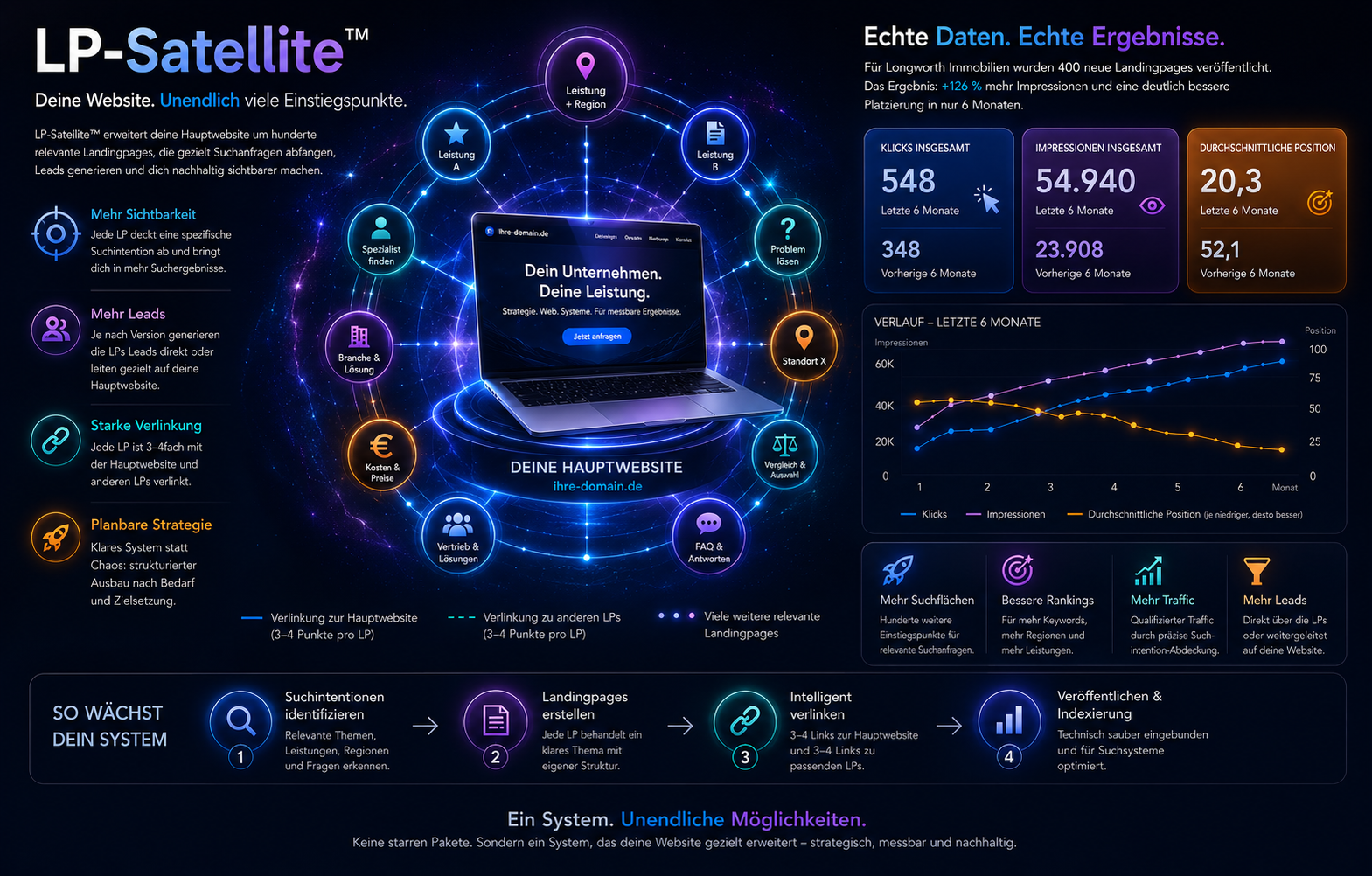
Global proof of systematic expansion
Repeatable quality is more important than a high number of individual pages
The global LP-Satellite™ case demonstrates why extensive website development requires clear architecture, quality control, and measurement; therefore, for B2B websites, the rules for comprehensible argumentation based on real B2B questions must be established before expansion. This reference is not from Lower Saxony and is not presented as a local customer relationship.
What Sets Us Apart
Reliable system work requires coherence, not handoff chains
Classic project logic
-
Bottleneck in existing infrastructure during analysis: Individual measures without a shared vision
-
Bottleneck in existing infrastructure during architecture: Handoffs between strategy, design, and technology
-
Bottleneck in existing infrastructure during implementation: Launch without a well-thought-out operational logic
VELUNO System Responsibility
-
Architectural decision during analysis: Combining target group and buying center logic with a clear performance and use case structure
-
Architectural decision during architecture: Jointly planning proofs, cases, trust elements, and conversion for longer decision-making processes
-
Architectural decision during implementation: Considering operation and expansion from the outset
How We Work
From Current State to Sustainable System Logic: Four Controlled Steps
This process leads from the existing system, through the bottleneck, to a binding architecture, and only then does it enable expansions. For analysis purposes, this step documents how queries, handovers, and unclear responsibilities are translated into architectural decisions and permissible expansion levels.
Analysis
This step documents for analysis how queries, handovers, and unclear responsibilities are translated into architectural decisions and permissible expansion levels. Goals, existing content, systems, and risks are recorded.
Architecture
This step documents for architecture how queries, handovers, and unclear responsibilities are translated into architectural decisions and permissible expansion levels. A clear performance and use-case structure, along with proofs, cases, and trust elements, are translated into a common page, data, and responsibility logic.
Implementation
For implementation, the system boundary is closed to prevent queries, handovers, and unclear responsibilities before further building blocks are opened. Implementation follows the defined architecture and proceeds in verifiable steps.
Operations
This step defines how queries, handovers, and unclear responsibilities are translated into architectural decisions and permissible development stages. Content expansion, CRM integration, tracking, and sales feedback are assigned clear responsibilities.
Typical Project Sizes
Not every project needs to start as a large-scale undertaking.
The impact is evident in better-prepared discussions, a clearer fit, and transparent inquiry processes. Flat-rate prices, minimum budgets, and fixed contract durations would be unethical without reliable initial data. Further details on the procedure can be found at [link to relevant section]. Digital Experience.
Focused sub-project
The scale is appropriate when queries, handovers, and unclear responsibilities are resolved during analysis and the next stage is architecturally prepared.
Complete setup or rebuild
The scale is appropriate when queries, handovers, and unclear responsibilities are resolved during architecture and the next stage is architecturally prepared.
Scalable System Project
The size is right if questions, handovers, and unclear responsibilities during implementation are resolved and the next stage is architecturally prepared.
What Determines the Scope
The size is right if questions, handovers, and unclear responsibilities during further development are resolved and the next stage is architecturally prepared.
Further classifications
Background information on architecture, search, and digital systems
The following articles delve deeper into questions of architecture, visibility, and digital systems and help in classifying the next step.

SEO · GEO · AEO
Why classic SEO page models fall short in AI search
An explanation of how content must be structured so that search engines and response systems can reliably understand relationships.
Structure
Why company websites often fail due to their system logic
Analysis of typical breaks between content, user guidance, tracking, and technical maintainability.
Platforms
When a web project needs to evolve into a robust platform logic
Guidance for the transition from individual pages to roles, processes, data, and reusable system components.
FAQ
Decision-making questions for the digital project
The answers classify the scope, procedure, and Collaboration without any price, duration, or success guarantees.
A B2B website must consider multiple decision-makers, longer review processes, and services requiring explanation. It connects use cases, technical depth, proof of concept, and next steps in such a way that relevance can be assessed even before the sales conversation.
Complexity is managed through problems, use cases, decision criteria, and tiered information. Brief introductions provide orientation, while in-depth sections offer specialized content for different roles.
They make claims verifiable and demonstrate which problem class was solved with which approach. Context, decision, and impact are crucial; mere logos or vague success claims are no substitute for solid evidence.
It answers key preliminary questions, defines suitable use cases, and leads to a clear next step. CRM and tracking integration then help identify which content supports qualified conversations.
The answer depends on the objective, the existing infrastructure, and the relevant system boundaries. VELUNO clarifies target group and buying center logic, a clear performance and use case structure, and proof, cases, and trust elements, deriving a comprehensible next step from this.
Next Step
Translating complex services into a viable B2B decision-making process
The first step involves analyzing the current situation and identifying bottlenecks before defining the architecture and development sequence for "A B2B website that builds relevance, proof, and next steps based on real decision-making questions"; collaboration with companies in Lower Saxony takes place digitally and across regions.