
Website Systems · Lower Saxony
Website Systems Lower Saxony: Decide Clearly and Implement Cleanly
Internally, the offering can be complex; externally, the path to relevant information must remain clear, verifiable, and decision-oriented. Before a solution is determined, VELUNO examines the assumptions regarding information and URL architecture, modular components, content model, and governance; the first risk becomes apparent during the analysis. The goal is not a quick fix, but a modular website system with a clear information architecture and reusable content modules.
A CMS with templates is not yet a website system. It often lacks rules for URL logic, content models, variations, quality assurance, and controlled expansion. The benefit arises from avoiding risky shortcuts during implementation: faster expansion, consistent quality, and fewer structural legacies.
Information and URL architecture
Translates business objectives and user needs into a clear page, data, and decision logic
Modular Components
Connects information architecture, components, content model, and governance with a clear decision for the next expansion stage.
Content Model and Governance
Prevents maintenance and expansion from depending on isolated knowledge or spontaneous exceptions
Modular growth without loss of structure: a clear system decision.
The project becomes viable when four points are planned as a coherent system decision: information and URL architecture; modular components; content model and governance; performance and technical extensibility. "System decision" bridges the gap between in-depth technical expertise and external orientation with a robust rule for architecture and ensures the next step remains compatible.
VELUNO works digitally and across regions with companies in Lower Saxony; workshops, decisions, and approvals are documented without claiming a local branch, on-site presence, or local customer relationship.
Where impact is lost
Modular growth without structural loss: The real bottleneck lies behind the visible surface
The website grows, but navigation, content model, and technical basis do not scale accordingly. Individual pages are added without creating a consistent, maintainable system. The argument first examines the obvious shortcut and reveals the risks it creates in terms of structure and operation.
New pages create inconsistency instead of reach
The misconception behind this bottleneck primarily concerns analysis; without correction, it exacerbates the gap between in-depth expertise and external orientation.
-
Unclear side roles
-
Internal competition
-
Weak linking
Content is duplicated and difficult to maintain
This bottleneck illustrates how the gap between in-depth expertise and external orientation shifts the risk in architecture and must be corrected before the next step. New pages are only helpful if their role in the overall system is clear. Without this rule, redundancy, internal competition, and editorial effort increase.
-
Unclear side roles
-
Internal competition
-
Weak linking
Technical upgrades become more expensive with each step
This bottleneck illustrates how the gap between in-depth expertise and external orientation shifts the risk in implementation and must be corrected before the next step.
-
Special Solutions
-
Increasing Risk of Errors
-
Poor extensibility
Building blocks of the solution
How the target image becomes a robust system architecture
The goal is not a quick fix, but a modular website system with a clear information architecture and reusable content modules. The building blocks correct risky individual assumptions and integrate them into the more robust logic of "modular growth without loss of structure" in architecture. A more in-depth analysis is provided by: Website Systems.
Information Architecture
"Information Architecture" addresses the gap between in-depth technical content and external orientation, clarifying the consequences of adding content later during analysis. Pages, content, and components are assigned clearly defined roles. Reusable rules ensure that new topics or markets can be added without disrupting navigation and maintenance.
-
Information and URL architecture
-
Modular Components
-
Clearly Defined Side Roles
-
Reusable Rules
Components & Templates
"Components & Templates" replaces the gap between in-depth technical content and external orientation with a robust architectural rule, ensuring compatibility with the next step.
-
Modular Components
-
Information and URL architecture
-
Clearly Defined Side Roles
-
Reusable Rules
Content and Data Model
For "Content and Data Model," implementation is clarified before implementation to prevent the gap between in-depth technical content and external orientation from being carried over to the next project phase. Pages, content, and components are assigned clearly defined roles. Reusable rules ensure that new topics or markets can be added without disrupting navigation and maintenance.
-
Content Model and Governance
-
Information and URL architecture
-
Clearly Defined Side Roles
-
Reusable Rules
Operation & Growth Expansion
For "Operations & Growth Expansion," further development is clarified before implementation to prevent the gap between technical depth and external orientation from being carried over to the next project phase.
-
Measurement and Ongoing Development
-
Information and URL architecture
-
Tracking and Monitoring
-
Prioritization Based on Impact
The Right Starting Point Considers Impact, Risk, and Future Integration
Start Small or Completely Reorganize: The System Boundary is Crucial
The initial phase first defines the common model; individual page types are then built upon it in a controlled manner. The project scope is only determined after the misconception and its technical or organizational consequences have been clarified.
Focused Entry Point
For "Focused Initial Phase," only as much is opened as is necessary to reliably resolve the gap between technical depth and external orientation during analysis.
Structural Rebuild
This stage is appropriate when the gap between technical depth and external orientation, as well as the architectural risk, can be completely mitigated. The rebuild phase is implemented when multiple legacy issues can no longer be resolved separately. It reorganizes the information architecture, components, content model, and governance within a controlled project.
Systematic Expansion
The scope separates the gap between in-depth technical expertise and external orientation during implementation from the deliberately later expansion phases.
Project Decisions with Impact
How resilient digital structures emerge from diverse starting points
Exemplary project scenarios demonstrate how the focus on "modular growth without structural loss" leads from the initial situation through the decision-making process to the final impact; no local references are claimed.
Multi-Market Website
Multiple markets or languages are planned not as copies, but as controlled variations of a common structure.
Project Logic
Multi-market website: Connecting markets without multiplying the structure.
Initial Situation: Multiple markets or languages are planned not as copies, but as controlled variations of a common structure. The central decision corrects the risky shortcut: The architecture defines core components and deliberately variable content for market, language, and search intent. Effect: This reduces translation and maintenance efforts, while each variation retains a clear role.
Performance and Industry Hub
Technical depth provides clear entry points for different roles, industry-specific questions, and use cases
Project Logic
Performance and Industry Hub: Organizing Performance Logic from the Customer's Perspective
Initial Situation: Technical depth provides clear entry points for different roles, industry-specific questions, and use cases. The central decision corrects the risky shortcut: The structure connects use cases, performance modules, technical details, and relevant evidence in a consistent hierarchy. Effect: Prospects find the relevant context more quickly, while sales has to explain fewer basic terms. The effect is evident in the fact that the gap between technical depth and external orientation in the architecture is not carried over to the next expansion.
LP-Satellite Expansion
Organic visibility is systematically built through topics, page types, and internal linking.
Project Logic
LP-Satellite Expansion: Connecting search intent, page roles, and measurement.
Initial situation: Organic Visibility Systematically built through topics, page types, and internal linking. The central decision corrects the risky shortcut: Topic architecture, content guidelines, and measurement are linked before page production scales. Impact: New pages complement the system transparently and can be further developed based on impact rather than quantity.
Website with Portal or Tool Integration
Status, documents, and tasks are given shared access with defined roles and data sources
Project Logic
Website with Portal or Tool Integration: Cleanly integrating service processes, roles, and data.
Starting point: Status, documents, and tasks are given shared access with defined roles and data sources. The central decision corrects the risky shortcut: The core process is modeled before the functions; roles, states, integrations, and exceptions determine the solution. Impact: The impact is evident in transparent processes, shorter follow-up questions, and an expandable service process.
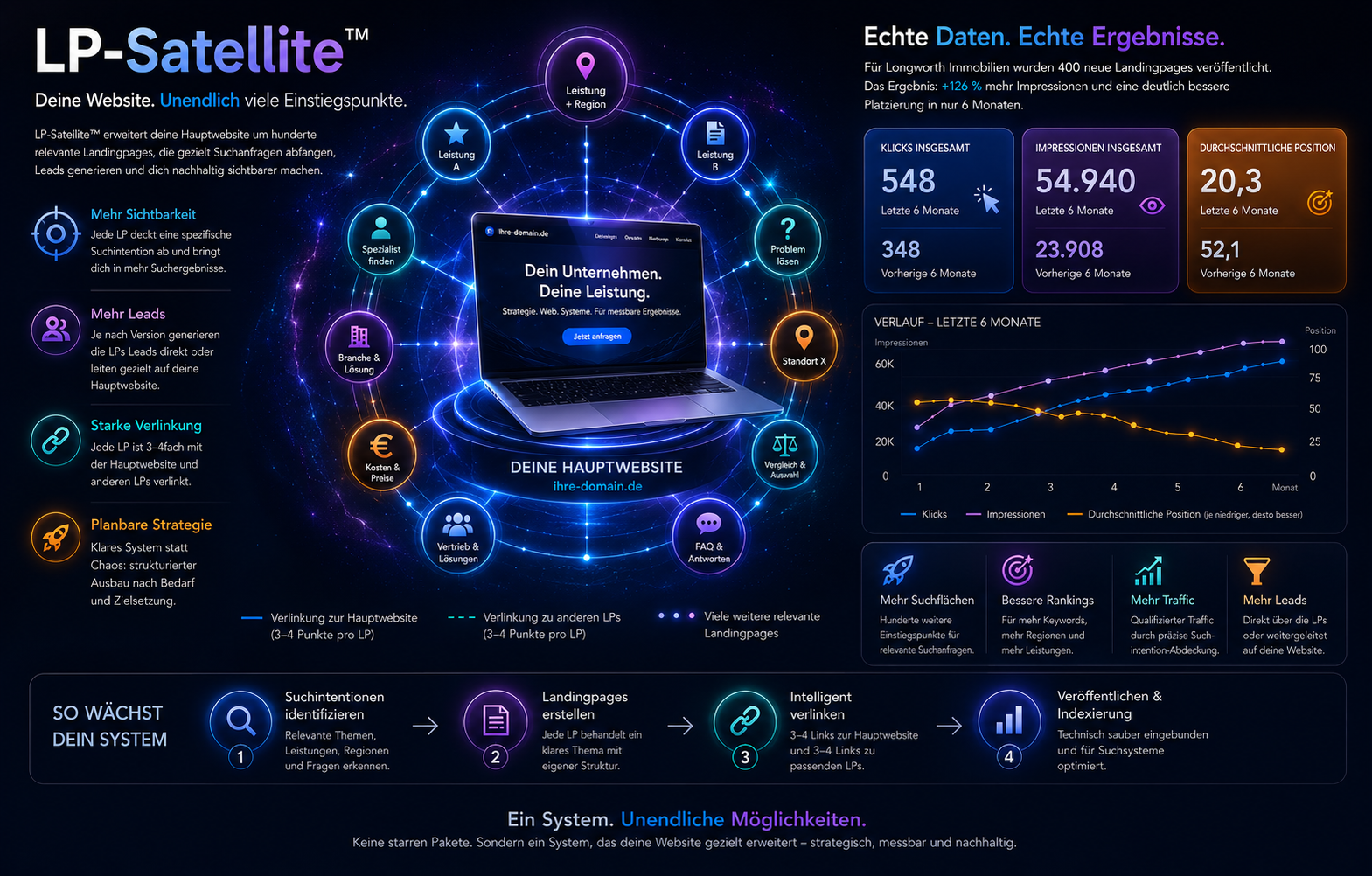
Global proof of systematic expansion
The global case demonstrates repeatable components and controlled page production.
The global LP-Satellite™ case demonstrates why extensive page building requires clear architecture, quality control, and measurement; for Website Systems, the rules for repeatable components and controlled page production must therefore be defined before expansion.
What Sets Us Apart
The difference lies not in more disciplines, but in consistent responsibility.
Classic project logic
-
Risk in Analysis: Individual measures without a shared vision
-
Risk in Architecture: Handoffs between strategy, design, and technology
-
Risk in Implementation: Launch without well-thought-out operational logic
VELUNO System Responsibility
-
Improved Logic in Analysis: Connecting information and URL architecture with modular components
-
Improved Logic in Architecture: Planning content model and governance, performance, and technical extensibility together
-
Improved Logic in Implementation: Considering operation and expansion from the outset
How We Work
This ensures the project remains consistent from analysis to expansion. Controllable
Each step resolves an assumption, limits the risk, and creates the basis for the next binding decision. This step documents how the gap between in-depth expertise and external orientation was resolved during analysis before the next assumption is addressed.
Analysis
For analysis, it is recorded what portion of the gap between business depth and external orientation is confirmed, rejected, or continued. The current state is reviewed in relation to business objectives, user needs, and technical dependencies.
Architecture
This step documents how the gap between business depth and external orientation was addressed in the architecture before the next assumption is considered. The target architecture defines the information architecture, components, content model, and governance.
Implementation
Acceptance testing verifies whether the gap between business depth and external orientation and the associated risks are indeed limited during implementation. Implementation follows the defined architecture and proceeds in verifiable steps.
Operations
This step documents how the gap between business depth and external orientation was addressed during further development before the next assumption is considered. After launch, quality, data, and technical stability are monitored.
Typical Project Sizes
Project size is determined by dependencies and objectives, not by a one-size-fits-all approach.
The effect is evident in faster expansion, consistent quality, and fewer structural legacies.
Focused sub-project
The project size is appropriate if the gap between technical depth and external orientation, as well as the current risk, are fully resolved during analysis.
Complete setup or rebuild
The scope remains small as long as the correction of the gap between technical depth and external orientation can be independently addressed during architecture.
Scalable System Project
The next expansion phase is only initiated once the gap between technical depth and external orientation has been reliably resolved during implementation.
What Determines the Scope
The scope remains small as long as the correction of the gap between technical depth and external orientation can be independently addressed during further development.
Further classifications
Three global insights for informed digital decisions
The following articles delve deeper into questions of architecture, visibility, and digital systems and help in classifying the next step.

SEO · GEO · AEO
Why classic SEO page models fall short in AI search
An explanation of how content must be structured so that search engines and response systems can reliably understand relationships.
Structure
Why company websites often fail due to their system logic
Analysis of typical breaks between content, user guidance, tracking, and technical maintainability.
Platforms
When a web project needs to evolve into a robust platform logic
Guidance for the transition from individual pages to roles, processes, data, and reusable system components.
FAQ
Decision-making questions for the digital project
The answers classify the scope, procedure, and Collaboration without any price, duration, or success guarantees.
A website system combines information architecture, components, content models, governance, technology, and measurement in reusable rules. It is more than a CMS with templates because page roles, variants, and controlled expansion are also defined.
When services, markets, target groups, or page types grow regularly, and each addition generates new, special logic, then the website needs a modular model for structure, content, components, and technical expansion.
Templates have clearly defined components, data fields, and variant rules. Content is structured according to page type and user query; governance and quality assurance prevent scaling from leading to duplication and inconsistencies.
Yes, if the existing system is technically viable and fits the target vision. Before an acquisition, maintainability, data, interfaces, security, and the costs of future expansions are examined.
Regional sites need a flat, unambiguous URL logic, shared components, and genuinely independent content. Expansion is based on search intent and market role, without inventing local presence or references.
Next Step
Modular growth without structural loss: defining the next step definitively
The initial consultation clarifies which assumptions pose the greatest risk during analysis and what the next step will be toward "A modular website system with a clear information architecture and reusable content modules"; collaboration with companies in Lower Saxony takes place digitally and across regions.