
Digital Experience · Mecklenburg-Vorpommern
B2B Website Mecklenburg-Vorpommern: Making complexity understandable.
Technical depth is valuable, but an unclear digital presentation forces prospects and sales to perform unnecessary translation work. The consequences for target group and buying center logic, a clear performance and use case structure, and proof, cases, and trust elements are derived from this specific problem; from this, a common target image for positioning is created. The resulting target vision is a B2B website that builds relevance, proof, and next steps around real-world decision-making questions.
Complex services don't need to be simplified to the point of losing substance. They need to be clearly structured around problems, use cases, roles, and evidence.
Target Group and Buying Center Logic
Organizes services, user journeys, and technical limitations into a comprehensible overall structure
Clear Service and Use Case Structure
Translates business objectives and user needs into a clear page, data, and decision logic
Proof, Cases, and Trust Elements
Connects Buying Center, Use Cases, Proof, and longer decision-making processes with a clear decision for the next development stage
Systems work means: Context instead of isolation Individual Area
The project becomes viable when four points are planned as a coherent system decision: target group and buying center logic; clear performance and use case structure; proof, cases, and trust elements; conversion for longer decision-making processes. The "system decision" structures the framework within the target vision in such a way that the gap between technical depth and external orientation is not carried over to the next phase.
VELUNO works digitally and across regions with companies in Mecklenburg-Western Pomerania; workshops, decisions, and approvals are documented without claiming a local branch, on-site presence, or local customer relationships.
The structural bottleneck
If decisions remain unresolved, the system doesn't grow, but rather the friction does.
The website generates traffic or leads, but does not adequately support the actual B2B decision. Complex services are explained correctly internally, but externally they are too abstract, technical, or interchangeable. The operational consequences are derived from the visible problem before a target state and the appropriate system solution are defined.
Services are explained from an internal perspective rather than a customer perspective.
This bottleneck extends to positioning; the gap between in-depth expertise and external orientation cannot be closed with a single measure.
-
Internal language
-
Lack of context
-
Interchangeable presentation
Decision-makers can't find a suitable entry point
This bottleneck extends to structure; the gap between in-depth expertise and external orientation cannot be closed with a single measure. Traffic is only valuable if the landing page, argumentation, and next step toward Search Intent are a good fit. Otherwise, visits increase without making informed decisions any easier.
-
Incorrect entry points
-
Missing proof
-
Vague next steps
Proof and next steps are too weakly connected
This bottleneck has a further impact on technology; the gap between in-depth expertise and external orientation cannot be closed with a single measure.
-
Incorrect entry points
-
Missing proof
-
Vague next steps
Performance logic
Four building blocks for a viable system structure
The resulting target image is a B2B website that builds relevance, proof, and next steps around real decision-making questions. Each building block addresses a cause and effect for structure; together they support the target image of "making complexity understandable." A more in-depth analysis is provided by: Solutions for Technology Companies.
Positioning & Buying Center
"Positioning & Buying Center" translates the gap between in-depth expertise and external orientation into a concrete system decision for positioning. Business objectives, target groups, and relevant decision-making situations are translated into a clear line of reasoning. This prevents general statements and creates clear entry points.
-
Target Group and Buying Center Logic
-
Clear Service and Use Case Structure
-
Target Groups and Priorities
-
Understandable Performance Logic
Service and Use Case Architecture
"Performance and Use-Case Architecture" translates the gap between in-depth expertise and external orientation into a concrete system decision for structure.
-
Clear Service and Use Case Structure
-
Proof, Cases, and Trust Elements
-
Clearly Defined Side Roles
-
Reusable Rules
Proof & Conversion
“Proof & Conversion” translates the gap between in-depth expertise and external orientation into a concrete system decision for technology. Proof, objections, and next steps are integrated where they support a decision. Conversion thus arises from relevance and clarity rather than pressure.
-
Proof, Cases, and Trust Elements
-
Conversion for longer decision-making processes
-
Proof at relevant points
-
Measurable Inquiry channels
CRM, Tracking & Growth
For “CRM, Tracking & Growth,” the root cause and the gap between in-depth expertise and external orientation in operations are connected before the technical solution is determined.
-
Integration with Content, CRM, and Tracking
-
Target Group and Buying Center Logic
-
Tracking and Monitoring
-
Prioritization Based on Impact
Systematic Scope
Aligning the Project Scope with the Bottleneck, Not a Wish List
The initial phase focuses on the offerings and roles that currently require a significant amount of explanation. The project size depends on how many underlying issues need to be addressed to truly support the target vision.
Focused Entry Point
This phase is complete when the gap between technical depth and external orientation in positioning is resolved and the system boundary is clearly defined.
Structural Rebuild
This phase is complete when the gap between technical depth and external orientation in structure is resolved and the system boundary is clearly defined. The rebuild phase is implemented when multiple legacy issues can no longer be resolved separately. It reorganizes buying centers, use cases, proofs of concept, and lengthy decision-making processes within a controlled project.
Systematic Expansion
For "Systematic Expansion," it is assessed whether the gap between technical depth and external orientation in technology can be resolved independently or whether it affects the shared target vision.
Project Decisions with Impact
Four Project Logics for Different Bottlenecks in B2B Websites
Exemplary project scenarios demonstrate how the focus on "Making Complexity Understandable" leads from the initial situation through the decision to the final impact; no local references are claimed. Relevant project and system references are shown. B2B Website Rebuild.
B2BSaaSRelaunch
Legacy content, technical issues, and unclear page roles are transformed into a robust target structure
Project Logic
B2B SaaS Relaunch: Deciding on Architecture and Migration Together
The initial problem: Existing content, legacy technical issues, and unclear page roles are transformed into a robust target structure. The result is translated into a system decision: Instead of simply renewing the interface, URL logic, content, components, and tracking are all rebuilt together. Impact in the target scenario: The impact lies in more stable user journeys, cleaner technology, and a foundation that can be maintained after launch.
Industry website
Technical depth provides clear entry points for different roles, industry-specific questions, and use cases
Project Logic
Industry website: Organizing performance logic from the customer's perspective
The initial problem: Technical depth provides clear entry points for different roles, industry-specific questions, and use cases. The result is translated into a system decision: The structure connects use cases, performance modules, technical details, and relevant documentation in a consistent hierarchy. Impact in the target scenario: Prospective customers find the relevant context more quickly, while sales has to explain fewer basic concepts. This case bridges the gap between technical depth and external orientation in terms of structure, resulting in a robust system decision.
Professional Services Presence
Project Logic Connects User Needs, Business Goals, and Technical Feasibility
Project Logic
Professional Services Presence: From Bottleneck to a Robust System Decision
The Initial Problem: An unclear initial situation is transformed into a structured digital project with defined results. The outcome is translated into a system decision: First, the goal, dependencies, and system boundaries are clarified; then, controlled implementation follows. Impact on the Target Image: This reduces operational friction and makes the next development phase predictable.
Multi-Market Website with Search Architecture System
Regional and linguistic requirements are addressed with clear rules, without multiplying content and technology
Project Logic
Multi-Market Website with Search Architecture System: Connecting Markets Without Multiplying the Structure
The initial problem: Multiple markets or languages are planned not as copies, but as controlled variations of a common structure. This translates into a system decision: Shared content, local differences, URL systems, and approvals are clearly separated before implementation. The effect in the target architecture: The expansion remains consistent, maintainable, and technically traceable, even when additional markets are added. This effect arises because the gap between in-depth expertise and external orientation is resolved during operation within the same target architecture as the root cause.
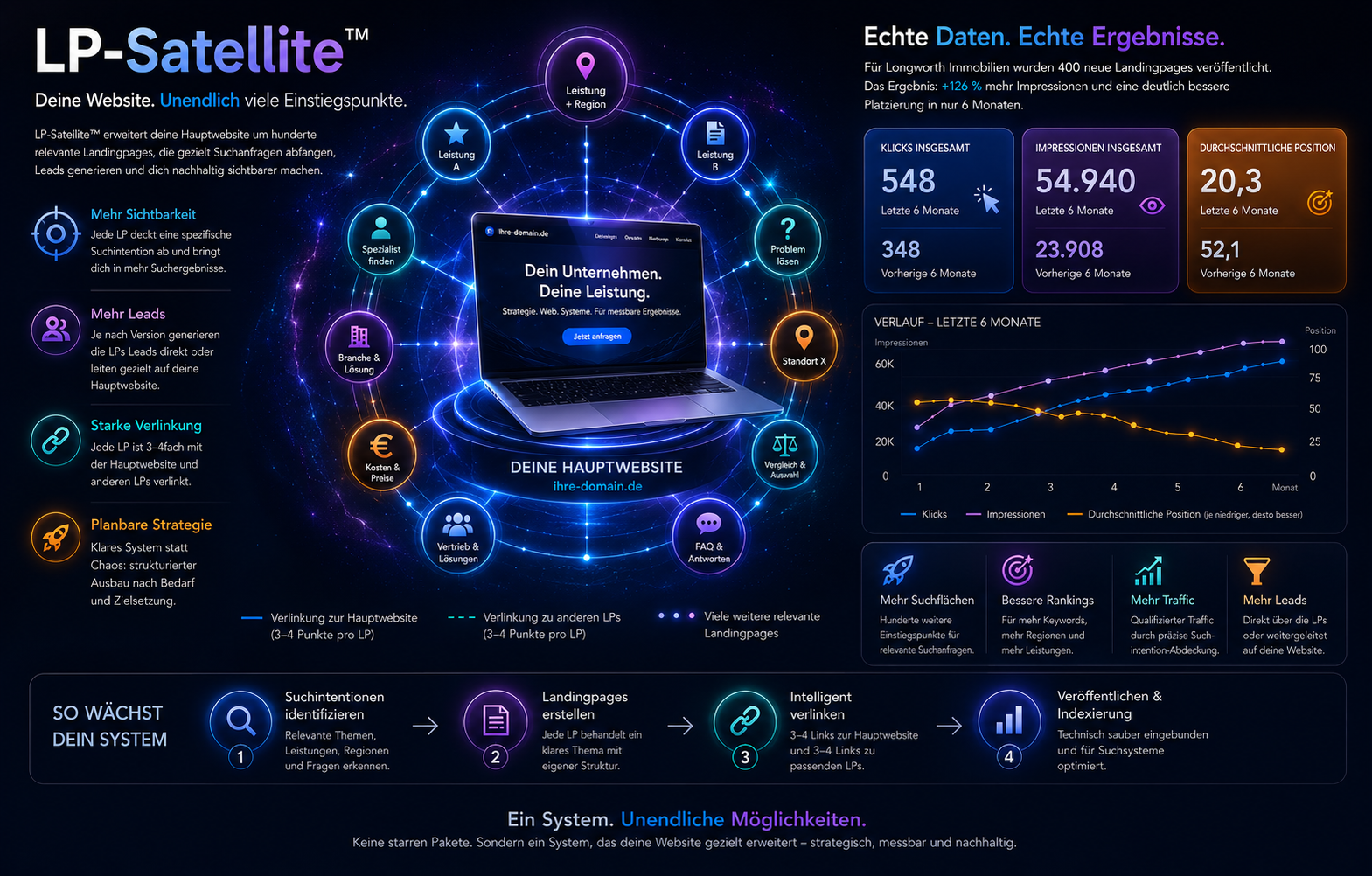
Global proof of systematic expansion
The global case demonstrates a comprehensible rationale based on real-world B2B issues.
The global LP-Satellite™ case shows why extensive website development requires a clear architecture, quality control, and measurement; therefore, for B2B websites, the rules for a comprehensible rationale based on real-world B2B issues must be established before expansion. The reference is not from Mecklenburg-Vorpommern and is not presented as a local customer relationship. ```
What Sets Us Apart
The difference lies not in more disciplines, but in consistent responsibility.
Classic project logic
-
Consequence of problems with positioning: Individual measures without a shared vision.
-
Consequence of problems with structure: Handoffs between strategy, design, and technology.
-
Consequence of problems with technology: Launch without a well-thought-out operational logic.
VELUNO System Responsibility
-
System response with positioning: Combine target group and buying center logic with a clear performance and use-case structure.
-
System response with structure: Jointly plan proofs, cases, trust elements, and conversions for longer decision-making processes.
-
System response with technology: Consider operation and expansion from the outset.
How We Work
This ensures the project remains consistent from analysis to expansion. Controllable
This process integrates the problem, its consequences, the target vision, and the technical solution into a continuous decision-making chain. For positioning, it documents what portion of the gap between technical depth and external orientation has been resolved and which dependencies remain.
Analysis
For positioning, it documents what portion of the gap between technical depth and external orientation has been resolved and which dependencies remain. Goals, existing content, systems, and risks are recorded.
Architecture
Acceptance testing verifies whether the system solution actually eliminates the gap between technical depth and external orientation in terms of structure.
Implementation
This step documents how the gap between technical depth and external orientation is translated into the target vision and the system solution. Positioning, service architecture, use cases, conversion, and system integration are linked in a controlled manner.
Operations
Acceptance testing verifies whether the system solution effectively closes the gap between technical depth and external orientation during operation. After launch, quality, data, and technical stability are monitored.
Typical Project Sizes
Not every project needs to start as a large-scale undertaking.
The impact is evident in improved self-qualification, more targeted discussions, and a credible digital presence. Flat-rate pricing, minimum budgets, and fixed contract durations would be unethical without reliable baseline data. Further details on the procedure can be found at [link to relevant section]. Digital Experience.
Focused sub-project
The size is appropriate if the gap between technical depth and external orientation can be resolved within a comprehensive target vision.
Complete setup or rebuild
The size is appropriate if the gap between technical depth and external orientation can be resolved within a comprehensive target vision.
Scalable System Project
The size is appropriate if the gap between technical depth and external orientation can be resolved within a comprehensive target vision.
What Determines the Scope
The size is appropriate if the gap between technical depth and external orientation can be resolved within a comprehensive target vision.
Further classifications
Three global insights for informed digital decisions
The following articles delve deeper into questions of architecture, visibility, and digital systems and help in classifying the next step.

SEO · GEO · AEO
Why classic SEO page models fall short in AI search
An explanation of how content must be structured so that search engines and response systems can reliably understand relationships.
Structure
Why company websites often fail due to their system logic
Analysis of typical breaks between content, user guidance, tracking, and technical maintainability.
Platforms
When a web project needs to evolve into a robust platform logic
Guidance for the transition from individual pages to roles, processes, data, and reusable system components.
FAQ
Frequently Asked Questions, Answered Objectively
The answers classify the scope, procedure, and Collaboration without any price, duration, or success guarantees.
A B2B website must consider multiple decision-makers, longer review processes, and services requiring explanation. It connects use cases, technical depth, proof of concept, and next steps in such a way that relevance can be assessed even before the sales conversation.
Complexity is managed through problems, use cases, decision criteria, and tiered information. Brief introductions provide orientation, while in-depth sections offer specialized content for different roles.
They make claims verifiable and demonstrate which problem class was solved with which approach. Context, decision, and impact are crucial; mere logos or vague success claims are no substitute for solid evidence.
It answers key preliminary questions, defines suitable use cases, and leads to a clear next step. CRM and tracking integration then help identify which content supports qualified conversations.
The answer depends on the objective, the existing infrastructure, and the relevant system boundaries. VELUNO clarifies target group and buying center logic, a clear performance and use case structure, and proof, cases, and trust elements, deriving a comprehensible next step from this.
Next Step
Making complexity understandable: defining the next step definitively
The initial consultation clarifies the problem sequence, the target vision, and the system boundaries for positioning, enabling realistic planning of "A B2B website that builds relevance, proof, and next steps based on real decision-making questions." Companies in Mecklenburg-Western Pomerania receive digital and supra-regional support.