
Digital Experience · Bavaria
B2B Website Bavaria: System Logic Instead of Digital Background.
If every new page generates more engagement than benefit, the bottleneck isn't in the design, but in the lack of System Logic of the digital offering. Before a solution is determined, VELUNO examines the assumptions regarding target group and buying center logic, a clear service and use-case structure, and proof, cases, and trust elements; the first risk becomes apparent when considering the business objective. The goal isn't a quick fix, but a B2B website that builds relevance, proof, and next steps around real decision-making questions.
Complex services don't need to be simplified to the point of losing substance. They need to be clearly structured around problems, use cases, roles, and evidence. The benefit arises from avoiding risky shortcuts during implementation: better pre-qualification and less explanation required in sales.
Target Group and Buying Center Logic
Translates business objectives and user needs into a clear page, data, and decision logic
Clear Service and Use Case Structure
This building block organizes a clear performance and use-case structure in such a way that the goal, implementation, and subsequent expansion remain comprehensibly linked.
Proof, Cases, and Trust Elements
Connects Buying Center, Use Cases, Proof, and longer decision-making processes with a clear decision for the next development stage
Systems work means: Context instead of isolation Individual Area
The project becomes viable when four points are planned as a coherent system decision: target group and buying center logic; a clear performance and use-case structure; proof, cases, and trust elements; and conversion for longer decision-making processes. "System decision" replaces follow-up costs, duplicate maintenance, and unnecessary loops with a robust rule for system boundaries and ensures the next step remains compatible.
VELUNO works digitally and across regions with companies in Bavaria; workshops, decisions, and acceptances are documented without claiming a local branch, on-site proximity, or local customer relationship.
Starting Point
Making complexity understandable: The real bottleneck lies behind the visible surface.
The website generates traffic or conversations, but does not adequately support the actual B2B decision. Complex services are explained correctly internally, but externally they are too abstract, technical, or interchangeable. The argument first examines the seemingly obvious shortcut and reveals the risks it creates in terms of structure and operation.
Services are explained from an internal perspective rather than a customer perspective.
This bottleneck examines the assumption that the business objective can be added later; subsequent costs, duplicate maintenance, and unnecessary loops demonstrate the resulting risk.
-
Internal language
-
Lack of context
-
Interchangeable presentation
Decision-makers can't find a suitable entry point
This bottleneck shows how subsequent costs, duplicate maintenance, and unnecessary loops shift the risk at system boundaries and must be corrected before the next step. Many pages answer a question but do not guide the user through the decision-making process. Relevance, proof, and conversion must therefore be linked within the same page logic.
-
Incorrect entry points
-
Missing proof
-
Vague next steps
Proof and next steps are too weakly connected
The flawed assumption behind this bottleneck primarily concerns implementation; without correction, it exacerbates subsequent costs, duplicate maintenance, and unnecessary loops.
-
Incorrect entry points
-
Missing proof
-
Vague next steps
Building blocks of the solution
Four building blocks for a viable system structure
The goal is not a quick fix, but a B2B website that builds relevance, proof, and next steps around real decision-making questions. The building blocks correct risky individual assumptions and, at system boundaries, integrate them into the more robust logic of "making complexity understandable." A more in-depth classification is offered. Solutions for Technology Companies.
Positioning & Buying Center
"Positioning & Buying Center" replaces follow-up costs, duplicate maintenance, and unnecessary loops with a robust rule for business objectives and ensures the next step is seamlessly integrated. The performance presentation is not driven by internal departments but by real-world questions and use cases. This makes technical depth understandable without oversimplifying it.
-
Target Group and Buying Center Logic
-
Clear Service and Use Case Structure
-
Target Groups and Priorities
-
Understandable Performance Logic
Service and Use Case Architecture
For "Performance and Use-Case Architecture," system boundaries are clarified before implementation to prevent follow-up costs, duplicate maintenance, and unnecessary loops from rolling over into the next project phase.
-
Clear Service and Use Case Structure
-
Proof, Cases, and Trust Elements
-
Clearly Defined Side Roles
-
Reusable Rules
Proof & Conversion
"Proof & Conversion" replaces follow-up costs, duplicate maintenance, and unnecessary loops with a robust rule for implementation and ensures the next step is seamlessly integrated. The page guides users from a specific question through verifiable evidence to a suitable next step. Forms and inquiry processes remain concise, clear, and measurable.
-
Proof, Cases, and Trust Elements
-
Conversion for longer decision-making processes
-
Proof at relevant points
-
Measurable Inquiry Paths
CRM, Tracking & Growth
For "CRM, Tracking & Growth," measurement is clarified before implementation to prevent follow-up costs, duplicate maintenance, and unnecessary loops from being carried over to the next project phase.
-
Integration with Content, CRM, and Tracking
-
Target Group and Buying Center Logic
-
Tracking and Monitoring
-
Prioritization Based on Impact
The Right Starting Point Considers Impact, Risk, and Future Integration
The Right Starting Point Considers Impact, Risk, and Future Integration
The initial phase focuses on the offerings and roles that currently require a significant amount of explanation. The project scope is determined only after the misconception and its technical or organizational consequences have been clarified.
Focused Entry Point
For "Focused Initial Phase," only the necessary scope is opened to reliably resolve follow-up costs, duplicate maintenance, and unnecessary loops related to the business objective.
Structural Rebuild
The scope separates follow-up costs, duplicate maintenance, and unnecessary loops at system boundaries from the deliberately planned later expansion steps. The rebuild phase is implemented when multiple legacy issues can no longer be resolved separately. It reorganizes buying centers, use cases, proofs of concept, and lengthy decision-making processes within a controlled project.
Systematic Expansion
This stage is beneficial when follow-up costs, duplicate maintenance, unnecessary iterations, and implementation risks are completely minimized. After establishing a robust foundation, additional content, markets, functions, or integrations can be added modularly. Each expansion stage remains tied to measurable goals.
Project Decisions with Impact
How resilient digital structures emerge from diverse starting points
Exemplary project scenarios demonstrate how the focus on "Making Complexity Understandable" leads from the initial situation through the decision to the final impact; no local references are claimed. Relevant project and system references are shown. B2B Website Rebuild.
B2B SaaSRelaunch
Legacy content, technical issues, and unclear page roles are transformed into a robust target structure
Project Logic
B2B SaaS Relaunch: Deciding on Architecture and Migration Together
Initial situation: A legacy website is reorganized based on user feedback, content value, and technical maintainability. The central decision corrects the risky shortcut: Instead of simply updating the interface, URL logic, content, components, and tracking are rebuilt together. Impact: The impact lies in more stable user journeys, cleaner technology, and a foundation that can be maintained after launch.
Industry website
Complex Products and Services are Structured from the Perspective of Real-World Applications Instead of Internal Product Lists
Project Logic
Industry website: Organizing performance logic from the customer's perspective
Initial situation: Complex products and services are structured from the perspective of real-world applications rather than along internal product lists. The central decision corrects the risky shortcut: The structure connects use cases, service modules, technical details, and relevant evidence in a consistent hierarchy. Impact: Prospective customers find the relevant context more quickly, while sales staff have to explain fewer basic concepts. This approach corrects follow-up costs, duplicate maintenance, unnecessary iterations, and the risk associated with system limitations, providing a foundation for the next step.
Professional Services Presence
An unclear initial situation is transformed into a structured digital project with defined deliverables.
Project Logic
Professional Services Presence: From Bottleneck to a Robust System Decision
Initial Situation: The project logic combines user needs, business objectives, and technical feasibility. The central decision corrects the risky shortcut: The decision is based on impact and operational capability rather than a long to-do list. Impact: This reduces operational friction and ensures that the next expansion phase remains predictable.
Multi-market website with Search Architecture System
Regional and linguistic requirements are addressed with clear rules, without multiplying content and technology
Project Logic
Multi-Market Website with Search Architecture System: Connecting Markets Without Multiplying the Structure
Initial situation: Regional and linguistic requirements are given clear rules without multiplying content and technology. The central decision corrects the risky shortcut: Shared content, local differences, URL system, and approvals are definitively separated before implementation. Effect: This reduces translation and maintenance efforts, while each variant retains a clear role. The decision prevents the recurring costs, duplicate maintenance, and unnecessary measurement loops from arising as technical or organizational legacies.
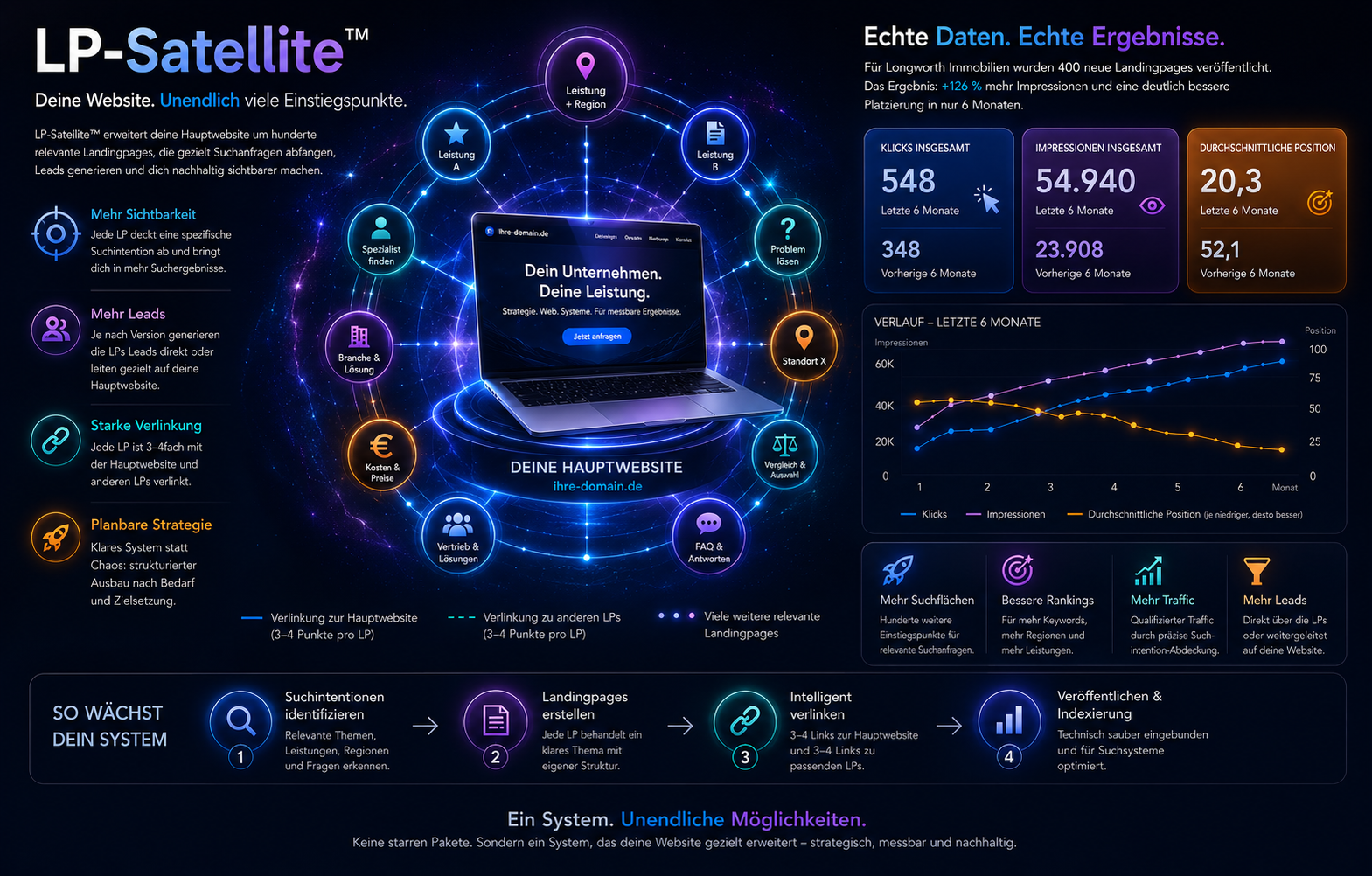
Global proof of systematic expansion
Repeatable quality is more important than a high number of individual pages
The global LP-Satellite™ case demonstrates why extensive website development requires clear architecture, quality control, and measurement; for B2B websites, the rules for transparent argumentation based on real B2B questions must therefore be established before expansion. The reference is not from Bavaria and is not presented as a local customer relationship.
What Sets Us Apart
Reliable system work requires coherence, not handoff chains
Classic project logic
-
Risk at Business Objective: Individual measures without a shared vision
-
Risk at System Boundaries: Handoffs between strategy, design, and technology
-
Risk in Implementation: Launch without well-thought-out operational logic
VELUNO System Responsibility
-
Improved Logic at Business Objective: Combining target group and buying center logic with a clear performance and use case structure
-
Improved Logic at System Boundaries: Jointly planning proofs, cases, trust elements, and conversions for longer decision paths
-
Improved Logic in Implementation: Considering operation and expansion from the outset
How We Work
Clarify first, then structure, then implement and operate reliably
Each step resolves an assumption, limits the risk, and creates the basis for the next binding decision. This step documents how follow-up costs, duplicate maintenance, and unnecessary loops were decided upon for the business objective before the next assumption is opened.
Analysis
Acceptance testing verifies whether follow-up costs, duplicate maintenance, unnecessary loops, and the risk for the business objective are indeed limited. Objectives, existing content, systems, and risks are identified.
Architecture
Acceptance testing verifies that follow-up costs, duplicate maintenance, unnecessary loops, and risks associated with system boundaries are effectively limited. A clear performance and use-case structure, along with proofs, cases, and trust elements, are translated into a common page, data, and responsibility logic.
Implementation
Acceptance testing verifies that follow-up costs, duplicate maintenance, unnecessary loops, and risks during implementation are effectively limited. Positioning, performance architecture, cases, conversion, and system integration are systematically linked.
Operations
Acceptance testing verifies that follow-up costs, duplicate maintenance, unnecessary loops, and risks associated with measurement are effectively limited. Content expansion, CRM integration, tracking, and sales feedback are assigned clear responsibilities.
Typical Project Sizes
Not every project needs to start as a large-scale undertaking.
The impact is evident in improved self-qualification, more targeted discussions, and a credible digital presence. Flat-rate pricing, minimum budgets, and fixed contract durations would be unethical without reliable baseline data. Further details on the procedure can be found at [link to relevant section]. Digital Experience.
Focused sub-project
The project size is appropriate when follow-up costs, duplicate maintenance, unnecessary loops, and the current risk associated with the business objective are fully addressed.
Complete setup or rebuild
The scope remains small as long as the correction of follow-up costs, duplicate maintenance, and unnecessary loops at system boundaries can be independently resolved.
Scalable System Project
The scope remains small as long as the correction of follow-up costs, duplicate maintenance, and unnecessary loops during implementation can be independently resolved.
What Determines the Scope
The project size is appropriate if follow-up costs, duplicate maintenance, unnecessary loops, and the current risk during measurement are fully resolved.
Further classifications
Three global insights for informed digital decisions
The following articles delve deeper into questions of architecture, visibility, and digital systems and help in classifying the next step.

SEO · GEO · AEO
Why classic SEO page models fall short in AI search
An explanation of how content must be structured so that search engines and response systems can reliably understand relationships.
Structure
Why company websites often fail due to their system logic
Analysis of typical breaks between content, user guidance, tracking, and technical maintainability.
Platforms
When a web project needs to evolve into a robust platform logic
Guidance for the transition from individual pages to roles, processes, data, and reusable system components.
FAQ
Five clear answers about B2B websites
The answers outline the scope, approach, and collaboration without making any promises regarding price, duration, or success.
A B2B Website Must consider multiple decision-makers, longer review processes, and services requiring explanation. It combines use cases, technical depth, proof, and next steps in such a way that relevance can be assessed even before the sales meeting.
Complexity is managed through problems, use cases, decision criteria, and tiered information. Brief introductions provide orientation, while in-depth sections offer specialized content for different roles.
They make claims verifiable and demonstrate which problem class was solved with which approach. Context, decision, and impact are crucial; mere logos or vague success claims are no substitute for solid evidence.
It answers key preliminary questions, defines suitable use cases, and leads to a clear next step. CRM and tracking integration then help identify which content supports qualified conversations.
The answer depends on the objective, the existing infrastructure, and the relevant system boundaries. VELUNO clarifies target group and buying center logic, a clear performance and use case structure, and proof, cases, and trust elements, deriving a comprehensible next step from this.
Next Step
Current friction can be transformed into a controllable development path.
The initial consultation clarifies which assumption poses the greatest risk to the business objective and what the next step will be toward "A B2B website that builds relevance, proof, and next steps based on real decision-making questions." Collaboration with companies in Bavaria is digital and takes place across regions.