
Web Design Ulm: Clear Decisions and Clean Implementation
Anyone searching for "web design Ulm" primarily needs clear decision criteria. VELUNO analyzes target groups, value propositions, user paths, proof, design, and technical foundation, prioritizes effective interventions, and manages the digital implementation. The benchmark is not mere activity, but this goal: A clearly positioned, fast, and inquiry-oriented company website.
It's not the most conspicuous individual measure that matters, but rather the combination of relevant components. The expected benefits: clearer communication, improved user guidance, and a robust technical foundation. The project will be managed digitally across regions and with complete transparency.
Positioning and Messaging
"Positioning and Messaging" combines the business priority with a verifiable technical or content-related decision.
Information Architecture
"Information Architecture" defines what needs to be clarified before implementation to ensure the project isn't based on assumptions.
UX and conversion management
"UX and Conversion Management" defines what needs to be clarified before implementation to ensure the project isn't based on assumptions.
Information architecture & UX
Design system & frontend
Performance, tracking & operation
From Individual Problem to Robust Structure
The visible presence is only one part of the system. The requirements of "Positioning and Messaging" and "Information Architecture" must be linked to "UX and Conversion Management" and "solid technical implementation." Otherwise, decisions will fail at the interfaces between content, technology, and operations. Positioning, user guidance, and the technical foundation are integrated in such a way that the website can be marketed effectively and further developed in a controlled manner. The initial step reveals the point at which the existing structure and current needs no longer align.
Designed for companies with outdated, haphazard, or poorly managed websites that require a well-founded decision rather than a loose list of measures. The project is managed digitally and across regions.
Taking the wrong shortcut increases the later effort.
The existing website provides insufficient information, appears generic, or generates too few qualified inquiries. This is usually due to a combination of unresolved decisions, technical limitations, and a lack of operational logic. For the area between Ulm and Neu-Ulm, Senden (Bavaria), and Ehingen the needs are addressed objectively; the project work itself remains digital and across regions. For the neighboring market, the site refers to Webdesign Neu-Ulm.
Unclear positioning and interchangeable statements
This point initially appears to be operational, but it has structural consequences. Without a clear priority, the effort increases, while the desired effect – clearer communication – is not reliably achieved.
-
Decisions without a baseline
-
Technology and content drift apart
-
Operations only react
Arbitrary page logic without clear decision-making
This situation shifts responsibility between content, UX, and technology. The system remains difficult to control, even though individual measures show short-term activity.
-
Decisions without a baseline
-
Technology and content drift apart
-
Operations only react
Technology that is slow, difficult to maintain, or poorly extensible
The error becomes visible on the surface but originates earlier in the decision-making process. Therefore, it must first be clarified which dependencies cause the effect and which changes are sustainable.
-
Dependencies remain hidden
-
A standalone solution falls short
-
Expansion becomes riskier
From diagnosis to a robust web design solution
A robust result doesn't arise from the sum of many tasks, but from clear dependencies. Therefore, target groups, value propositions, user paths, proof, design, and the technical foundation are prioritized first. This is followed by controlled implementation in these areas: messaging, information architecture, UX, design system, frontend, and operations. The functional relationships are then established. Digital Experience ```
Positioning & Messaging
In "Positioning & Messaging," relevant assumptions are specified, dependencies are documented, and responsibilities are defined. This results in a more precise presentation rather than a mere to-do list.
-
Positioning and Messaging
-
Making Assumptions Visible
-
Considering Operations Early on
-
Information Architecture
Information architecture & UX
"Information Architecture & UX" connects business requirements with the technical or content-related implementation. Crucially, the page logic must remain comprehensible during operation.
-
Information Architecture
-
Making Assumptions Visible
-
Considering Operations Early on
-
UX and conversion management
Design system & frontend
The "Design System & Frontend" module defines which tasks actually contribute to the desired result. Unclear additional requests are evaluated against the objectives, risks, and development path.
-
UX and conversion management
-
Making Assumptions Visible
-
Considering Operations Early on
-
Solid technical implementation
Performance, tracking & operation
"Performance, Tracking & Operations" ensures that the solution doesn't break down at the next interface. The desired effect is a more stable technical foundation. The implementation remains testable, handover-ready, and extensible.
-
Solid technical implementation
-
Risks before implementation
-
Clean Handovers
-
Performance and maintainability
Starting Small Without Compromising the Goal
Not every situation requires the largest possible scope immediately. The crucial question is whether a clearly defined bottleneck needs to be resolved, a supporting foundation needs to be rebuilt, or an existing system needs to be expanded in a controlled manner.
Focused Entry Point
The initial phase addresses a prioritized user journey, technical bottleneck, or decision block. The scope and metrics are intentionally kept narrow.
Structural Rebuild
The Rebuild reorganizes the central dependencies and eliminates legacy issues that repeatedly block individual improvements.
Systematic Expansion
The expansion phase extends a stable system step by step. New modules are only added once their role and operational overhead have been determined.
Differentiating Starting Points Instead of Treating Projects the Same
The cases serve as conceptual models for decision-making. They categorize typical starting points and demonstrate the impact of clear prioritization. A supplementary reference on the methodology is: B2B Website Rebuild.
Company website with a clear performance logic
Example Project Scenario · Focus on Positioning & Messaging
Project Logic
From the Problem of “Unclear Positioning and Interchangeable Statements” to a Clear Result
The initial situation allowed for several quick fixes, but none of them would have addressed the root cause. The "Positioning & Messaging" component therefore became the primary focus, while "Information Architecture" served as a quality criterion. The resulting effect can be summarized as follows: a more precise presentation.
Positioning & Messaging
Clearer Communication
B2B Relaunch with a New Information Architecture
Decision Model · Website as a Sales and System Platform
Project Logic
The Turning Point Lies in the “Information Architecture & UX” Module
The risk lay not in a single function, but in the problem of "arbitrary page logic without clear decision-making." The solution prioritized the "Information Architecture & UX" component, clarified responsibilities, and prepared the "Information Architecture" requirement. The result can be summarized as follows: a comprehensible page logic.
Information architecture & UX
Improved orientation
Search Architecture System for Recurring Campaigns
Transferable Case – No Local Reference
Project Logic
The central decision behind "Search Architecture System for Recurring Campaigns"
The initial situation was defined by the problem of "technology that is slow, difficult to maintain, or poorly extensible." Instead of addressing the "UX and Conversion Management" requirement in isolation, it was combined with the "Design System & Frontend" component. This resulted in the following outcome: a consistent design system.
Design system & frontend
Increased Trust
Technical Consolidation of a Grown Website
Initial Situation, Decision, and Impact · Performance, Tracking & Operation
Project Logic
A Visible Bottleneck, a Crucial System Decision
Initially, the problem was "unclear positioning and interchangeable statements." Further individual measures would only have masked the dependencies. Therefore, "Performance, Tracking & Operation" was established as a binding focus and secured with the requirement of "Performance and Maintainability." The result can be summarized as follows: a more stable technical foundation.
Performance, tracking & operation
A Maintainable Website Foundation
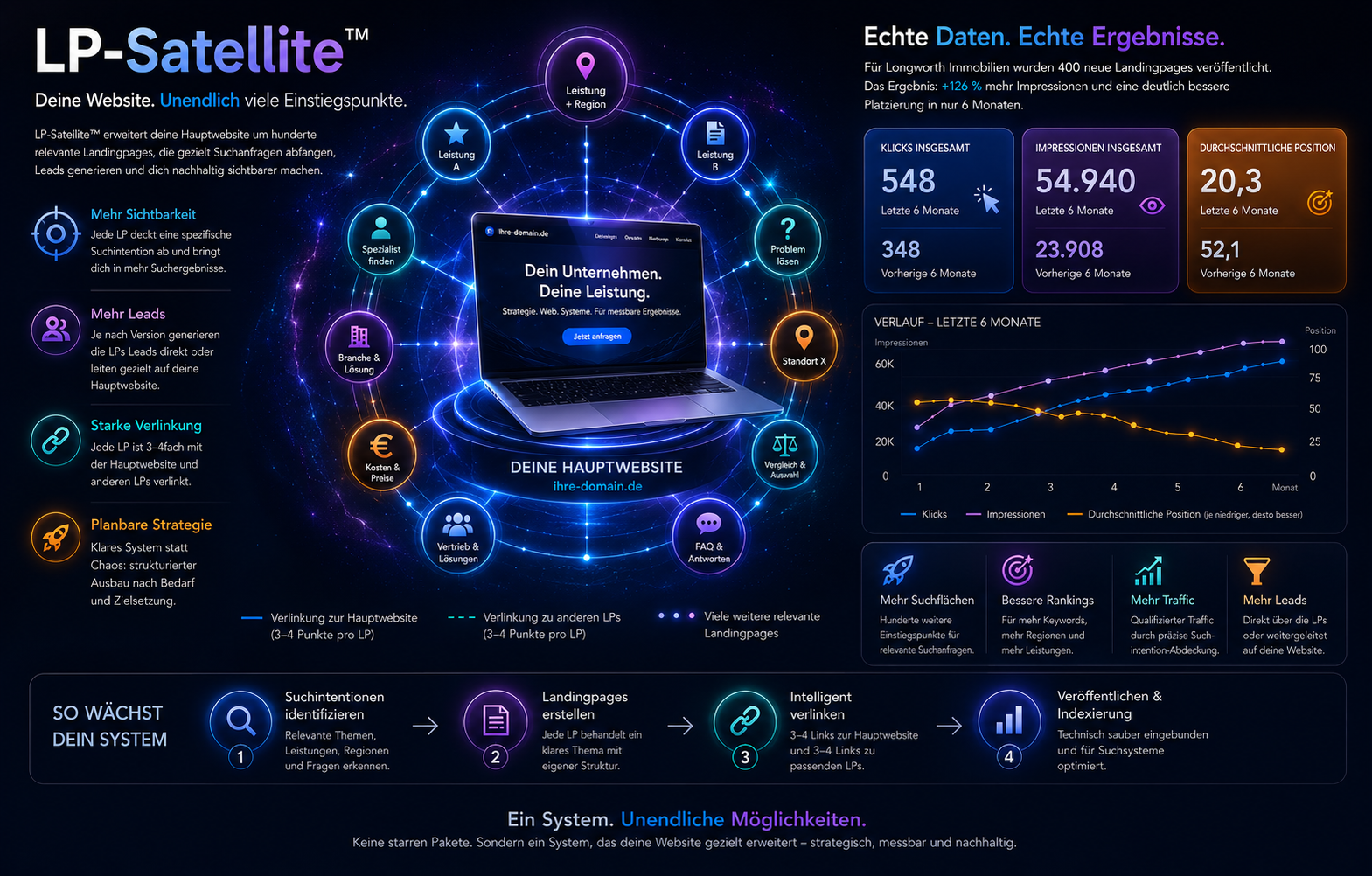
A global case study demonstrating controlled development
The global case study serves as proof of the methodology: clear structure, repeatable implementation, and measurable further development. For the situation described here, the parallel lies in the positioning, content, and user guidance logic, and not in a purported customer reference from Ulm.
Separate tasks create handoffs, a system creates responsibility
Typical project logic
-
Individual measures without a common goal.
-
Transitions between strategy, design and technology.
-
Launch without a plan for operation and further development.
VELUNO system logic
-
Connect positioning and messaging with information architecture.
-
Plan UX and conversion leadership and solid technical implementation together.
-
Consider operation and expansion from the outset.
How Web Design is Decided and Implemented in a Controlled Manner
From the specific problem, the path leads through its consequences to a clear target vision and a suitable system solution. Operationally, the approach remains pragmatic: first understand, then decide, then implement, and finally test in operation. Further details: Website Systems.
Analysis
The current state is reviewed from both a technical and functional perspective. User needs, system limitations, and the requirement for "positioning and messaging" are consolidated into a prioritized set of findings.
Architecture
The supporting structure is developed based on the findings. The requirements "Information Architecture" and "UX and Conversion Leadership" are anchored in the architecture. Responsibilities and quality criteria are defined before production begins.
Implementation
Production only begins once the scope is clearly defined. The areas of messaging, information architecture, UX, design system, frontend, and operations are integrated in such a way that transitions do not create new friction.
Operations
Operations encompass monitoring, maintenance, and documented further development. The requirement for "Performance and maintainability" prevents the system from remaining stagnant at its launch state.
No artificial size: The bottleneck determines the start
A focused sub-project can be useful if there is a clear bottleneck and a verifiable result. A complete build or rebuild is necessary if structure, technology, and operations are inextricably linked. An expandable system project is suitable if further markets, functions, or content are planned to follow.
Targeted entry
The audit, core site, technical bottleneck, or central user path are clearly delineated. The result must enable a reliable next decision.
Structural reorganization
When individual fixes are no longer sufficient, architecture, implementation, and migration are planned as a cohesive project.
Modular Expansion
Recurring requirements are extended via common rules and components without leveling the individual content.
Thinking Ahead: Visibility, Structure, and Platform Logic
Those who want to delve deeper into the decision-making logic behind the project will find three global VELUNO insights on search, website structure, and platform strategy. The content is not presented as local evidence.

SEO · GEO · AEO
Classifying Visibility in Classic and Generative Search
This article demonstrates how technical readability, topic structure, and clear answers work together.
Website Structure
Identifying Structural Errors Before They Hinder Development
This article identifies typical inconsistencies between content, user guidance, technology, and operations.
Platforms
From Individual Project to a Sustainable Platform Logic
This article explains when reusable components, workflows, and integrations become beneficial.
Official Regional Framework · GV-ISys
Ulm in the official municipal context
The Federal Statistical Office lists Ulm as a university city in Baden-Württemberg. This information places Ulm regionally for web design purposes. It does not substantiate a VELUNO location or a local customer relationship.
Population and area data are taken from the official municipal register. Neither demand nor project success can be derived from this information. We continue to evaluate projects in Ulm based on their objectives, existing infrastructure, system limitations, and necessary cooperation.
Federal state – Baden-Württemberg
District or Independent city – Ulm, Urban District
Administrative postal code – 89,073
Area – 118.68 km²
Population as of December 31, 2024 – 129,882
Population density – 1,094 people per km²
Travel region in the GV-ISys – Swabian Alb
Degree of urbanization – Densely populated
Official municipality code – 08421000
Official municipality name – Ulm, University City
What the regional data on Ulm classifies – and what it doesn't
The data clearly defines Ulm and avoids Confusion with places of the same or similar name is possible. This information does not replace an individual analysis by the requesting company.
Clear answers before the project decision
Short answers, clear boundaries, and no fabricated local claims. An inventory remains necessary for concrete planning.
Strategic Web design It begins with positioning, target groups, information architecture, and decision-making processes. Design translates this logic into visual form but does not replace it. A purely visual overhaul can therefore look good and still miss the actual problem. Prioritization is based on which message needs to be understood first and how users can reach the appropriate next step.
A clear goal, existing content, performance knowledge, target group information, and existing evidence are required. Missing foundational information can be systematically developed within the project. It is crucial that approvals and responsibilities are clarified early on.
The process leads from analysis and target vision through structure and design to technical implementation and quality assurance. Content, UX, and technology are not delivered separately. After launch, the ongoing operation and development are defined. The benchmark remains a clearly positioned, fast, and inquiry-oriented company website.
Yes. If the technical foundation is sound, positioning, core pages, or conversion paths can be improved first. A complete rebuild is only necessary if existing limitations permanently block the desired changes.
Yes. VELUNO works digitally and nationwide with companies at their respective locations. Coordination, reviews, and project management are conducted remotely; a local office or on-site presence is not claimed.
Inventory as a starting point for web design
The most sensible starting point is a clear decision about the problem, scope, and quality criteria. This requires an understanding of the existing foundation, the goal, and known risks. This allows for the objective preparation of the appropriate next step. For the initial review, the service structure, target groups, existing evidence, and the most important desired inquiry channels are particularly relevant.