
Website Relaunch Ulm: Clear Decisions and Clean Implementation.
Anyone searching for "website relaunch Ulm" needs clear decision criteria above all. VELUNO analyzes content, URLs, rankings, tracking, technology, and editorial processes, prioritizes effective interventions, and manages the implementation digitally. The benchmark is not mere activity, but this goal: a controlled relaunch with clearer positioning, controlled migration, and a better technical foundation. The project scope remains manageable only if mandatory requirements, later expansion phases, and deliberately excluded points are clearly separated.
It's not the most conspicuous individual measure that matters, but the combination of the relevant components. The expected benefit: Modernization without avoidable losses in visibility, data, or structure. The project will be managed digitally across regions and with complete transparency. Technical and editorial dependencies will be considered together, because improvements in one area could otherwise create new problems elsewhere.
Inventory and URL Inventory
The "Inventory and URL Inventory" module provides the foundation for transparent decisions about what should be retained, reorganized, merged, or deliberately removed.
Positioning and New Information Architecture
"Positioning and New Information Architecture" defines what needs to be clarified before implementation to ensure the project is not based on assumptions.
Migration and Redirect Concept
The "Migration and Redirect Concept" module provides the foundation for transparent decisions about what should be retained, reorganized, merged, or deliberately removed.
Target Vision & Architecture
Migration & Development
Launch & Stabilization
From Individual Problem to Robust Structure
VELUNO addresses website relaunch as a combination of relaunch and migration logic, implementation, and operation. The modules are planned in a sequence that reveals risks and prepares for future expansions. The relaunch is planned from URL and content inventory through migration to post-launch monitoring. The initial approach contrasts the quick fix with the actual system risk.
For companies with a website that has grown organically, is slow, or is strategically outdated. Collaboration takes place digitally, with clear documentation and without any claim to a local presence.
Individual measures do not solve the core problem.
The typical mistake begins with a quick fix for a complex system. A relaunch is treated as a new design, even though architecture, migration, and operation carry the greater risks. Those seeking support in Ulm therefore need criteria for cause, priority, and feasibility, not locally sounding generalities. Website relaunch Neu-Ulm serves as a separate, objectively relevant market page. Website Relaunch Neu-Ulm
Old content is adopted without review
The problem of "old content being adopted without review" rarely occurs in isolation. Decisions become slower, measurements lose their significance, and the desired effect—a controlled transition—fails to materialize.
-
Dependencies remain hidden
-
A standalone solution falls short
-
Expansion becomes riskier
URLs, rankings, and tracking are lost during the migration
The issue of "URLs, rankings, and tracking being lost during the migration" is usually caused by multiple dependencies. User guidance, editorial teams, and technical staff are then working on different symptoms of the same unresolved root cause.
-
Cause not clear
-
Priority remains unclear
-
Follow-up costs during operation
The new design sits on the same weak infrastructure
This issue initially appears to be operational but has structural consequences. Without a clear priority, the workload increases, while the desired effect—reduced migration risk—is not reliably achieved.
-
Symptom instead of cause
-
Handovers create friction
-
Impact remains uncertain
How a project becomes a viable system
VELUNO combines analysis, structure, implementation, and further development. The requirements for "inventory and URL inventory," "positioning and new information architecture," and "migration and redirect concept" are not tied to separate goals. Each component must contribute to the desired result: a controlled relaunch with clearer positioning, controlled migration, and a better technical foundation. The business context is further integrated. Website Systems Interfaces are planned with data responsibility, error handling, and operational consequences; Simply connecting two systems is not enough.
Analysis & Inventory
The "Analysis & Inventory" module transforms a general intention into a concrete deliverable. Scope, quality criteria, and follow-up questions become clear before implementation.
-
Inventory and URL Inventory
-
Documented decisions
-
Defined responsibilities
-
Positioning and New Information Architecture
Target Vision & Architecture
The "Target Vision & Architecture" module translates the project's rationale into verifiable decisions. It ensures a controlled migration and prepares the next stage without unnecessary handover losses.
-
Positioning and New Information Architecture
-
Clear delineation
-
Verifiable quality criteria
-
Migration and Redirect Concept
Migration & Development
In "Migration & Development," relevant assumptions are specified, dependencies are documented, and responsibilities are defined. This results in a consolidated platform instead of a mere to-do list.
-
Migration and Redirect Concept
-
Clear delineation
-
Verifiable quality criteria
-
Performance, Tracking, and Technical QA
Launch & Stabilization
"Launch & Stabilization" combines business requirements with technical or content-related implementation. Crucially, a stable launch must remain verifiable in subsequent operation.
-
Performance, Tracking, and Technical QA
-
Clear delineation
-
Verifiable quality criteria
-
Launch and Development Plan
The Right Approach to the Project
VELUNO separates short-term, impactful sub-projects from structural rebuilds. This prevents both artificially large projects and small-scale solutions that merely postpone the real problem.
Focused Entry Point
The initial phase addresses a prioritized user journey, technical bottleneck, or decision block. The scope and metrics are intentionally kept narrow.
Structural Rebuild
The rebuild reorganizes core dependencies and eliminates legacy issues that repeatedly block individual improvements.
Systematic Expansion
The expansion phase extends a stable system step by step. New modules are only added once their role and operational overhead have been determined.
Differentiating Starting Points Instead of Treating Projects the Same
Not every case requires the same solution. Therefore, the project logics differentiate between problem class, architectural decision, and the resulting benefit, without presenting them as actual projects from Ulm. A supplementary reference to the methodology is: B2B Website Rebuild.
B2B Relaunch
Transferable Case – No Local Reference
Project Logic
The Turning Point Lies in the "Analysis & Inventory" Module
The risk lay not in a single function, but in the problem of "Old content being adopted without review." The solution prioritized the "Analysis & Inventory" module, clarified responsibilities, and prepared the requirement for "Inventory and URL Inventory." The result can be summarized as follows: a binding target vision.
Analysis & Inventory
A controlled transition
Mid-Market Rebuild
Initial situation, decision, and impact – Target vision & architecture
Project Logic
The central decision behind “SME Rebuild”
The initial situation was defined by the problem of “URLs, rankings, and tracking being lost during the transition.”
Target Vision & Architecture
Clearer Side Paths
Multilingual Relaunch
Exemplary Project Scenario – Focus on Migration & Development
Project Logic
A Visible Bottleneck, a Crucial System Decision
Initially, the problem was that "the new design sits on the same weak structure." Further individual measures would only have masked the dependencies. Therefore, "Migration & Development" was established as a binding focus and secured with the requirement of "performance, tracking, and technical QA." The result can be summarized as follows: a consolidated platform.
Migration & Development
Reduced Migration Risk
Technical Consolidation with CMS Change
Decision Model · Restart without Information Loss
Project Logic
Don't Just Fix It, Address the Root Cause
The issue begins at a typical system boundary: "Old content is being imported without review."
Launch & Stabilization
A better foundation for operations
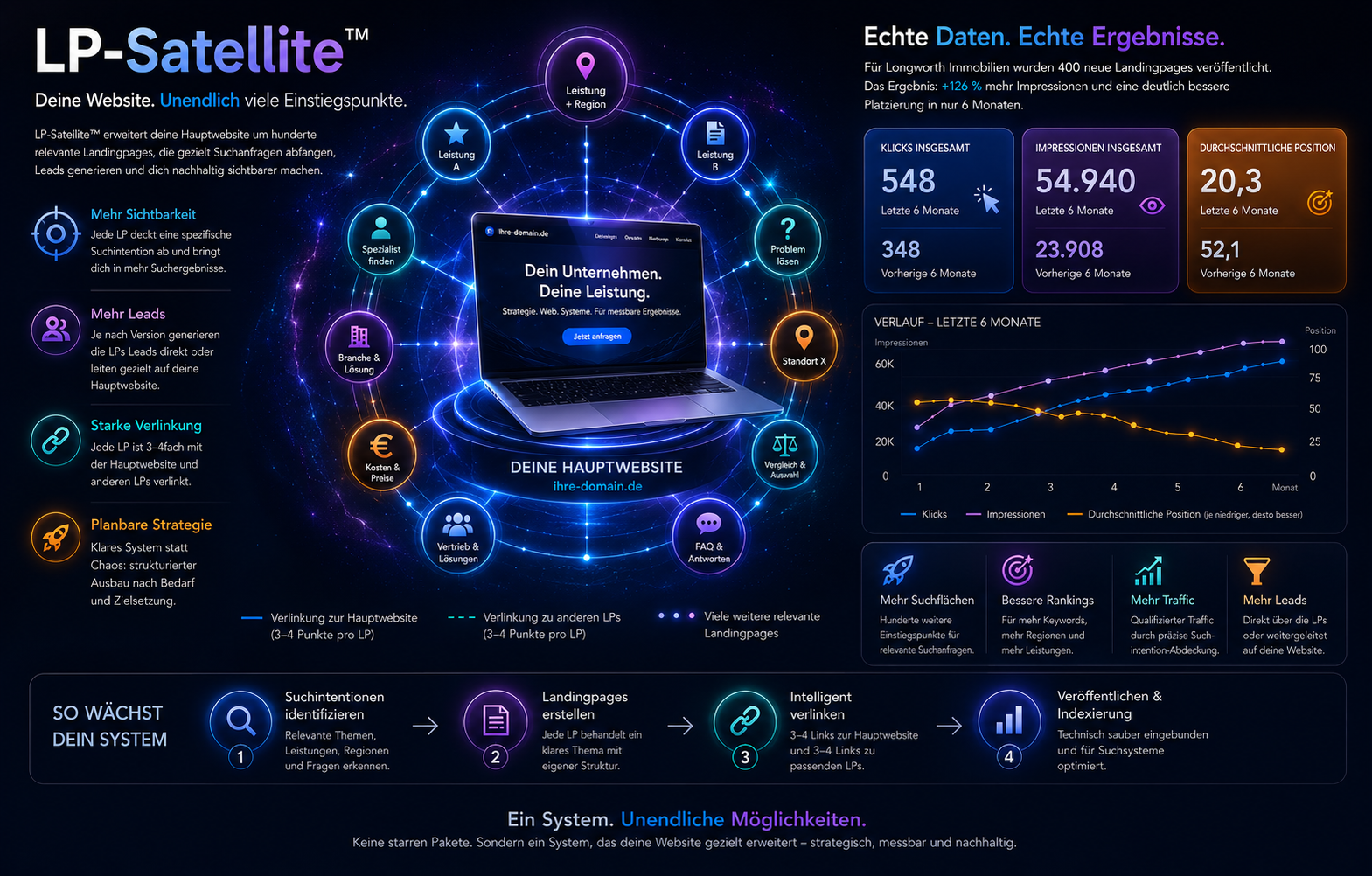
A global case study demonstrating controlled development
The existing LP-Satellite case study shows how a digital system can be gradually expanded and measured according to a clear architecture. For website relaunches, the transferable point is not the specific scope, but rather the combination of priority, clean implementation, and ongoing testing. The case study is not from Ulm and is not presented as a local reference.
Differentiation: visible activity or viable project logic
Typical project logic
-
Individual measures without a common goal.
-
Transitions between strategy, design and technology.
-
Launch without a plan for operation and further development.
VELUNO system logic
-
Combine inventory and URL analysis with positioning and a new information architecture.
-
Jointly plan migration and redirect concepts, performance, tracking, and technical QA.
-
Consider operation and expansion from the outset.
How to make controlled decisions and implement website relaunches.
First, the obvious misconception is examined, then the resulting risk is assessed and replaced with a more robust logic. Each step resolves a specific uncertainty before the next one begins. Where data is lacking, observability is improved before far-reaching conclusions or investments are decided upon.
Analysis
We capture the initial situation, objectives, risks, and available data. The requirement "Inventory and URL Inventory" is explicitly reviewed. Open assumptions are recorded as decision questions.
Architecture
The architecture defines roles, components, data paths, and handoffs. It combines the requirements "Positioning and New Information Architecture" and "Migration and Redirect Concept" in a common model.
Implementation
Content, UX, and technology are implemented in a controlled manner and tested together. The requirement "PerformanceTracking and Technical QA" is secured through concrete review and approval steps.
Operations
Operation includes monitoring, maintenance, and documented further development. The requirement "Launch and Further Development Plan" prevents the system from remaining at its launch state.
Choose a scope that balances risk and benefit
A focused sub-project can be useful if there is a clear bottleneck and a verifiable result. A complete build or rebuild is necessary if structure, technology, and operation are inextricably linked. An expandable system project is suitable if further markets, functions, or content are planned to follow. The first release does not need to include every conceivable function, but it must reliably solve the core task and create a robust learning base.
Clearly Defined Start
The scope remains narrow but expandable.
Complete Rebuild
An outdated foundation is replaced in a controlled manner if it prevents the desired changes due to technical or structural limitations.
Systematic Growth
Following a stable foundation, further modules are added in prioritized development phases and with controlled operation.
Relevant Insights for Architecture and Development
The linked articles delve deeper into questions that frequently arise at the intersection of content, technology, and further development during website relaunches. They remain global content and are referenced here only.

SEO · GEO · AEO
Classifying Visibility in Classic and Generative Search
This article demonstrates how technical readability, topic structure, and clear answers work together.
Identifying Structural Errors Before They Hinder Development
This article identifies typical inconsistencies between content, user guidance, technology, and operations.
Platforms
From Individual Project to a Sustainable Platform Logic
This article explains when reusable components, workflows, and integrations become beneficial.
Official Regional Framework · GV-ISys
Ulm in the official municipal context
The population and area data are taken from the official municipal register.
Population and area data are taken from the official municipal register. Neither demand nor project success can be derived from this information. We continue to evaluate projects in Ulm based on their objectives, existing infrastructure, system limitations, and necessary cooperation.
Population density – 1,094 people per km²
Travel region in the GV-ISys – Swabian Alb
Degree of urbanization – Densely populated
Official municipality code – 08421000
Official municipality name – Ulm, University City
Federal state – Baden-Württemberg
District or Independent city – Ulm, Urban District
Administrative postal code – 89,073
Area – 118.68 km²
Population as of December 31, 2024 – 129,882
What the regional data on Ulm classifies – and what it doesn't
The data clearly defines Ulm and avoids Confusion with places of the same or similar name is possible. This information does not replace an individual analysis by the requesting company.
Clear answers before the project decision
This section addresses the points that can be reliably clarified before a request. Where the initial situation is decisive, the answer deliberately refrains from a general commitment.
A relaunch is advisable when the structure, positioning, technology, or maintenance no longer align with current business objectives. An outdated design alone is not sufficient grounds. The benefit arises when the change eliminates specific bottlenecks and does not merely replace the interface. The benchmark remains a controlled relaunch with clearer positioning, controlled migration, and a better technical foundation.
Rankings are protected through a complete URL inventory, clear content decisions, redirects, and technical testing. After the launch, crawling, indexing, and relevant pages must continue to be monitored. There are no guarantees, but avoidable migration errors can be systematically reduced.
No. Existing content is evaluated based on search value, business relevance, timeliness, and user needs. Valuable content can be retained or improved, while duplicate or outdated content can be merged or removed. The objection, "We'll just transfer the existing content into a new design," is explicitly addressed.
The duration depends on the scope, amount of content, integrations, approvals, and migration risk. Therefore, a robust phase plan is created first. Fixed timeframes without an initial assessment would be unethical.
Yes. Analysis, architecture, coordination, development, testing, and launch management can all be organized digitally. Collaboration takes place across regions with clear responsibilities and documented decisions, without maintaining a local office.
Initial Assessment as the Starting Point for a Website Relaunch
The most sensible starting point is a clear decision regarding the problem, scope, and quality criteria. This requires understanding the existing infrastructure, the objective, and any known risks. This allows for the objective preparation of the appropriate next step. For the initial review, you should have access to the URL inventory, key content, tracking access points, and known dependencies of the existing system.