
Website Performance Optimization Ulm: System logic instead of digital scenery.
Loading times, mobile usability, or technical stability negatively impact visibility, conversion, or maintainability. VELUNO therefore examines loading paths, rendering, assets, server responses, and third-party scripts, deriving a prioritized approach from its findings. Website performance in Ulm is thus not planned as a standalone measure, but as a controlled path to the following result: a measurably faster, more stable, and technically verifiable website.
The assumption "A cache plugin should solve the problem" only saves effort if the existing structure is already robust. The expected benefits: improved user experience, reduced technical risk, and a more sustainable foundation for SEO and conversion. VELUNO collaborates digitally with the company's technical and business professionals to achieve this.
Measurement of real user and lab data
The point "Measuring real user and lab data" translates the project's rationale into concrete criteria, responsibilities, and next steps.
Frontend and Asset Analysis
The "Frontend and Asset Analysis" step translates the project's rationale into concrete criteria, responsibilities, and next steps.
Hosting, Caching, and Delivery
"Hosting, Caching, and Delivery" validates assumptions and creates the conditions for less technical waste.
Frontend & Assets
Hosting & Delivery
Monitoring & Operations
Optimize in isolation, manage interrelationships
A viable outcome is achieved when the requirements "Measurement of real user and lab data," "Frontend and Asset Analysis," and "Hosting, Caching, and Delivery" are not commissioned separately. The system logic first determines the priorities and then the specific scope of production. The focus is on a robust measurement base, a prioritized list of root causes, and a re-evaluation after implementation. Therefore, the initial step examines the most obvious shortcut and identifies which root causes it leaves untouched.
Relevant for companies with slow websites, weak Core Web Vitals, or unstable technical setups. Technical coordination, implementation, and quality assurance are organized digitally.
Where website performance is structurally out of sync
The typical mistake begins with a quick fix for a complex system. Performance is addressed with individual plugins or compression, even though architecture, assets, hosting, and the frontend all interact. Those seeking support in Ulm need criteria for cause, priority, and feasibility, not just vague, locally sounding generalities. For the neighboring market, the site refers to Website Performance Neu-Ulm.
Large assets and unnecessary frontend code slow down pages
Behind "Large assets and unnecessary frontend code slowing down pages" there are usually several dependencies. User guidance, editorial, and technical teams then work on different symptoms of the same unresolved issue. ...
-
Responsibility is shifted
-
Quality is difficult to verify
-
Errors recur
Hosting and caching are not aligned with the system
This point initially has an operational effect, but has structural consequences. Without a clear priority, the effort increases, while the desired effect – more stable interactions – is not reliably achieved.
-
Decisions without a baseline
-
Technology and content drift apart
-
Operations only react
Individual optimizations postpone problems instead of solving them
This situation shifts responsibility between content, UX, and technology. The system remains difficult to control, even though individual measures show short-term activity.
-
User journey is slowed down
-
Measurement loses its significance
-
Maintenance becomes more complex
What needs to come together for a viable solution
VELUNO combines analysis, structure, implementation, and further development. The requirements of "measuring real user and lab data," "frontend and asset analysis," and "hosting, caching, and delivery" are not treated as separate objectives. Each component must contribute to the desired outcome: a measurably faster, more stable, and technically verifiable website. The functional relationships are defined in: Platforms & Infrastructure ```
Measurement & Diagnostics
The "Frontend & Assets" component specifies relevant assumptions, documents dependencies, and defines responsibilities. This leads to a leaner delivery process instead of a mere to-do list.
-
Measurement of real user and lab data
-
Making Assumptions Visible
-
Considering Operations Early on
-
Frontend and Asset Analysis
Frontend & Assets
The "Frontend & Assets" component specifies relevant assumptions, documents dependencies, and defines responsibilities.
-
Frontend and Asset Analysis
-
Risks before implementation
-
Clean Handovers
-
Hosting, Caching, and Delivery
Hosting & Delivery
"Hosting & Delivery" combines business requirements with technical or content-related implementation. Crucially, this ensures a more stable technical basis system that remains traceable during subsequent operation.
-
Hosting, Caching, and Delivery
-
Clear delineation
-
Verifiable quality criteria
-
Code and Component Optimization
Monitoring & Operations
The "Monitoring & Operation" module defines which tasks actually contribute to the desired outcome. Unclear additional requests are reviewed against the objective, risk, and development path.
-
Code and Component Optimization
-
Risks before implementation
-
Clean Handovers
-
Post-Implementation Monitoring
This ensures the scope remains manageable and adaptable.
VELUNO separates short-term, impactful sub-projects from structural rebuilds. This prevents both artificially large projects and small-scale solutions that merely postpone the real problem.
Focused Entry Point
A sub-project provides clarity before committing larger investments. However, it must fit into a comprehensible target vision.
Structural Rebuild
When structure, technology, and operations are all simultaneously causing bottlenecks, a comprehensive reorganization is more economical than ongoing repairs.
Systematic Expansion
For recurring needs, components and processes are prepared in such a way that future expansions remain consistent.
How four bottlenecks become four robust solutions.
The case studies serve as conceptual models for decision-making. They categorize typical starting points and demonstrate the impact of clear prioritization.
Core Web Vitals Remediation
Decision Model · Measurably Eliminating Technical Obstacles
Project Logic
Don't Just Fix It, Address the Root Cause
The starting point was defined by the problem "Large assets and unnecessary frontend code slow down pages." Instead of addressing the requirement "Measuring real user and lab data" in isolation, it was combined with the "Measurement & Diagnostics" component. This resulted in the following outcome: a transparent priority list.
Measurement & Diagnostics
Shorter Loading Paths
PerformanceRebuild
Transferable Case – No Local Reference
Project Logic
From the Problem "Hosting and Caching Are Not Optimized for the System" to a Clear Result
Initially, the problem was "Hosting and caching are not optimized for the system." Further individual measures would only have masked the dependencies. Therefore, "Frontend & Assets" was established as a mandatory focus and secured with the requirement of "Hosting, Caching, and Delivery." The result can be summarized as follows: leaner delivery.
Frontend & Assets
More stable interactions
CMS and Asset Consolidation
Initial situation, decision, and impact · Hosting & Delivery
Project Logic
The turning point lies in the "Hosting & Delivery" component
The case begins at a typical system boundary: "Individual optimizations postpone problems instead of solving them."
Hosting & Delivery
Reduced technical waste
Technical Foundation for SEO Growth
Exemplary project scenario – Focus on monitoring & operation
Project Logic
The key decision behind “Technical foundation for SEO growth”
The initial situation allowed for several quick fixes, but none of them would have addressed the root cause. Therefore, the "Monitoring & Operation" component became the primary focus, while "Post-Implementation Monitoring" served as a quality criterion. The resulting effect can be summarized as: controllable monitoring.
Monitoring & Operations
A reliable measurement base
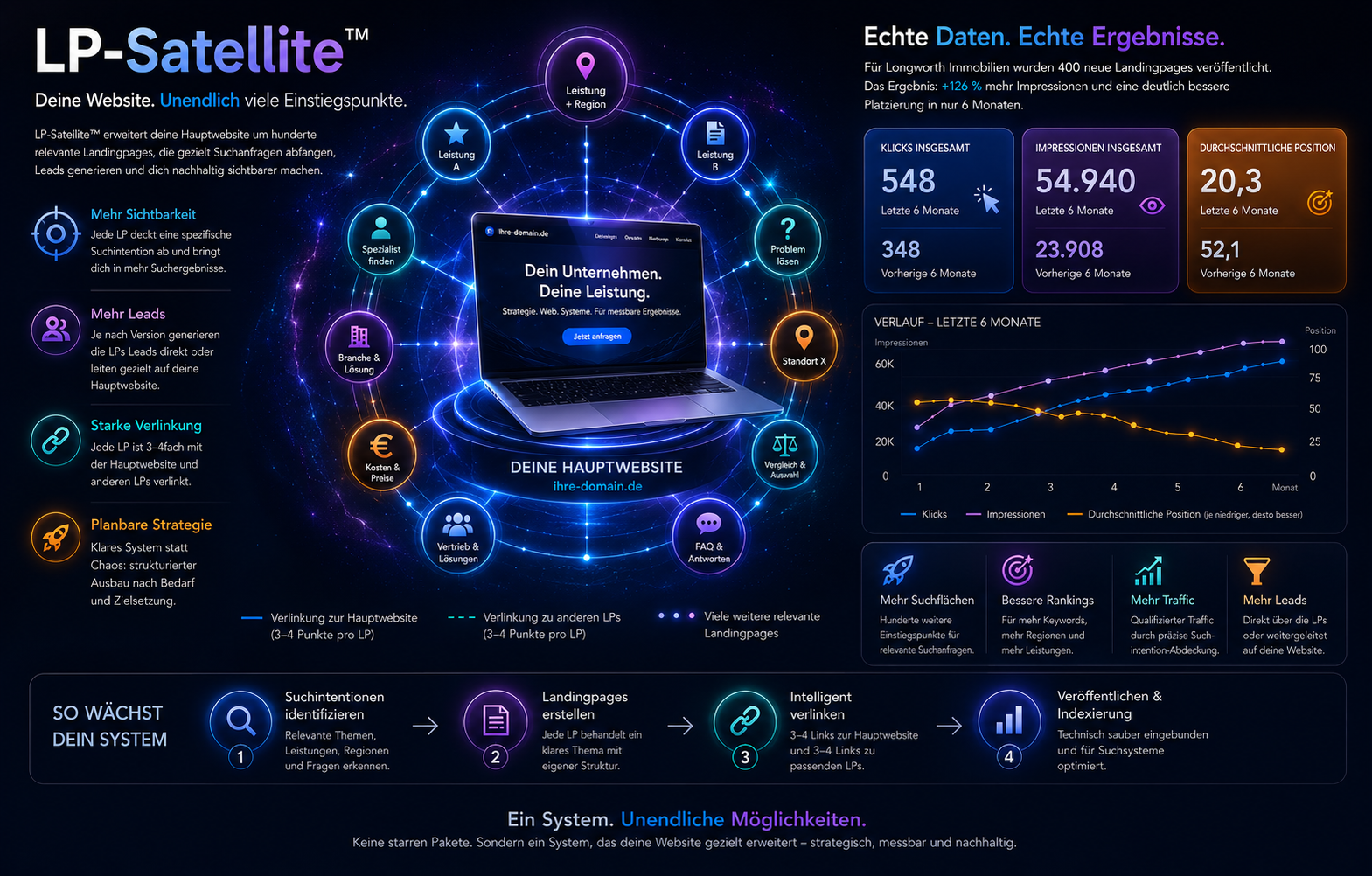
Systematic expansion requires a robust underlying logic
As a global project example, the LP-Satellite case demonstrates controlled expansion instead of unconnected individual measures. Applied to website performance, this means: first clarify system boundaries, then implement them consistently, and verify their effectiveness during operation. No local connection to the target location is derived from this.
System responsibility counts more than selling services
Typical project logic
-
Individual measures without a common goal.
-
Transitions between strategy, design and technology.
-
Launch without a plan for operation and further development.
VELUNO system logic
-
Combine the measurement of real user and lab data with frontend and asset analysis.
-
Plan hosting, caching, delivery, and code and component optimization together.
-
Consider operation and expansion from the outset.
How to Control and Implement Website Performance
This process prevents production from starting before the necessary clarity is achieved. Business objectives, system boundaries, quality criteria, and further development are linked in a comprehensible sequence. The process begins with the initial situation, clarifies the decision criteria, leads to implementation, and ends with verifiable results. Further information: Website Systems.
Analysis
Analysis means considering load paths, rendering, assets, server responses, and third-party scripts holistically. The result is a clear sequence of the most important decisions.
Architecture
The supporting structure is derived from the findings. The requirements for "frontend and asset analysis" and "hosting, caching, and delivery" are anchored in the architecture. Responsibilities and quality criteria are defined before production begins.
Implementation
Content, UX, and technology are implemented in a controlled manner and tested together. The requirement for "code and component optimization" is ensured through concrete testing and approval steps.
Operations
Finally, responsibilities, measurement, and the development path are defined. The desired effect thus becomes a permanent feature: a reliable measurement base.
From a focused sub-project to an expandable system
VELUNO distinguishes between a clearly defined start, a structural reorganization, and a modular system expansion. This ensures that the initial investment remains economically viable without limiting future expansion options.
Clearly Defined Start
The scope remains narrow but expandable.
Complete Rebuild
An outdated foundation is replaced in a controlled manner if it prevents the desired changes due to technical or structural limitations.
Systematic Growth
Following a stable foundation, further modules are added in prioritized development phases and with controlled operation.
Three Perspectives on the Systemic Issues Behind the Project
Those wishing to delve deeper into the decision-making logic behind the project will find three global VELUNO insights on search, Website Structure and platform strategy. The content is not presented as local evidence.

SEO · GEO · AEO
Classifying Visibility in Classic and Generative Search
This article demonstrates how technical readability, topic structure, and clear answers work together.
Website Structure
Identifying Structural Errors Before They Hinder Development
This article identifies typical inconsistencies between content, user guidance, technology, and operations.
Platforms
From Individual Project to a Sustainable Platform Logic
This article explains when reusable components, workflows, and integrations become beneficial.
Official Regional Framework · GV-ISys
Ulm in the official municipal context
The Federal Statistical Office lists Ulm, a university city in Baden-Württemberg. The data places Ulm regionally for website performance. It does not substantiate either a VELUNO location or a local customer relationship.
Population and area data are taken from the official municipal register. Neither demand nor project success can be derived from this information. We continue to evaluate projects in Ulm based on their objectives, existing infrastructure, system limitations, and necessary cooperation.
Population density – 1,094 people per km²
Travel region in the GV-ISys – Swabian Alb
Degree of urbanization – Densely populated
Official municipality code – 08421000
Official municipality name – Ulm, University City
Federal state – Baden-Württemberg
District or Independent city – Ulm, Urban District
Administrative postal code – 89,073
Area – 118.68 km²
Population as of December 31, 2024 – 129,882
What the regional data on Ulm classifies – and what it doesn't
The data clearly defines Ulm and avoids Confusion with places of the same or similar name is possible. This information does not replace an individual analysis by the requesting company.
Frequently Asked Questions about Website Performance in Ulm
The FAQs connect the specific reason for the search with the VELUNO service model and transparent, digitally managed collaboration.
Individual files alone are rarely decisive. Frontend code, images, fonts, server responses, caching, and third-party scripts must be measured together. Prioritization is based on real user data and reproducible lab tests, not on a blanket plugin recommendation. This starting point is taken into account for the specific situation in Ulm: loading times, mobile usability, or technical stability negatively impact visibility, conversion, or maintainability.
Largest Contentful Paint, Interaction to Next Paint, and Cumulative Layout Shift are particularly relevant. They reflect loading experience, responsiveness, and visual stability. Field data and lab measurements are considered separately to ensure informed decisions.
Yes, an existing website can often be improved in a targeted manner. First, it is checked whether the architecture, CMS, and hosting allow for the necessary modifications. A rebuild is only worthwhile if the existing limitations permanently prevent proper optimization. For the specific project in Ulm, this starting point is taken into account: Loading times, mobile usability, or technical stability are impacting visibility, conversion, or maintainability.
Before implementation, a baseline is defined. Then, technical measurements, real-world field data, and relevant user journeys are re-examined and monitored during operation. This ensures that which changes are actually effective and where further work is needed.
Yes. For the technical analysis, access, measurement data, and a clear exchange regarding the goal and priorities are usually sufficient. Collaboration takes place digitally and across regions; a branch office or on-site presence is not required.
Clarify the initial situation, goal, and boundaries before starting.
To get started, the current bottleneck, the affected users or processes, and the desired result are relevant. VELUNO categorizes this information and derives a realistic testing or project step from it. Coordination and implementation are organized digitally. Existing measurement data, known load peaks, and the technically conspicuous pages or components are particularly helpful for the initial test.