
Website Systems Würzburg: Structure for Multiple Markets and Services.
The website is growing, but the navigation, content model, and technical foundation aren't scaling with it. VELUNO therefore analyzes markets, services, target groups, URL structure, components, content, roles, and technical extensions, and derives a prioritized approach from this analysis. Website Systems in Würzburg are thus not planned as a one-off measure, but as a controlled path to the following result: A modular website system with a clear information architecture and reusable content modules.
The objection, "A CMS with templates is already a website system." This approach falls short because it confuses cause and symptom. The expected benefits: faster expansion, consistent quality, and fewer structural legacies. Coordination, reviews, and handovers are conducted digitally and across regions. Existing systems are not automatically replaced; first, it is assessed which components are viable and where a controlled replacement is necessary.
Information and URL architecture
"Information and URL Architecture" combines the business priority with a verifiable technical or content-related decision.
Modular Components
"Modular Components" define what needs to be clarified before implementation so that the project is not based on assumptions.
Content Model and Governance
The "Content Model and Governance" component creates the basis for a transparent decision about which patterns must be reusable and where genuine content differentiation is required.
Components & Templates
Content and Data Model
Operation & Growth Expansion
Website Systems as a system decision
Website Systems don't function as isolated interfaces. The crucial factor is the interplay between "information and URL architecture," "modular components," "content model and governance," and "performance and technical extensibility." Only then can a solution be created whose operational decisions remain transparent. URL architecture, components, and content model are designed so that additional markets and services can be added without structural duplication of effort. Therefore, the initial approach first examines the obvious shortcut and identifies the underlying cause it leaves untouched. For the Würzburg area and neighboring markets such as Kitzingen and Wertheim the geographical classification remains objective; the service is provided supra-regionally.
For companies with this starting point: The website is growing, but navigation, content model, and technical foundation are not scaling accordingly. VELUNO operates transparently, supra-regionally, and digitally.
Why the visible error in Website Systems is rarely the actual cause
The typical mistake begins with a quick fix for a complex system. Individual pages are added without creating a consistent, maintainable system. Those seeking support in Würzburg therefore need criteria for cause, priority, and feasibility, not just vague, locally sounding generalities. Website Systems Kitzingen serves as a separate, objective market resource. A viable solution combines information, component, and content architecture with an implementation that remains documented, testable, and operational in everyday use.
New pages create inconsistency instead of reach
The problem "New pages create inconsistency instead of reach" rarely exists in isolation. Decisions become slower, metrics lose their significance, and the desired effect—faster expansion—fails to materialize.
-
User journey is slowed down
-
Measurement loses its significance
-
Maintenance becomes more complex
Content is duplicated and difficult to maintain
Behind the issue of "content being duplicated and difficult to maintain" lie multiple dependencies. User guidance, editorial staff, and technical teams are then working on different symptoms of the same unresolved root cause.
-
Decisions without a baseline
-
Technology and content drift apart
-
Operations only react
Technical upgrades become more expensive with each step
This point initially appears to be an operational issue, but it has structural consequences. Without a clear priority, the workload increases, while the desired effect—less duplicate maintenance—is not reliably achieved.
-
Symptom instead of cause
-
Handovers create friction
-
Impact remains uncertain
A clear delivery logic instead of distributed individual tasks
The four building blocks interlock within a common decision-making logic. The requirements for "information and URL architecture" and "modular components" are clarified before production. Implementation and operation are planned in such a way that faster expansion and consistent quality are not only visible at launch. The business context is further categorized in Website Systems A comprehensible inquiry identifies the initial situation, affected users, existing systems, desired effect, and known dependencies.
Information Architecture
The "Information Architecture" module translates the project's rationale into verifiable decisions. It establishes a clear URL logic and prepares the next stage without unnecessary handover losses.
-
Information and URL architecture
-
Risks before implementation
-
Clean Handovers
-
Modular Components
Components & Templates
In "Components & Templates," relevant assumptions are specified, dependencies are documented, and responsibilities are defined. This results in reusable components instead of a mere to-do list.
-
Modular Components
-
Prioritizing by Impact
-
Testing and Approvals
-
Content Model and Governance
Content and Data Model
"Content and Data Model" connects business requirements with the technical or content-related implementation. Crucially, a manageable content model must remain transparent and traceable during later operations.
-
Content Model and Governance
-
Prioritizing by Impact
-
Testing and Approvals
-
Performance and Technical Extensibility
Operation & Growth Expansion
The "Operations & Growth Expansion" module defines which tasks actually contribute to the desired outcome. Unclear additional requests are evaluated against the objectives, risks, and expansion path.
-
Performance and Technical Extensibility
-
Documented decisions
-
Defined responsibilities
-
Measurement and Ongoing Development
This ensures the scope remains manageable and adaptable.
VELUNO separates short-term, impactful sub-projects from structural rebuilds. This prevents both artificially large projects and small-scale solutions that merely postpone the real problem.
Focused Entry Point
A sub-project provides clarity before committing larger investments. However, it must fit into a comprehensible target vision.
Structural Rebuild
When structure, technology, and operations are all simultaneously causing bottlenecks, a comprehensive reorganization is more economical than ongoing repairs.
Systematic Expansion
For recurring needs, components and processes are prepared in such a way that future expansions remain consistent.
How four bottlenecks become four robust solutions.
Project examples are only helpful if they illustrate the crucial change. Therefore, the four cases do not describe fabricated references, but rather transferable solutions.
Multi-Market Website
Transferable Case – No Local Reference
Project Logic
From the problem "New pages create inconsistency instead of reach" to a clear result
The case begins at a typical system boundary: "New pages create inconsistency instead of reach." The key decision was to reorganize the "information architecture" component and the "information and URL architecture" requirement together. This kept the scope manageable. The result can be summarized as follows: a clear URL logic.
Information Architecture
Faster Expansion
Performance and Industry Hub
Initial Situation, Decision, and Impact – Components & Templates
Project Logic
The Turning Point Lies in the “Components & Templates” Module
The initial situation allowed for several quick fixes, but none of them would have addressed the root cause. Therefore, the “Components & Templates” module became the primary decision, while “Content Model and Governance” served as a quality criterion. The resulting effect can be summarized as follows: reusable components.
Components & Templates
Consistent Quality
LP-Satellite Expansion
Exemplary Project Scenario – Focus on Content and Data Model
Project Logic
The Central Decision Behind “LP-Satellite Expansion”
The risk lay not in a single function, but in the problem that “Technical expansions become more expensive with each step.” The solution prioritized the “Content and Data Model” component, clarified responsibilities, and prepared the requirements for “Content Model and Governance.” The result can be summarized as follows: a manageable content model.
Content and Data Model
Reduced Duplication of Maintenance
Website with PortalPortal or tool integration
Decision Model – Structure for Multiple Markets and Services
Project Logic
A Visible Bottleneck, a Crucial System Decision
The initial situation was defined by the problem that “New pages create inconsistency instead of reach.” Instead of addressing the requirement of "performance and technical extensibility" in isolation, it was integrated with the "Operations & Growth Expansion" component. This resulted in controlled growth expansion.
Operation & Growth Expansion
A scalable website foundation
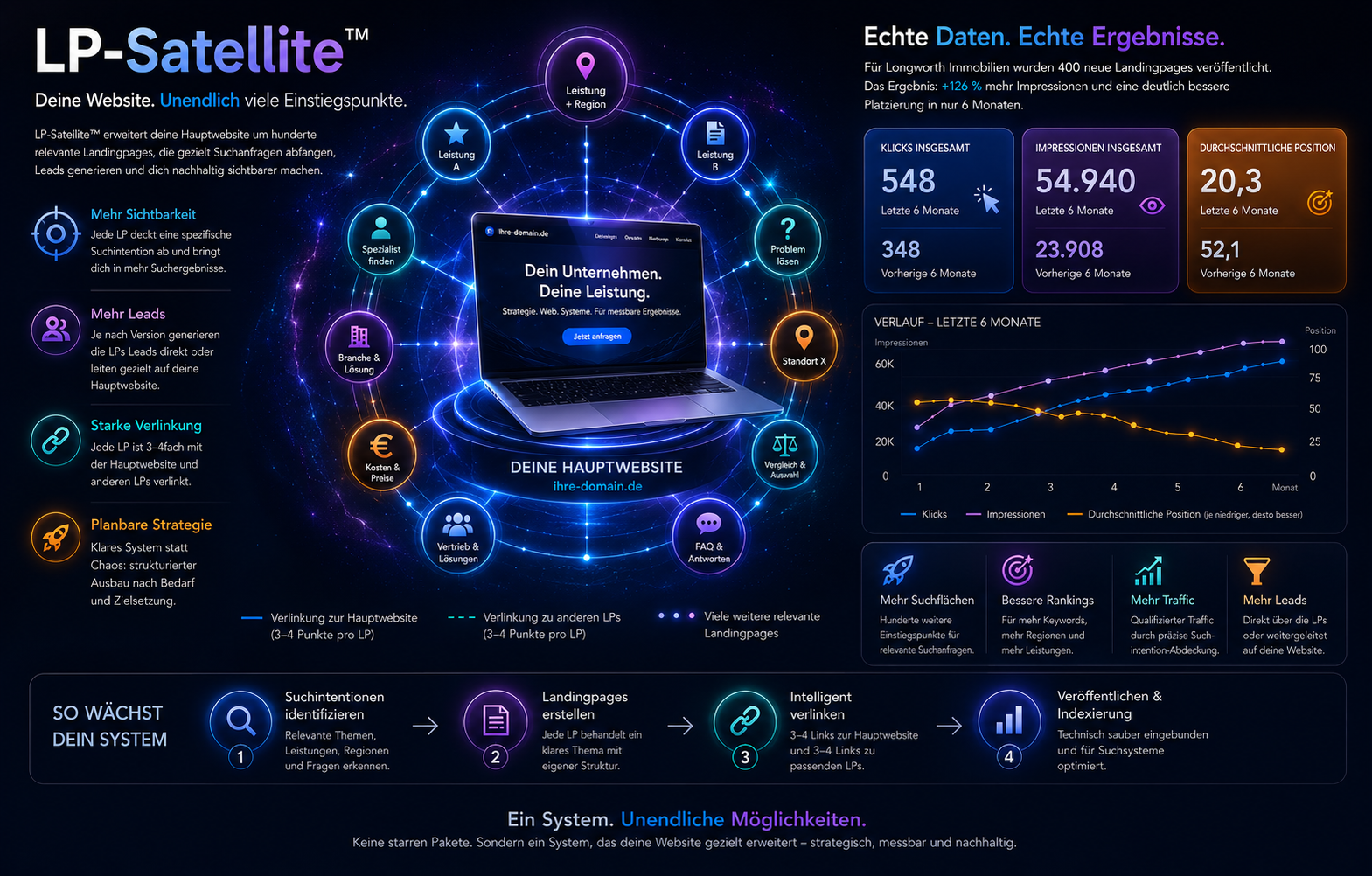
Transferable Proof without Local Reference Claim
The existing LP-Satellite case demonstrates how a digital system can be expanded and measured step by step according to a clear architecture. For Website Systems, the transferable point is not the specific scope, but rather the combination of priority, clean implementation, and ongoing testing. This case is not from Würzburg and is not presented as a local reference.
System responsibility counts more than selling services
Typical project logic
-
Individual measures without a common goal.
-
Transitions between strategy, design and technology.
-
Launch without a plan for operation and further development.
VELUNO system logic
-
Connecting information and URL architecture with modular components.
-
Planning the content model, governance, performance, and technical extensibility together.
-
Consider operation and expansion from the outset.
Structure for Multiple Markets and Services: Four Steps with Clear Responsibility
First, the obvious misconception is examined, then the resulting risk is assessed and replaced with a more robust logic. Each step resolves a specific uncertainty before the next one begins. Collaboration can be conducted entirely digitally if access, contact persons, and decision-making processes are clearly defined.
Analysis
The current state is reviewed from both a functional and technical perspective. User needs, system boundaries, and the requirements for information and URL architecture are consolidated into a prioritized set of findings.
Architecture
Here, decisions are made regarding the necessary structure of the information, component, and content architecture. Dependencies are identified before they become costly in terms of code, content, or design.
Implementation
Content, UX, and technology are implemented in a controlled manner and tested together. The requirement "Performance "and technical extensibility" is ensured through concrete testing and approval steps.
Operations
Finally, responsibilities, measurement, and the development path are defined. The desired effect thus becomes a permanent feature: a scalable website foundation.
Project size is determined by decision-making needs, not by sales logic.
VELUNO distinguishes between a clearly defined start, a structural reorganization, and a modular system expansion. This ensures that the initial investment remains economically viable without limiting future expansion options.
Clearly Defined Start
The scope remains narrow but expandable.
Complete Rebuild
An outdated foundation is replaced in a controlled manner if it prevents the desired changes due to technical or structural limitations.
Systematic Growth
Following a stable foundation, further modules are added in prioritized development phases and with controlled operation.
Thinking Ahead: Visibility, Structure, and Platform Logic
The following references supplement the project context with overarching perspectives. They do not replace an analysis of the specific initial situation, but they do illustrate relevant systemic relationships.

SEO · GEO · AEO
Classifying Visibility in Classic and Generative Search
This article demonstrates how technical readability, topic structure, and clear answers work together.
Website Structure
Identifying Structural Errors Before They Hinder Development
This article identifies typical inconsistencies between content, user guidance, technology, and operations.
Platforms
From Individual Project to a Sustainable Platform Logic
This article explains when reusable components, workflows, and integrations become beneficial.
Official Regional Framework · GV-ISys
Würzburg in the Official Municipal Context
The Federal Statistical Office lists Würzburg in Bavaria. This information places Würzburg regionally for Website Systems. It does not substantiate a VELUNO location or a local customer relationship.
Population and area data are taken from the official municipal register. Neither demand nor project success can be derived from this. We continue to evaluate projects in Würzburg based on their objectives, existing infrastructure, system limitations, and necessary collaboration.
District or Independent city – Würzburg
Administrative postal code – 97070
Area – 87.6 km²
Population as of December 31, 2024 – 133,258
Population density – 1,521 people per km²
Travel region in the GV-ISys – Franconian Wine Country
Degree of urbanization – Densely populated
Official municipality code – 09663000
Official municipality name – Würzburg
Federal state – Bavaria
What the regional data on Würzburg classifies – and what it doesn't
– Würzburg
Clear answers before the project decision
The answers objectively address typical decision-making questions. Scope, costs, or duration are not promised without a data basis.
A website system combines URL architecture, reusable components, content model, roles, and technical operational logic. It is more than just a set of visual templates. The goal is controlled expansion without increasing inconsistency. The benchmark remains a modular website system with a clear information architecture and reusable components. Content modules.
A classic website is no longer sufficient when many markets, services, target groups, or recurring page types need to be maintained. Duplication of effort and structural errors then outweigh the benefits. A system establishes common rules.
Templates define structure and components, while content remains differentiated according to search intent and user needs. Required fields, variants, and governance prevent empty copies. Reuse concerns the mechanics, not interchangeable text. Prioritization depends on which templates must be reusable and where genuine content differentiation is required.
Yes, if the CMS allows for structured content, clean templates, and the necessary technical extensions. The data model, plugins, performance, and editorial workflows are examined beforehand. Switching is not an end in itself.
The system can use one location as a starting point and later add other regions using the same architecture. Each page still requires its own unique search intent and individual content. Collaboration is digital and cross-regional.
Turning a bottleneck into a clear project mandate
A qualified inquiry should specify the current situation, existing systems, desired impact, and relevant deadlines. This allows for the derivation of a verifiable next step without predetermining price, duration, or success. The location remains transparent and without claiming a local branch. Existing page types, target groups, URL patterns, editorial roles, and planned expansion phases are helpful for the initial review.