
Web Development Würzburg: System Logic Instead of Digital Background.
The crucial question is which functions need to be developed individually and which standards can be consciously used. To address this, requirements, system boundaries, data models, roles, interfaces, and operational requirements are evaluated in a joint inventory. The results will lead to a digitally managed project for companies in Würzburg with a clear objective: a maintainable, high-performance, and scalable web solution with a clear architecture. A complete rebuild is only justified if several structural issues need to be addressed in conjunction with one another.
The most conspicuous individual measure is not the deciding factor, but rather the combination of the relevant components. The expected benefits: fewer technical dead ends and a solution that can be further developed in a controlled manner. The project will be managed digitally across regions and with transparency. A clear migration or handover plan protects functioning content, data, and processes from avoidable losses.
Requirements and System Boundaries
The point "Requirements and System Boundaries" translates the project's impetus into concrete criteria, responsibilities, and next steps.
Data Model and Integrations
"Data Model and Integrations" translates the project's rationale into concrete criteria, responsibilities, and next steps.
Frontend and Backend Architecture
The point "Frontend and Backend Architecture" translates the project's rationale into concrete criteria, responsibilities, and next steps.
Architecture & Data
Development & Integration
Testing, Deployment & Operations
Web Development as a System Decision
Web development doesn't function as an isolated interface. The crucial factor is the interplay between the areas of "Requirements and System Boundaries," "Data Model and Integrations," "Frontend and Backend Architecture," and "Performance, Security, and Testing." Only then can a solution be created whose decisions remain readily verifiable during operation. Features are only prioritized once the data model, system boundaries, integrations, and operating model are thoroughly verifiable. The initial assessment reveals the point at which the existing structure and current needs no longer align. A sound inventory separates observable facts from assumptions and makes missing access points or data visible early on.
Relevant for companies with requirements that go beyond standard templates and simple CMS pages. Technical coordination, implementation, and quality assurance are digitally organized.
The Structural Bottleneck Behind the Visible Problem
The typical mistake begins with a quick fix for a complex system. Custom development too often starts with features instead of system boundaries, data model, and operations. Those seeking support in Würzburg therefore need criteria for cause, priority, and feasibility, not just vague, locally sounding generalities. For the neighboring market, the site refers to web development in Kitzingen. Decisions about tools or frameworks follow the requirements and the operating model; personal preferences are not a sufficient criterion.
Features are built without a robust data and role model.
This issue initially appears operational but has structural consequences. Without a clear priority, the effort increases, while the desired effect—clear system boundaries—is not reliably achieved.
-
Symptom instead of cause
-
Handovers create friction
-
Impact remains uncertain
Interfaces are fragile or manual
This situation shifts responsibility between content, UX, and technology. The system remains difficult to control, even though individual measures show short-term activity.
-
Decisions without a baseline
-
Technology and content drift apart
-
Operations only react
Maintenance depends on individuals or undocumented code
The error is visible on the surface but originates earlier in the decision-making process. Therefore, it is essential to first clarify which dependencies are causing the effect and which changes are viable.
-
Dependencies remain hidden
-
A standalone solution falls short
-
Expansion becomes riskier
What needs to come together for a viable solution
VELUNO combines analysis, structure, implementation, and further development. The requirements of "requirements and system boundaries," "data model and integrations," and "frontend and backend architecture" are not treated as separate goals. Each component must contribute to the desired result: a maintainable, high-performing, and extensible web solution with a clear architecture. The functional context is further categorized. Digital Products A viable result combines system, data, and integration architecture with an implementation that remains documented, testable, and operational in everyday use. The analysis considers requirements, system boundaries, data models, roles, interfaces, and operational requirements to ensure that priorities are not derived from a single symptom.
System Analysis
"System analysis" ensures that the solution doesn't break down at the next interface. The desired effect is a viable architecture. The implementation remains testable, deployable, and extensible.
-
Requirements and System Boundaries
-
Clear delineation
-
Verifiable quality criteria
-
Data Model and Integrations
Architecture & Data
The "Architecture & Data" module transforms a general intention into a concrete deliverable. Scope, quality criteria, and follow-up questions become clear before implementation.
-
Data Model and Integrations
-
Documented decisions
-
Defined responsibilities
-
Frontend and Backend Architecture
Development & Integration
The "Development & Integration" module translates the project's rationale into verifiable decisions. It creates a testable core functionality and prepares the next stage without unnecessary handover losses.
-
Frontend and Backend Architecture
-
Making Assumptions Visible
-
Considering Operations Early on
-
Performance, Security, and Testing
Testing, Deployment & Operations
In "Testing, Deployment & Operation," relevant assumptions are specified, dependencies are documented, and responsibilities are defined. This results in a readily verifiable operational framework instead of a mere to-do list.
-
Performance, Security, and Testing
-
Documented decisions
-
Defined responsibilities
-
Deployment, Documentation, and Operation
Starting Small Without Compromising the Goal
The scope follows the risk and the objective. A focused approach is beneficial if it enables a sound decision. a Rebuild becomes necessary when multiple causes are inextricably linked.
Focused Entry Point
A sub-project provides clarity before committing larger investments. However, it must fit into a clearly verifiable target vision.
Structural Rebuild
When structure, technology, and operations are all simultaneously causing bottlenecks, a comprehensive reorganization is more economical than ongoing repairs.
Systematic Expansion
For recurring needs, components and processes are prepared in such a way that future expansions remain consistent.
Differentiating Starting Points Instead of Treating Projects the Same
Not Every Case Needs the Same Solution. Therefore, the project logics differentiate between problem class, architectural decision, and the resulting benefits, without presenting them as actual projects from Würzburg. A supplementary reference on the methodology is: SaaS Platform.
Custom web application
Exemplary Project Scenario · Focus on System Analysis
Project Logic
Don't Just Fix It, Address the Root Cause
The case begins at a typical system boundary: "Features are being built without a viable data and role model." The key decision was to reorganize the "System Analysis" component and the "Requirement and System Boundaries" requirement together. This kept the scope manageable. The result can be summarized as follows: a viable architecture.
System Analysis
Clear System Boundaries
SaaS Platform
Decision Model · Architecture before Feature List
Project Logic
From the Problem "Interfaces are fragile or manual" to a clear result
The initial situation allowed for several quick fixes, but none of them would have eliminated the root cause. The "Architecture & Data" component therefore became the primary focus, while "Frontend and Backend Architecture" served as a quality criterion. The resulting effect can be summarized as follows: cleanly integrated systems.
Architecture & Data
Stable Data Flows
Transferable Case – No Local Reference
Project Logic
The turning point lies in the "Development & Integration" component.
The risk did not lie in a single function, but in the problem of "maintenance depending on individuals or undocumented code." The solution prioritized the "Development & Integration" component, clarified responsibilities, and prepared the requirements for "frontend and backend architecture." The result can be summarized as follows: a testable core functionality.
Development & Integration
Fewer Dependencies
Technical website platform with APIs
Initial situation, decision, and impact: Testing, deployment, and operation.
Project Logic
The central decision behind "Technical website platform with APIs."
The initial situation was determined by the problem of "features being built without a viable data and role model." Instead of addressing the requirement of "performance, security, and testing" in isolation, it was integrated with the building block of "testing, deployment, and operation." This resulted in a readily verifiable operational environment.
Testing, Deployment & Operations
A Maintainable Development Base
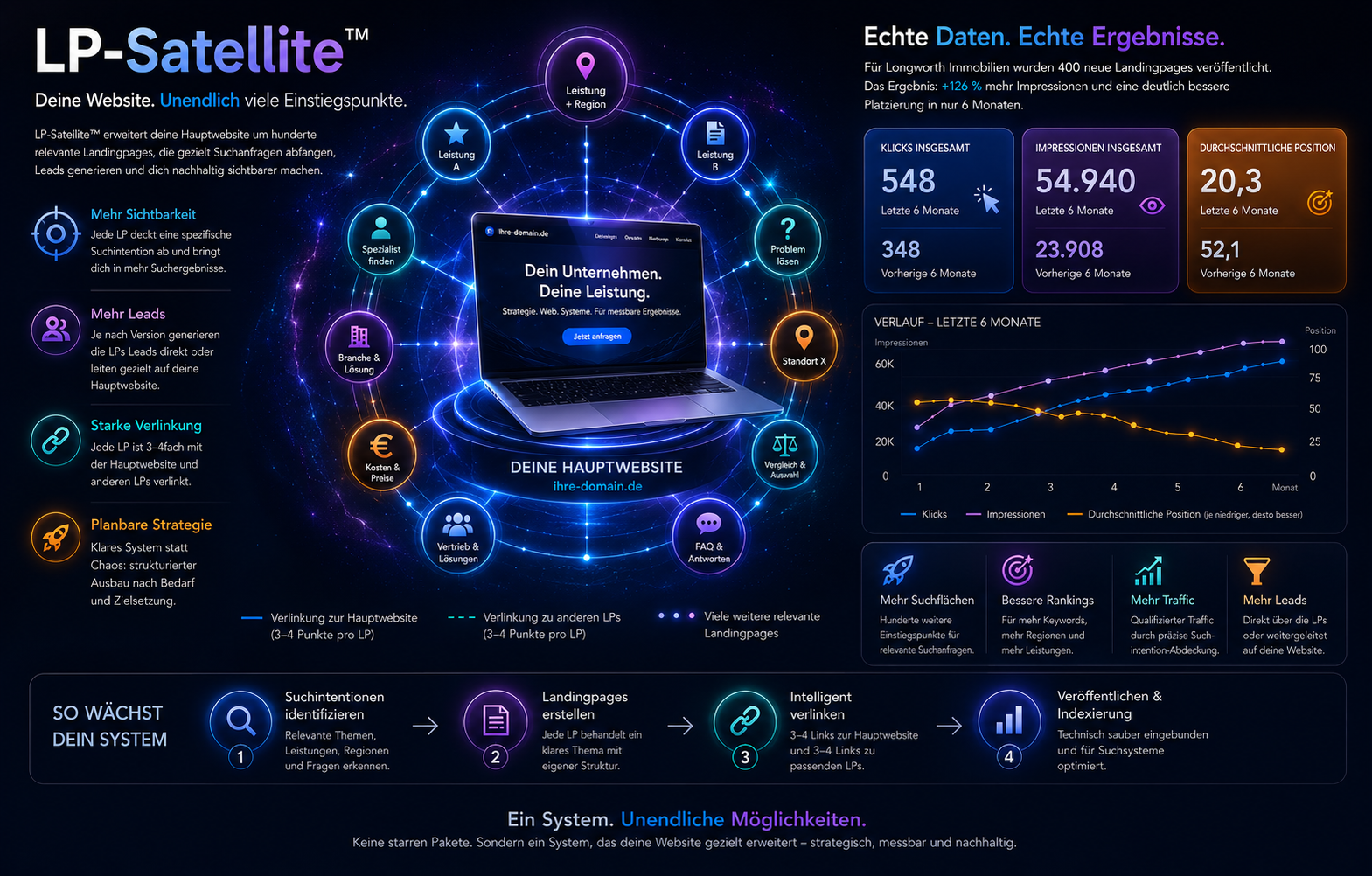
Impact arises not from quantity, but from structure
As a global project example, the LP-Satellite Case demonstrates controlled expansion rather than unconnected individual measures. Applied to web development, this means: first clarify system boundaries, then implement them consistently, and finally test their effectiveness in operation. No local connection to the target location is derived from this approach.
System responsibility counts more than selling services
Typical project logic
-
Individual measures without a common goal.
-
Transitions between strategy, design and technology.
-
Launch without a plan for operation and further development.
VELUNO system logic
-
Connect requirements and system boundaries with the data model and integrations.
-
Plan frontend and backend architecture, performance, security, and testing together.
-
Consider operation and expansion from the outset.
This is how web development decisions are made and implemented in a controlled manner.
This process prevents production from starting before the necessary clarity is achieved. Business objectives, system boundaries, quality criteria, and further development are linked in a readily verifiable sequence. The process begins with the user question, identifies the underlying structural cause, and links the solution components with verifiable evidence. Further information: Platforms & InfrastructureWhere data is lacking, observability is improved first before far-reaching conclusions or investments are decided upon. Content, UX, and technology follow the same vision so that good messages don't fail due to weak leadership or an unsuitable technical foundation.
Analysis
The current state is reviewed from both a functional and technical perspective. User needs, system boundaries, and the requirement "requirements and system boundaries" are consolidated into a prioritized set of findings.
Architecture
The supporting structure is developed based on these findings. The requirements "data model and integrations" and "frontend and backend architecture" are anchored in the architecture. Responsibilities and quality criteria are defined before production. The first release doesn't need to include every conceivable function, but it must reliably solve the core task and create a solid learning foundation. Quality assurance includes expert reviews, technical tests, mobile usability, accessibility, and the testing of key components. User journeys.
Implementation
Content, UX, and technology are implemented in a controlled manner and tested together. The requirement "Security and Testing" is ensured through specific testing and approval steps.PerformanceOperation includes monitoring, maintenance, and documented further development. The requirement "Deployment, Documentation, and Operation" prevents the system from remaining at its launch state.
Operations
Operation encompasses monitoring, maintenance, and documented further development.
From a focused sub-project to an expandable system
VELUNO distinguishes between a clearly defined launch, a structural reorganization, and a modular system expansion. This ensures that the initial implementation remains economically viable and doesn't preclude future expansion.
Focused sub-project
A prioritized bottleneck is analyzed and addressed with a clear quality criterion. Suitable for preparing clear system boundaries.
Complete setup or rebuild
Several structural causes are reorganized within the network. Content, technology, and operations follow a viable target model.
Scalable System Project
A robust foundation is built in such a way that further functions, content, or markets can be added in a controlled manner.
Technical background information instead of additional sales arguments.
Those who want to delve deeper into the decision-making logic behind the project will find three global VELUNO insights on search, website structure, and platform strategy. The content is not presented as local evidence.

SEO · GEO · AEO
Classifying Visibility in Classic and Generative Search
This article demonstrates how technical readability, topic structure, and clear answers work together.
Identifying Structural Errors Before They Hinder Development
This article identifies typical inconsistencies between content, user guidance, technology, and operations.
Platforms
From Individual Project to a Sustainable Platform Logic
This article explains when reusable components, workflows, and integrations become beneficial.
Official Regional Framework · GV-ISys
Würzburg in the Official Municipal Context
The Federal Statistical Office lists Würzburg in Bavaria. This information places Würzburg regionally for web development. It does not indicate a VELUNO location or a local customer relationship.
Population and area data are taken from the official municipal register. Neither demand nor project success can be derived from this. We continue to evaluate projects in Würzburg based on their objectives, existing infrastructure, system limitations, and necessary collaboration.
Federal state – Bavaria
District or Independent city – Würzburg
Administrative postal code – 97070
Area – 87.6 km²
Population as of December 31, 2024 – 133,258
Population density – 1,521 people per km²
Travel region in the GV-ISys – Franconian Wine Country
Degree of urbanization – Densely populated
Official municipality code – 09663000
Official municipality name – Würzburg
What the regional data on Würzburg classifies – and what it doesn't
– Würzburg
Frequently Asked Questions about Web Development in Würzburg
The FAQs connect the specific reason for the search with the VELUNO service model and transparent, digitally managed collaboration.
Custom web development is advisable when processes, data flows, or integrations cannot be reliably mapped using standard functions. It should not be chosen simply because a function sounds unusual. Long-term benefits, maintainability, and clear system boundaries are crucial. Prioritization depends on which functions need to be developed custom and which standards can be consciously used.
The technology is selected based on requirements, existing infrastructure, teamwork capabilities, and the operating model. A fixed favorite framework is not a measure of quality. Documented decisions and a manageable stack are essential.
Interfaces are planned with data responsibility, formats, error handling, authentication, and synchronization rules. Only then does the actual implementation follow. This ensures that dependencies remain visible and testable. The benchmark remains a maintainable, high-performance, and extensible web solution with a clear architecture.
Maintainability is achieved through a clear architecture, testing, documentation, controlled deployment, and easily verifiable responsibilities. Updates and monitoring must also be part of operations. Unnecessary custom logic is avoided.
The process can be organized digitally with subject matter experts and technical managers. Requirements, reviews, tests, and handover are documented and coordinated remotely. A local office is not required.
Clearly define the bottleneck in web development
The most sensible starting point is a clear decision regarding the problem, scope, and quality criteria. This requires understanding the existing foundation, the goal, and known risks. This allows for the objective preparation of the appropriate next step. The initial review considers core processes, data objects, integrations, roles, and security and operational requirements within the overall framework.