
Website relaunch in Hanover: Make clear decisions and implement them flawlessly.
The benchmark for every project decision regarding the service "Website Relaunch" is: Relaunch without loss of visibility. The existing website should be renewed without losing rankings, content, tracking, or functioning processes. A viable solution for companies in Hanover begins with the building blocks "Inventory and URL Survey," "Positioning and New Information Architecture," and "Migration and Redirect Concept." The result should be a controlled relaunch with clearer positioning, controlled migration, and a better technical foundation, not just a new interface or isolated function.
The seemingly simple answer "We'll just transfer the existing content into a new design" leaves the subsequent costs of an unclear architecture unaddressed. Every measure is therefore evaluated based on whether it supports the following benefit: Modernization without avoidable losses of visibility, data, or structure. Collaboration takes place digitally with clear responsibilities and traceable approvals.
Inventory and URL Inventory
The "Inventory and URL Survey" module makes responsibilities, quality criteria, and open risks for the project visible.
Positioning and New Information Architecture
The "Positioning and New Information Architecture" module creates a solid factual basis and separates proven causes from mere assumptions.
Migration and Redirect Concept
The "Migration and Redirect Concept" module clarifies which decision must be made first and what dependencies follow.
Target Vision & Architecture
Migration & Development
Launch & Stabilization
What matters after the visible launch
The visible launch is just one milestone. The "Performance, Tracking, and Technical QA" and "Launch and Development Plan" modules ensure that measurement, stability, and future decisions remain consistently defined.
Pragmatic with visible system logic: clear decisions, documented dependencies, and a development path that aligns with actual needs.
The Checkpoint Behind the Visible Problem
The visible deficiency is a signal, not a diagnosis. A relaunch is treated as a new design, even though architecture, migration, and operation carry the greater risks. For companies with organically grown, slow, or strategically outdated websites, the quality of the root cause analysis determines whether the solution will remain effective after changes, growth, and ongoing operation. Projects from the surrounding area related to Laatzen, Ronnenberg, Langenhagen can also be categorized in this way, without claiming a local presence.
Old content is adopted without review
The map shows a checkpoint for the entire project: Old content is being adopted without review. It is related to the issues "legacy problems in the new system," "duplicate content," and "unclear responsibility."
-
Legacy issues in the new system
-
Duplicate content.
-
Unclear responsibility
URLs, rankings, and tracking are lost during the migration
This map shows a critical issue for the entire project: URLs, rankings, and tracking are lost during the transition. It is related to the issues of "broken internal links," "incomparable tracking data," and "missing redirects." This confirms the central diagnosis: A relaunch is being treated as a new design, even though architecture, migration, and operations pose the greater risks.
-
Broken internal links
-
Incomparable tracking data
-
Missing redirects
The new design sits on the same weak infrastructure
This map shows a critical issue for the entire project: The new design is built on the same weak infrastructure. It is related to the issues of "no robust development path," "outdated page logic," and "difficult maintenance." This confirms the central diagnosis: A relaunch is being treated as a new design, even though architecture, migration, and operations pose the greater risks.
-
No reliable development path
-
Outdated page logic
-
Difficult maintenance
What VELUNO manages, both technically and professionally
VELUNO doesn't just handle individual tasks, but rather the connection between the business objective and technical responsibility. The four building blocks illustrate how a controlled relaunch with clearer positioning, controlled migration, and an improved technical foundation is planned, implemented, and tested. Further details: Website Systems.
Analysis & Inventory
The impact of this building block includes "Inventory and URL Inventory," "Positioning and New Information Architecture," and "Migration and Redirect Concept." Analysis & Inventory connects business priorities, technical execution, and subsequent operation. This ensures that future expansions remain compatible and the target architecture remains controllable.
-
Prioritized Risks
-
Clear Decision Framework
-
Documented Starting Point
-
Verifiable Current State
Target Vision & Architecture
The impact chain of this module encompasses "Positioning and New Information Architecture," "Migration and Redirect Concept," and "Performance, Tracking, and Technical QA." The target architecture connects business priorities, technical implementation, and subsequent operation. This ensures that future expansions remain compatible and the target architecture remains controllable.
-
Clarified Dependencies
-
Structured User Guidance
-
Approved Architecture
-
Binding Target Image
Migration & Development
The impact chain of this module encompasses "Migration and Redirect Concept," "Performance, Tracking, and Technical QA," and "Launch and Development Plan." Migration and development connect business priorities, technical implementation, and subsequent operation. This ensures that future expansions remain compatible and the target architecture remains controllable.
-
Clean Handovers
-
Technical Quality Assurance
-
Measurable Interim Results
-
Controlled implementation
Launch & Stabilization
The impact chain of this building block encompasses "Performance, Tracking, and Technical QA," "Launch and Development Plan," and "Inventory and URL Inventory." Launch & Stabilization connects business priorities, technical implementation, and subsequent operation. This ensures that future expansions remain compatible and the target architecture remains controllable.
-
Monitoring and Error Control
-
Structured Maintenance
-
Planned Expansion
-
Stable Launch
Three key elements with a clear technical connection logic
The scope must be defined in terms of business, technology, and operations. Flat-rate prices or fixed durations would be speculative without this definition; the causes, target architecture, and dependencies are crucial.
Focused Entry Point
The focused initial phase includes clear acceptance criteria, a responsible party, and a documented follow-up decision.
Structural Rebuild
The structural rebuild combines functional reorganization, technical consolidation, and a controlled transition. This prevents the creation of separate sub-projects with conflicting acceptance procedures.
Systematic Expansion
The expansion remains modular and controlled. New requirements are added without reinventing central rules for data, user guidance, quality, or operation at each stage.
Project Logic Instead of Invented Local References
The four cases serve as test models for responsibility, dependencies, and acceptance. They do not describe customers from the target location, but rather comprehensible patterns for digital projects. A suitable structural example is provided by: B2B Website Rebuild.
B2B Relaunch
Test Case for Operation and Expansion: A B2B website had grown organically over the years and offered services without clear priorities.
Project Logic
Control Point: Before design and development, content was evaluated, search intents were consolidated, and a new page model was defined.
The relaunch guided users more clearly and reduced the number of strategically weak pages. The project logic was measured against the goal of "A controlled relaunch with clearer positioning, controlled migration, and a better technical foundation," as well as against the building blocks of "Inventory and URL Inventory" and "Launch and Development Plan."
Migration
Launch Plan
Mid-Market Rebuild
Case Study for Operation and Expansion: A medium-sized company's website combined old templates, inconsistent content, and special technical issues.
Project Logic
Control Point: Core components, URL structure, and content responsibility were reorganized.
The new foundation could be maintained and expanded without treating every change as a special project. The project logic was measured against the goal of "A controlled relaunch with clearer positioning, controlled migration, and a better technical foundation," as well as against the building blocks of "Positioning and new information architecture" and "Inventory and URL inventory." ...
Technical QA
URL Inventory
Multilingual Relaunch
Operational and Expansion Test Case: Multilingual content was structured differently and only partially synchronized.
Project Logic
Control Point: Language logic, canonicals, redirects, and editorial responsibilities were defined before migration.
The transition remained controllable, and new markets could build on the same basic structure.
Launch Plan
Information Architecture
Technical Consolidation with CMS Change
Operational and Expansion Test Case: A CMS migration was intended to eliminate legacy technical issues without losing valuable content and measurement data.
Project Logic
Control point: Data mapping, redirect concept, tracking, and technical acceptance were managed as a separate migration path.
Technical consolidation was achieved without blindly taking over the old system completely. The project logic was measured against the goal of "A controlled relaunch with clearer positioning, controlled migration, and a better technical foundation," as well as against the building blocks of "Performance, tracking, and technical QA" and "Migration and redirect concept."
URL Inventory
Migration
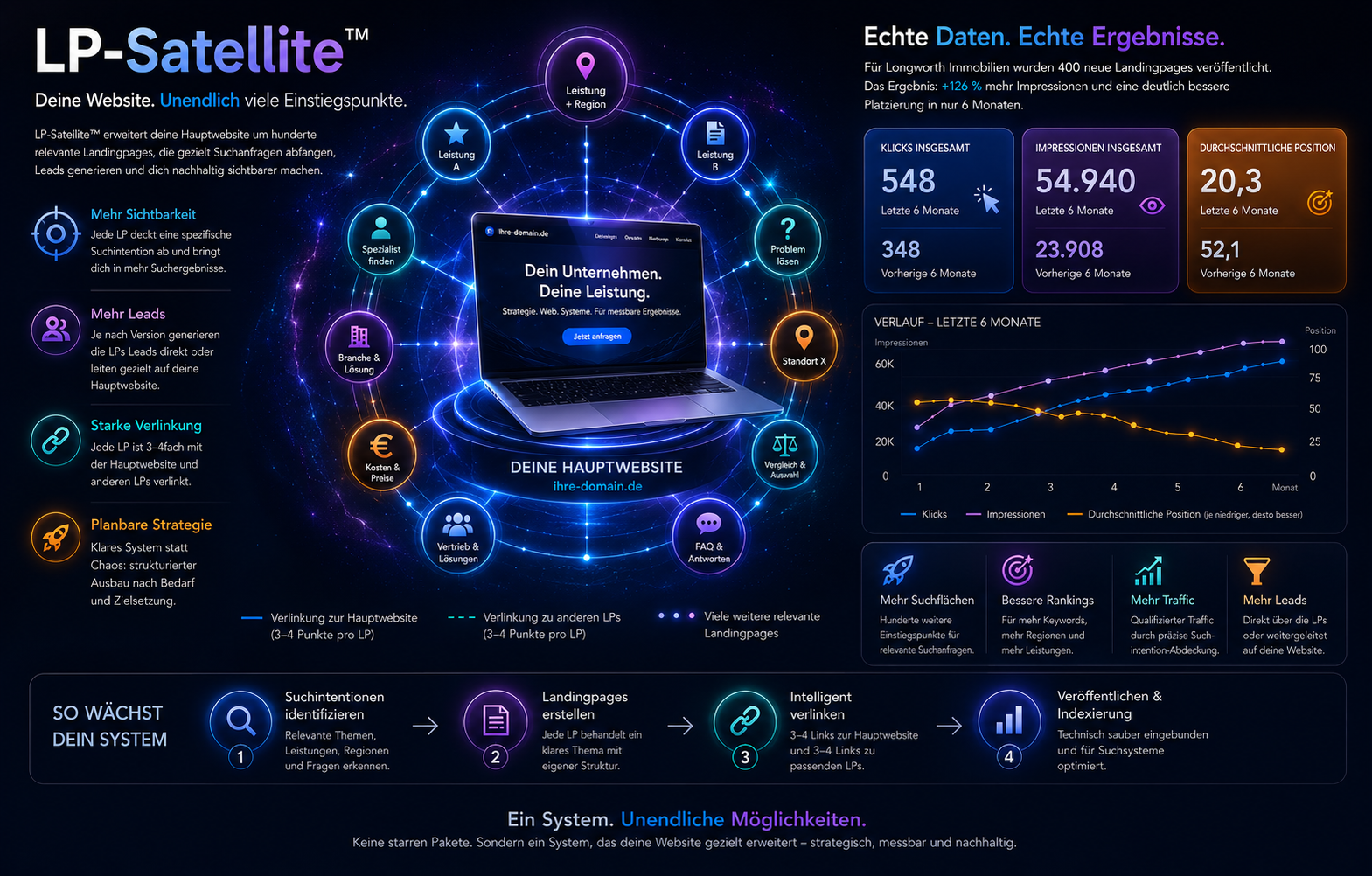
Demonstrable systematic approach instead of local claims
For this page, the LP satellite case provides evidence of systematic approach and acceptance. The statement regarding the "website relaunch" service deliberately remains supra-regional and is not presented as a client project from Hanover.
What characterizes a robust solution in practice
Classic individual-measure logic
-
The weakness lies in the following pattern: Individual measures without a shared vision. Ongoing operations assume risks that should have been addressed before implementation.
-
The weakness lies in the following pattern: Transitions between strategy, design, and technology. The chain of effects remains open, and errors are passed on to the next stage.
-
The weakness lies in the following pattern: Launch without a plan for operation and further development. Costs arise during handovers because the target vision and acceptance testing are not managed jointly.
VELUNO System Responsibility
-
The building blocks "Inventory and URL Inventory" and "Positioning and New Information Architecture" are managed as a joint decision. Operation, monitoring, and further development are treated as part of the same responsibility.
-
The building blocks "Migration and Redirect Concept" and "Performance, Tracking, and Technical QA" are linked in a consistent quality logic. This ensures that cause, decision, and effect remain traceable until acceptance.
-
The building block "Launch and Further Development Plan" anchors operation and expansion from the outset. Business objectives and technical responsibilities are linked without unnecessary handovers.
Clearly manage decisions, handovers, and quality
The process makes responsibility visible: Who decides, what is documented, how is quality assessed, and who bears the operational responsibility for the result? The pattern "Problem → Consequence → Target → System Solution" guides the argumentation.
Analysis
For analysis, the responsible party, acceptance criteria, and open risks are mandatory. The initial situation, objective, risks, and decision-making questions are recorded. The "Inventory and URL Survey" module provides the factual basis and verifies the diagnosis: A relaunch is treated as a new design, even though architecture, migration, and operation carry the greater risks.
Architecture
For architecture, the responsible party, acceptance criteria, and open risks are mandatory. The supporting structure is defined in a binding manner. The building blocks "Positioning and New Information Architecture" and "Migration and Redirect Concept" define user guidance, migration, and technical dependencies before implementation.
Implementation
For implementation, the responsible party, acceptance criteria, and open risk are mandatory. Content, UX, technology, and measurement are integrated in a controlled manner. The building block "Performance, Tracking, and Technical QA" defines the quality controls and acceptance procedures for production implementation.
Operations
For operation, the responsible party, acceptance criteria, and open risk are mandatory. Monitoring, maintenance, and the next development phase are defined. The building block "Launch and Development Plan" outlines how the result will remain stable and be further developed toward the goal of "A controlled relaunch with clearer positioning, controlled migration, and a better technical foundation."
How large does the project really need to be?
Project size is not a matter of status. What matters is whether the chosen scope covers the cause, implementation, and operation together, without relying on speculative prices, guarantees, or fixed deadlines.
Focused sub-project
Suitable for a clear review or implementation milestone in a "website relaunch" project. The project delivers a usable result and a documented decision regarding the next step.
Complete setup or rebuild
The functional reorganization, technical consolidation, and transition to operation are managed as a cohesive responsibility. This prevents conflicting individual acceptances.
Scalable System Project
Expansion can complement markets, processes, or integrations without reinventing core quality and data rules. Monitoring and responsibilities remain consistent throughout.
Technical articles on architecture, search, and platform capability
No additional performance promises, but rather expert analysis: The articles demonstrate why visibility, structure, and platform capability all relate to the same fundamental decisions.

SEO · GEO · AEO
Visibility arises from an understandable structure, not from mere keyword space.
This article demonstrates how content can be made technically and semantically readable for both traditional search and generative response systems. The connection to the "Website Relaunch" service lies in clear rules for visibility, architecture, and operation.
Why weak information architecture hinders many optimizations
This article explains how content logic, UX, tracking, and technology function as a unified system.
Platform Logic
When a Web Project Becomes a Robust Platform Architecture
This article separates simple website functions from role-based, data, and process logic with ongoing operational requirements. For the "Website Relaunch" service, it is particularly relevant to clarify which fundamental aspects must be addressed before any visible development.
Official Regional Framework · GV-ISys
Hanover in the official municipal context
The Federal Statistical Office lists Hanover as the state capital of Lower Saxony. This information provides a regional context for Hanover in the context of website relaunches. They do not indicate a VELUNO location or a local customer relationship.
Population and area data are taken from the official municipal register. Neither demand nor project success can be derived from this data.
Degree of urbanization – Densely populated
Official municipality code – 03241001
Official municipality name – Hanover, State Capital
Federal state – Lower Saxony
District or Independent city – Hanover Region
Administrative postal code – 30159
Area – 204.3 km²
Population as of December 31, 2024 – 522,131
Population density – 2,556 people per km²
Travel region in the GV-ISys – Hanover-Hildesheim
What the regional data on Hanover classifies – and what it doesn't
The data clearly defines the boundaries of Hanover and avoids confusion with places with the same or similar names. It does not replace an individual analysis by the requesting company.
Direct answers regarding risk, scope, and operation
Five direct answers regarding scope, technology, decision-making, and digital Collaboration Regarding the service "Website Relaunch"
A purely visual desire is rarely sufficient justification; first, it should be clear what problem the new version actually needs to solve. For the service "Website Relaunch," the components "Inventory and URL Inventory" and "Migration and Redirect Concept" must share the same objective. This ensures the answer remains concrete without imposing a fixed price or timeframe.
Existing rankings are not automatic, but rather a value that needs to be migrated. For the "Website Relaunch" service, the components "Positioning and New Information Architecture" and "Performance, Tracking, and Technical QA" must share the same objective. This ensures a concrete answer without imposing a fixed price or timeframe.
Content is evaluated based on relevance, quality, Search Intent and future role. For the "Website Relaunch" service, the components "Migration and Redirect Concept" and "Launch and Development Plan" must share the same objective. This ensures a concrete answer without imposing a fixed price or timeframe.
A reliable estimate will only be possible after an inventory and target vision have been developed; general time estimates before this clarification are not very reliable. For the "Website Relaunch" service, the components "Performance, Tracking, and Technical QA" and "Inventory and URL Survey" must share the same objective. This ensures a concrete answer without imposing a fixed price or timeframe.
Yes. The collaboration for the "Website Relaunch" service is designed to be nationwide and does not require a branch office in Hanover. What is needed are readily available contacts, full system access, clear decision-making, and a documented review process.
Start a "Website Relaunch" with a Verifiable Project Overview
Before estimating effort, the cause, existing data, technical dependencies, and acceptance criteria should be defined. This creates a verifiable starting point for the "Website Relaunch" project instead of a generic list of measures. For geographical context, the page also refers to Website Relaunch Laatzen; the URL also follows the flat location architecture.