
Digital agency Hanover: From a mix of measures to architecture.
With the "Digital Agency" service, it's not the quantity of individual measures that counts, but rather the guiding principle "From a mix of measures to an architecture." The specific reason is that several digital challenges exist simultaneously, and individual service providers only address partial problems. Instead of immediately defining a single solution, companies in Hanover first clarify the building blocks of "digital inventory," "prioritization based on business impact," and "system and data logic." From this, a prioritized digital system comprising Experience, Products, Infrastructure, and Growth can be developed.
"We only need support in individual disciplines." This sounds plausible at first. However, the underlying causes, dependencies, and subsequent operational responsibility remain unclear. Therefore, the benchmark is concrete benefit: fewer isolated solutions and a clear sequence for effective digital investments. VELUNO works digitally and location-independently; a branch office in Hanover is not claimed.
Digital inventory
The "Digital Inventory" module clarifies which decision must be made first and what dependencies follow.
Prioritization based on business impact
The "Prioritization Based on Business Impact" module translates the target vision into a verifiable basis for architecture, implementation, and acceptance.
System and data logic
Starting with the desired outcome, the "System and Data Logic" module defines what must be definitively established in the next step.
Digital Products
Platforms & Infrastructure
Growth Systems
From the target image to a sound decision
The "Implementation in Sensible Stages" module defines how quality is verified. "Operation and Further Development" determines how the result remains stable after launch and can be meaningfully expanded.
Precise, consultative, and without agency jargon: clear decisions, documented dependencies, and a development path that aligns with actual needs.
The costs of an unclear starting point for a "Digital Agency"
Visible friction is rarely the whole problem. Websites, tools, data, tracking, and growth strategies are evolving without a unified architecture. For companies that need to consider their website, processes, visibility, and technical systems together, this results in unnecessary costs because adjustments made in different areas don't support each other. Projects from the surrounding area related to Laatzen, Ronnenberg, Langenhagen, can also be categorized in this way, without claiming a local presence.
Many individual measures without a common vision
The visible consequence is numerous individual measures without a shared vision. This is often due to conflicting priorities, unclear business impact, and isolated project goals. A piecemeal correction would only postpone the effort and resurface during the next expansion.
-
Competing priorities
-
Unclear business impact
-
Isolated project goals
Tool landscape with media breaks and duplication of effort
The visible consequence is a disparate tool landscape with media breaks and duplication of effort. The underlying issues are often "manual handovers," "lack of transparency," and "duplicate data maintenance." A piecemeal correction would only postpone the effort and make it visible again during the next expansion.
-
Manual handoffs.
-
Lack of transparency
-
Duplicate data maintenance
Website and operational processes develop separately
The visible consequence is that the website and operational processes develop separately. The underlying issues are often "incomplete measurement," "separate user paths," and "weak system logic." A piecemeal correction would only postpone the effort and make it visible again during the next expansion.
-
Incomplete measurement
-
separate User journeys
-
Weak system logic
From a specific bottleneck to a manageable solution
The project angle "From Measures Mix to Architecture" is translated into four clearly defined work modules. Each module addresses a different decision and leads to the target vision: a prioritized digital system comprising Experience, Products, Infrastructure, and Growth. Further technical information: Services.
Digital Experience
The Digital Experience building block begins with a "digital inventory." Subsequently, "prioritization based on business impact" is defined in such a way that effort, handover, and open risks remain verifiable. The focus is not on activity itself, but on the contribution to the overall benefit: fewer isolated solutions and a clear sequence for effective digital investments.
-
Prioritized Risks
-
Clear Decision Framework
-
Documented Starting Point
-
Verifiable Current State
Digital Products
The Digital Products building block begins with "prioritization based on business impact." Subsequently, "system and data logic" is defined in such a way that effort, handover, and open risks remain verifiable. The focus is not on activity itself, but on the contribution to the overall benefit: fewer isolated solutions and a clear sequence for effective digital investments.
-
Clarified Dependencies
-
Structured User Guidance
-
Approved Architecture
-
Binding Target Image
Platforms & Infrastructure
The Platforms & Infrastructure building block begins with "system and data logic." Subsequently, "implementation in meaningful phases" is defined in such a way that effort, handover, and open risks remain verifiable. The focus is not on activity itself, but on the contribution to the overall benefit: fewer isolated solutions and a clear sequence for effective digital investments.
-
Clean Handovers
-
Technical Quality Assurance
-
Measurable Interim Results
-
Controlled implementation
Growth Systems
The Growth Systems building block begins with "implementation in sensible stages." Subsequently, "operation and further development" are defined in such a way that effort, handover, and open risks remain verifiable. The focus is not on activity, but on the contribution to the benefit: fewer isolated solutions and a clear sequence for effective digital investments.
-
Monitoring and Error Control
-
Structured Maintenance
-
Planned Expansion
-
Stable Launch
When a focused approach makes economic sense
An economically viable entry point completely solves the current problem and avoids unnecessary upfront costs. Therefore, in a "digital agency" project, a distinction is made between a focused sub-project, structural rebuild, and systematic expansion.
Focused Entry Point
The approach focuses on the greatest demonstrable leverage. It remains economically viable if dependencies are known and the result can later be integrated into the overall architecture.
Structural Rebuild
The rebuild addresses the issue where partial fixes would hinder each other. Existing values are evaluated and adopted, but legacy issues are not automatically transferred to the new solution.
Systematic Expansion
The initial stage remains usable while later expansions are architecturally prepared. This prevents both an oversized start and a technical dead end.
Which decisions are effective in different starting situations
Project examples are only helpful if they illustrate the underlying decision. Therefore, the four scenarios depict different problem classes without inventing local customers, key performance indicators, or successes. A suitable structural example is: Digital Products.
Website plus CRM and tracking integration
Cost factor: A website generated inquiries, but CRM, tracking, and processing were not integrated.
Project Logic
Why? User journey, data collection, and handover were planned as a shared process chain.
Marketing and operational processing received a traceable data flow. Crucially, the "digital inventory" component was definitively defined before "operation and further development."
System Logic
Further Development
Customer portal with operational process logic
Cost point: A service business wanted to digitally streamline recurring customer processes.
Project Logic
Why: A portal connected roles, tasks, and interfaces while strategically reusing existing systems.
Customers gained transparency, and internal teams required less manual coordination. Crucially, the "prioritization based on business impact" component was definitively defined before "digital inventory."
Development Stages
Current-State Assessment
Platform Relaunch
Cost point: A platform had grown technically, but its product logic and operations could no longer keep pace with its expansion.
Project Logic
Why: Core processes, architecture, and expansion phases were reprioritized.
Further development became more controllable without replacing the entire product at once. Crucially, the "System and Data Logic" component was definitively clarified before "Prioritization Based on Business Impact."
Further Development
Prioritization
Visibility System with Expanded Search Areas
Cost: Visibility was to be expanded across numerous topics and regions.
Project Logic
Why: A landing page and content system combined search intent, templates, internal links, and measurement.
The expansion became predictable and could be evaluated for quality and actual demand. Crucially, the "Implementation in Sensible Stages" component was definitively clarified before "System and Data Logic."
Current-State Assessment
System Logic
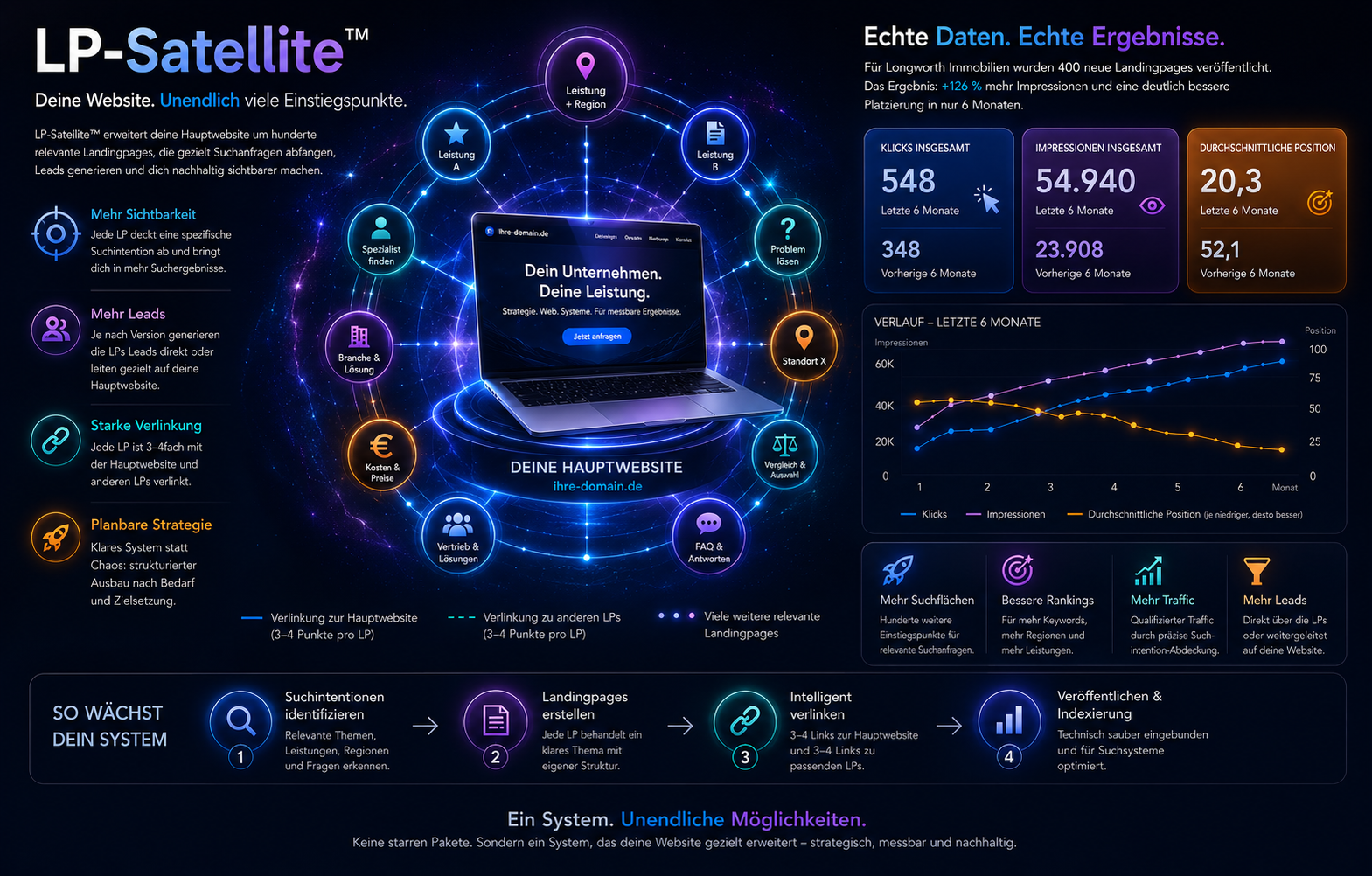
The global case demonstrates process discipline, not local proximity.
The existing case study documents a structured digital expansion. Applied to the "Digital Agency" service, it demonstrates clear decisions and technical repeatability, not a local client relationship in Hanover. Further context is provided. Platforms & Infrastructure.
Why handovers don't replace shared responsibility
Classic individual-measure logic
-
The weakness lies in the following pattern: individual measures without a shared vision. Costs arise during handovers because the vision and acceptance are not managed jointly.
-
The weakness lies in the following pattern: handoffs between strategy, design, and technology. This contradicts the guiding principle "From a mix of measures to architecture" and postpones the actual decision-making process.
-
The weakness lies in the following pattern: launch without a plan for operation and further development. From the perspective of the desired outcome, it is no longer possible to understand why this measure was prioritized.
VELUNO System Responsibility
-
The building blocks "digital inventory" and "prioritization based on business impact" are managed as a joint decision. Business objectives and technical responsibility are linked without unnecessary handoffs.
-
The building blocks "system and data logic" and "implementation in meaningful stages" are linked in a consistent quality logic. This makes the guiding principle "From a mix of measures to architecture" practically manageable.
-
The building block "operation and further development" anchors operation and expansion from the outset. Every technical decision can be justified and reviewed based on the target vision.
First clarify the cause and priority, then implement.
These four steps reduce costs by eliminating unclear handoffs. The rationale establishes a binding sequence for analysis, architecture, implementation, and further development, concluding each stage with a documented decision.
Analysis
The analysis step reduces later correction costs. The initial situation, objectives, risks, and decision-making questions are recorded. The "digital inventory" module provides the factual basis and verifies the diagnosis: Website, tools, data, tracking, and growth measures develop without a common architecture.
Architecture
The architecture step reduces later correction costs. The supporting structure is definitively established. The "prioritization by business impact" and "system and data logic" modules prioritize user guidance, migration, and technical dependencies before implementation.
Implementation
The implementation step reduces later correction costs. Content, UX, technology, and measurement are integrated in a controlled manner. The "implementation in meaningful stages" module defines the quality controls and acceptance procedures for production implementation.
Operations
The operation step reduces later correction costs. Monitoring, maintenance, and the next expansion phase are defined. The "Operation and Development" module defines how the result remains stable and is further developed toward the goal of "A prioritized digital system comprising Experience, Products, Infrastructure, and Growth."
What scope is economically viable for the "Digital Agency" service?
An economically viable scope for a project related to "a digital agency This completely solves the current problem and avoids unnecessary upfront costs. Therefore, the sub-project, rebuild, and scalable system are separated according to risk and target vision.
Focused sub-project
The focus is on a problem class with a clear benefit. Dependencies are documented, and unnecessary topics are deliberately excluded from the scope.
Complete setup or rebuild
The rebuild not only eliminates the visible weakness but also the underlying cause. Existing values are reviewed and adopted; legacy issues are not automatically perpetuated.
Scalable System Project
Reusable components, data models, and operating rules form the basis for further stages. New requirements are checked against the target architecture.
In-depth technical analysis for decisions regarding the "Digital Agency" service
Further content helps to avoid evaluating a "Digital Agency" project in isolation.

SEO · GEO · AEO
Visibility arises from an understandable structure, not from mere keyword space.
This article demonstrates how content can be made technically and semantically readable for both traditional search and generative response systems. For the "Digital Agency" service, it is particularly relevant to clarify which fundamental principles must be addressed before any visible development.
Website Structure
Why weak information architecture hinders many optimizations
This article explains how content logic, UX, tracking, and technology function as a unified system. Its relevance to the "Digital Agency" service lies in this shared understanding. System Logic, not in an additional local claim.
Platform Logic
When a Web Project Becomes a Robust Platform Architecture
This article distinguishes between simple website functions and role-based, data-driven, and process logic with ongoing operational requirements. It helps translate the target vision of a "Digital Agency" project into structural decisions.
Official Regional Framework · GV-ISys
Hanover in the official municipal context
The Federal Statistical Office lists Hanover as the capital of Lower Saxony.
Population and area data are taken from the official municipal register. Neither demand nor project success can be derived from this data.
Population density – 2,556 people per km²
Travel region in the GV-ISys – Hanover-Hildesheim
Degree of urbanization – Densely populated
Official municipality code – 03241001
Official municipality name – Hanover, State Capital
Federal state – Lower Saxony
District or Independent city – Hanover Region
Administrative postal code – 30159
Area – 204.3 km²
Population as of December 31, 2024 – 522,131
What the regional data on Hanover classifies – and what it doesn't
The data clearly defines the boundaries of Hanover and avoids confusion with places with the same or similar names. It does not replace an individual analysis by the requesting company.
What companies should specifically clarify regarding the service "digital agency"
Five direct answers regarding the scope, technology, decision-making, and digital collaboration of the "Digital Agency" service.
A digital agency can additionally combine products, platforms, data pathways, integrations, growth, and operations; the crucial factor is not the label, but whether this responsibility is actually assumed. For this project, "From the Mix of Measures to the Architecture" is the relevant project perspective. The "digital inventory" component will therefore be reviewed before a blanket commitment is made.
Which components are relevant depends on the specific bottleneck and the expected business benefits, not on a predefined list of services. For this project, "From the Mix of Measures to the Architecture" is the relevant project perspective. The "Prioritization Based on Business Impact" component will therefore be reviewed before a blanket commitment is made.
First, decisions are made that enable other steps or prevent costly missteps; these are followed by sensibly defined implementation phases. For this project, "From the Mix of Measures to the Architecture" is the relevant project perspective. The "System and Data Logic" component is therefore reviewed before a blanket commitment is made.
A project can start with a clear website, a process, an audit, or a limited MVP. For this project, "From Measures Mix to Architecture" is the relevant project perspective. The "Implementation in Sensible Stages" component is therefore reviewed before a blanket commitment is made.
Collaboration with companies from Hanover is digital and location-independent. For the "Digital Agency" service, goals, existing systems, responsibilities, and acceptance procedures are managed transparently without requiring an on-site presence.
The next step for a "digital agency": Defining costs and risks
The first step involves identifying current friction, the systems involved, responsibilities, and the target vision. From this, a clear scope for the "digital agency" service can be derived, without claiming a local branch in Hanover. For geographical context, the page also refers to the Laatzen digital agency; the URL also follows the flat location architecture.