
Website Systems Rhine-Main: System logic instead of digital scenery.
Quality isn't determined by the number of functions, but by their interrelationship. A clean structure organizes benefits, data flows, and next steps within a unified model. For companies in the Rhine-Main region, the scope is therefore derived from the actual bottleneck. The goal is a modular website system with a clear information architecture and reusable content modules.
More interface alone doesn't solve the problem. The aim is faster expansion, consistent quality, and less structural legacy. The objection "A CMS with templates is already a website system" is therefore examined based on usage, data flows, and operational costs. The project remains digitally documented from analysis to further development.
Information and URL architecture
Translates complex content into clear entry points and comprehensible paths. This reduces the number of open fundamental questions in the further course of the project.
Modular Components
Creates reusable rules for content, variations, and approvals. This simplifies decision-making and prevents unnecessary detours later on.
Content Model and Governance
Translates complex content into clear entry points and comprehensible paths. This ensures that the benefits remain understandable even with expansions. Templates, content, approvals, integrations, and measurement are considered together so that a correction doesn't create new problems elsewhere. The website system remains stable even when additional teams, content, or systems are added. A clear priority prevents the "Content Model and Governance" component from being diluted by additional requests or becoming unnecessarily complicated from a technical standpoint.
Performance becomes effective when individual pages are transformed into a clear, modular logic for pages, components, and governance.
The systems approach extends from "Information and URL Architecture" to "Measurement and Continuous Expansion." "Modular Components" organizes usage, while "Content Model and Governance" strengthens decision-making. "Performance and Technical Extensibility" links the next step to "Measurement and Continuous Expansion."
This approach is aimed at companies that want to turn a visible problem into a robust systems decision.
The Critical Bottleneck Lies Before the First Layout
The focus on "resolving erroneous assumptions" here means that the specific friction is described before the solution is sought. Individual pages are added without creating a consistent, maintainable system. This ensures that the requirements remain verifiable. The focus is on companies with multiple services, markets, target groups, or recurring page requirements.
New pages create inconsistency instead of reach
"New pages create inconsistency instead of reach" is a symptom of an unclear modular page, component, and governance logic. As a result, effort is shifted to coordination, maintenance, or sales, even though the root cause lies earlier in the system.
-
More queries in the decision-making process
-
Unclear responsibilities
-
Subsequent corrections with additional effort
Content is duplicated and difficult to maintain
This issue often only becomes apparent when new content or features are added. Without clear rules, the pattern of "content is duplicated and difficult to maintain" increases operational friction and hinders controlled expansion.
-
Weak user guidance
-
Inconsistent statements
-
Limited connectivity during expansion
Technical upgrades become more expensive with each step
The problem of "technical upgrades becoming more expensive with each step" can affect multiple areas simultaneously for the target group described. User guidance, data, and responsibilities then become misaligned.
-
Hidden media and system breaks
-
Duplicate maintenance
-
Lack of measurability
A result arises from interconnected decisions
Content, technology, and measurement are given a common priority. A related service area serves Website Systems as a reference for subsequent implementation and further development.
Information Architecture
For "information architecture," responsibilities, dependencies, and quality criteria are clarified before implementation. The aim is faster expansion, consistent quality, and fewer structural legacies. This ensures that the contribution of the component remains transparent. Expansion remains controlled if the "Performance and Technical Extensibility" component maintains its functionality in terms of content, technology, and measurement. The quality of the "Performance and Technical Extensibility" component is demonstrated by whether handovers, usage, and subsequent changes remain traceable.
-
Modeling Performance Logic
-
Building Entry Points as Needed
-
Assigning Pages and Content
-
Clearly Defining Next Steps
Components & Templates
This component combines business requirements with a robust implementation.
-
Organize the component library
-
Limit variants
-
Document template rules
-
Ensure technical consistency
Content and Data Model
VELUNO defines the "Content and Data Model" as a clearly delineated building block. Decisions contribute to the desired target state and remain linked to templates, content, approvals, integrations, and measurement. The goal is a modular website system with a clear information architecture and reusable content modules.
-
Capture data sources
-
Define the system of record
-
Plan interfaces and error handling
-
Monitor synchronization
Operation & Growth Expansion
In the "Operation & Growth Expansion" phase, the contribution to the goal is defined first. This is followed by content, functions, and technical requirements in a sequence that considers future operations.
-
Define measurement points
-
Clarify data transfers
-
Plan CRM integration
-
Control expansion based on usage
A viable start doesn't have to be a large-scale project
Not every bottleneck requires the same scope. The relevant global document is referenced once in the existing proof component; the starting point and expansion are derived from the existing data.
Focused Entry Point
A clearly defined section addresses the biggest bottleneck first. Architecture and data paths are designed so that the website system can be expanded later without changing direction.
Structural Rebuild
Multiple causes are addressed in a single, cohesive project. This includes inventory, target state, implementation, Migration and stabilization.
Systematic Expansion
This approach is suitable if the website system is to grow in several phases. Each stage has its own goal and remains technically compatible. The "Measurement and Ongoing Development" component is not treated as a later addition, but is directly linked to the goal, system boundaries, and responsibility. The aim is faster development, consistent quality, and fewer structural legacies.
Which Project Logic Fits Which Problem
The examples describe problem classes and key decisions, not fabricated local references. The corresponding structural contribution is linked once in the global Insights section of this page.
Multi-Market Website
Initially visible: numerous search queries without consistent page logic.
Project Logic
Multi-Market Website: Clarify dependencies, then expand strategically.
The project logic separated the necessary core from future expansion. The first step was clear: Implement a modular template with a clear intent and link structure. This made the website system more understandable, maintainable, and measurable.
Performance and Industry Hub
Starting point of the project: many related topics without a clear hierarchy.
Project Logic
A standardized architecture replaces the existing, fragmented approach.
The decisive factor was a binding system boundary. This led to a clear requirement: structure hub, detail, and linking logic according to the search intent. Unnecessary functions were removed, while viable components were retained.
LP-SatelliteExpansion
Initial situation: numerous search intents without consistent page logic.
Project Logic
From findings to a robust modular page, component, and governance logic.
The central decision was: implement a modular template with a clear intent and link structure. This resulted in a comprehensible foundation for use, implementation, and operation. The benefit lies in less friction and a controllable next step.
Website with PortalPortal or tool integration
Initial findings: recurring service processes with manual handoffs.
Project Logic
Structure before interface: Website with portal or tool integration as a clearly defined system project.
Instead of immediately producing new pages or functions, the guiding decision was formulated first: Model roles, tasks, and backend integration as a continuous process. This kept the scope verifiable and ensured compatibility for future expansion.
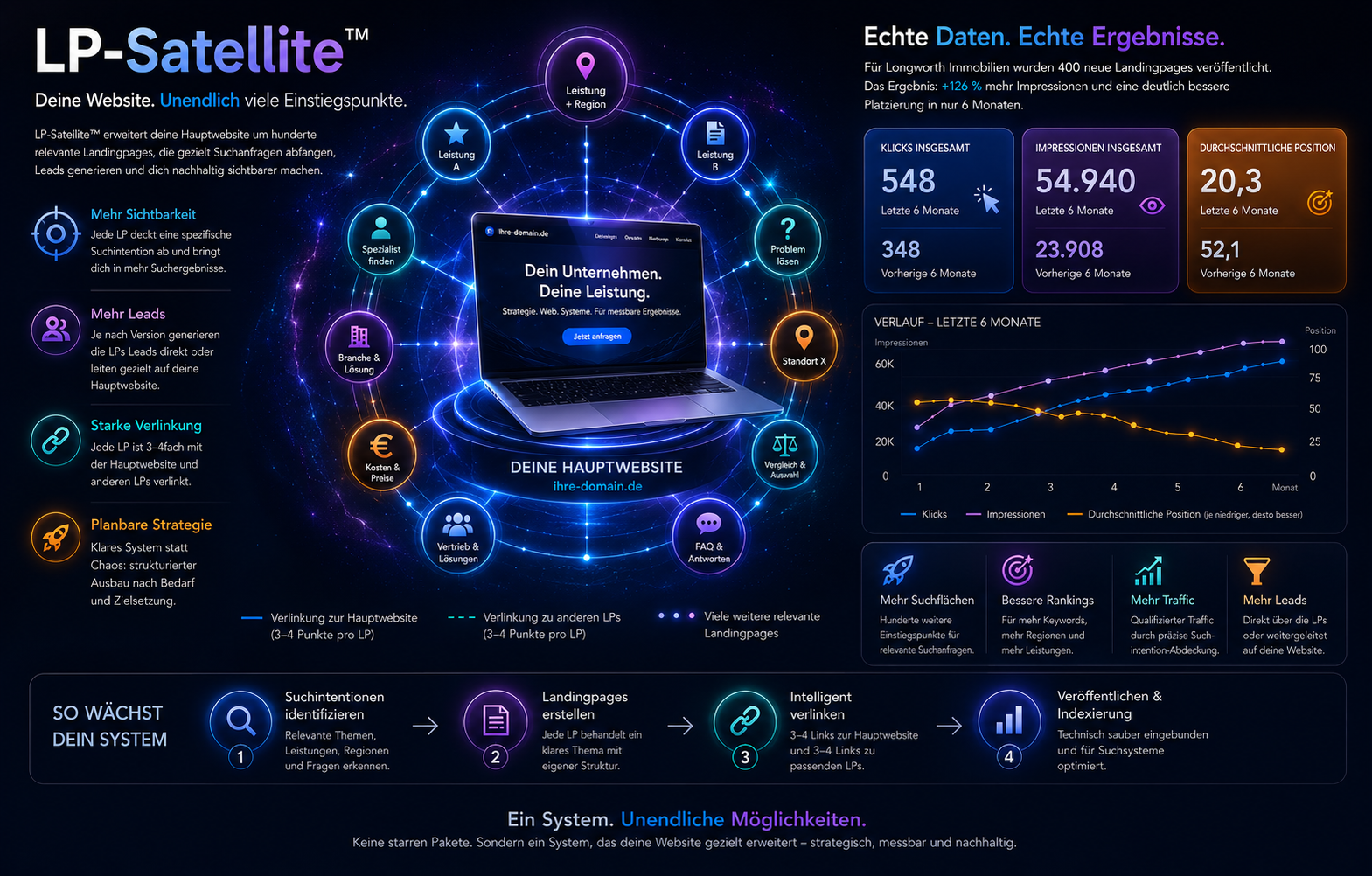
Impact arises from a consistent structure, not from a single measure
The global LP satellite project documentation demonstrates how controlled expansion can be organized across multiple sites.
From Performance Record to Shared Responsibility for Results
Separate Activities
-
Individual measures without a shared vision
-
Handover between strategy, design, and technology
-
Launch without a well-thought-out operational logic
VELUNO System Responsibility
-
Connecting Information and URL Architecture with Modular Components
-
Planning Content Model and Governance Together with Performance and Technical Extensibility
-
Considering operation and expansion from the outset
Four Phases with Clear Results Instead of Ambiguous Handovers
The process translates the perspective of "structure for multiple markets and services" into four clear phases. The rationale prioritizes the problem, followed by user guidance, proof, and conversion. Each phase concludes with a documented result.
Analysis
VELUNO separates symptoms from causes and documents dependencies within the existing system. This reduces the risk of subsequent work being based on unverified assumptions. The approach addresses the objection, "A CMS with templates is already a website system," without ignoring the structural cause within the project. For companies in the Rhine-Main region, location is not the deciding factor, but rather a digitally controllable and documented project logic. The next development stage is only prioritized when it demonstrably supports the desired target state.
Architecture
The modular page, component, and governance logic establishes a binding framework for content, functions, data flows, and responsibilities. Open issues remain visible and are clarified before the next phase.
Implementation
Implementation follows prioritized packages with clear acceptance criteria and visible progress reports. The handover is documented and traceable for all involved parties.
Operations
Operation means documented updates, measurable quality, and controlled development. Open issues remain visible and are resolved before the next phase. The website system remains extensible because decisions regarding the "Information and URL Architecture" component are not made solely for the initial release.
Project scope follows requirements, not a package deal
The scope is determined based on benefits, risks, and dependencies. A small start is economical if it delivers independent benefits and does not block later steps. For complex repositories, a cohesive rebuild may be more sensible.
Focused system component
Suitable for a prioritized function, a central page area, or a specific integration issue. The goal, acceptance criteria, and operational boundaries are clearly defined.
Coherent Reconstruction
Multiple issues are addressed in a single project: from the target architecture to components and data pathways, culminating in controlled release.
Modular Expansion
The project starts with a robust core and grows according to usage and priority. Each subsequent stage has its own objective and defined dependencies. The perspective of "structure for multiple markets and services" examines whether "modular components" facilitate specific user or operational decisions. Each dependency is assigned a responsible role and a verifiable outcome before implementation proceeds. The next step involves determining which data, content, and responsibilities are actually required for "modular components."
What Determines the Scope
Relevant factors include content depth, functionalities, integrations, migration, approvals, and operational requirements. These factors are prioritized transparently.
How digital systems remain viable beyond the specific project
The following global VELUNO content delves deeper into three related questions. It is referenced and not provided as individual project documentation.

SEO · GEO · AEO
Why Traditional SEO Page Models Often Fall Short in AI Search
How visibility changes when content must not only rank, but also be understood and cited.
Structure
Why Many Corporate Websites Do Not Have a Marketing Problem, but a System Problem
What goes wrong when content, tracking, UX, and technology coexist instead of working together.
Platforms
From Web Project to Platform Logic: When a Company Becomes More Digitally Resilient
When website logic is no longer enough—and why portals, workflows, and reusable systems are then the logical next step.
Frequently asked questions: Website Systems · Rhine-Main region
The answers directly address requirements and limitations. They do not include a price guarantee, a fixed duration, or any claim about a local branch.
A website system combines information architecture, components, content types, governance, and operations. New pages are created according to clear rules, without having to reinvent the wheel with structure and technology each time.
A project is justified as soon as the existing digital solution permanently hinders decision-making, maintenance, or operation. The analysis reveals whether targeted correction, a rebuild, or a modular expansion is the better choice.
The goal is faster expansion, consistent quality, and less structural legacy. To achieve this, the necessary core, useful extensions, and future options are clearly separated.
Adoption makes sense if it reduces costs and risk without blocking the new architecture. The decision will be made after technical and editorial review.
Adding other regions isn't simply a matter of changing the location name. For companies in the Rhine-Main region, the first step is to define the common template, content, and measurement logic. The entire expansion is digital and nationwide.
Identify the bottleneck before defining the scope and solution
A good inquiry outlines the current situation, affected users, existing technology, and the desired end state. This allows VELUNO to identify the bottleneck, eliminate unnecessary components, and propose a logical next step for companies in the Rhine-Main region. Collaboration This is done digitally and nationwide.