
Digital Experience · Lower Franconia
Website Relaunch in Lower Franconia: Clear Decision-Making and Clean Implementation
When coordination, revisions, and handovers consume more energy than the actual implementation, a clear chain of responsibility is lacking in the project. For inventory and URL analysis, positioning, new information architecture, and migration and redirect concepts, decision criteria are first defined; the implementation must then demonstrate its effectiveness in addressing problems. A verifiable effect is defined as a controlled relaunch with clearer positioning, controlled migration, and a better technical foundation.
A relaunch is not simply a graphical replacement. Without an inventory, target structure, and migration plan, existing problems are merely repackaged. The effectiveness in proof-of-concept testing is based on a clear benefit: modernization without avoidable losses in visibility, data, or structure.
Inventory and URL Inventory
Makes dependencies, priorities, and open decisions visible before Design or development begins.
Positioning and New Information Architecture
Organizes services, user journeys, and technical limitations into a comprehensible overall structure
Migration and Redirect Concept
Connects content inventory, target architecture, migration, and technical stability with a clear decision for the next development stage
Targeted reduction of technical debt: a clear system decision
The project becomes viable when four points are planned as a coherent system decision: inventory and URL inventory; positioning and new information architecture; migration and redirect concept; performance, tracking, and technical QA. For the "system decision," the outcome considered effective in terms of user guidance is defined before implementation.
VELUNO works digitally and across regions with companies in Lower Franconia; workshops, decisions, and acceptances are documented without claiming a local branch, on-site proximity, or local customer relationship.
The structural bottleneck
Targeted reduction of technical debt: The real bottleneck lies behind the visible surface
The existing website is to be renewed without losing rankings, content, tracking, or functioning processes. A relaunch is treated as a new design, even though architecture, migration, and operation carry the greater risks. The initial situation isn't immediately addressed with a solution; first, criteria for a well-informed decision are established.
Old content is adopted without review
The initial situation behind this bottleneck is measured by the problem itself, not by personal preference or a long wish list. Historical content is not an end in itself. During the relaunch, it is evaluated based on user needs, business role, and technical dependencies.
-
Duplicates remain.
-
Outdated statements.
-
Unnecessary migration.
URLs, rankings, and tracking are lost during the migration
The initial situation behind this bottleneck is measured by user experience, not by personal preference or a long wish list. Rankings and tracking cannot be protected by wishful thinking. They require mapping, testing, clean redirects, and controlled monitoring after launch.
-
Lost Signals
-
Tracking gaps
-
Faulty redirects
The new design sits on the same weak infrastructure
This bottleneck demonstrates the missing decision criterion in Proof and the resulting lack of impact. A new interface on an old information architecture changes the impression, not the function. User journeysEditorial problems and technical limitations remain.
-
Outdated user paths
-
Same maintenance problems
-
No system improvement
Performance logic
The solution combines content inventory, target architecture, migration, and technical stability
The verifiable impact is a controlled relaunch with clearer positioning, controlled migration, and a better technical foundation. Each module is assigned user guidance criteria to ensure that implementation and impact remain verifiable within the focus area of "Targeted Reduction of Technical Debt." Further details are provided in: Website Systems.
Analysis & Inventory
"Analysis & Inventory" provides clear criteria for identifying problems; implementation and acceptance testing are then aligned with the expected impact. VELUNO captures goals, existing content, systems, risks, and open decisions. This results in a realistic project scope that is not based on estimates or generic page lists.
-
Inventory and URL Inventory
-
Positioning and New Information Architecture
-
Clear decision-making questions
-
Risks and dependencies
Target Vision & Architecture
"Target Vision & Architecture" combines inventory, decision criteria, and acceptance testing for user guidance. Pages, content, and components are assigned clear roles. Reusable rules ensure that new topics or markets can be added without disrupting navigation and maintenance.
-
Positioning and New Information Architecture
-
Inventory and URL Inventory
-
Clearly Defined Side Roles
-
Reusable Rules
Migration & Development
"Migration & Development" combines inventory, decision criteria, and acceptance testing for proof. Development and integration follow clear system boundaries. This reduces custom logic and creates a foundation that doesn't need to be rebuilt immediately when new requirements arise.
-
Migration and Redirect Concept
-
Launch and Development Plan
-
Clean System Boundaries
-
Performance and Interfaces
Launch & Stabilization
"Launch & Stabilization" is defined by clear conversion criteria; implementation and acceptance are then aligned with the expected impact. The migration receives valuable signals without blindly inheriting legacy systems. Every redirect, content decision, and acceptance follows a transparent plan.
-
Launch and Development Plan
-
Inventory and URL Inventory
-
URL and Content Mapping
-
Pre-Switch Testing
The Right Starting Point Considers Impact, Risk, and Future Integration
The Right Starting Point Considers Impact, Risk, and Future Integration
Not every legacy system is replaced at once; critical paths, data, and recurring error sources are stabilized first. The project size is determined by the decision criteria and the achievable impact of a controlled step.
Focused Entry Point
The scope is determined by the criteria for the problem and the impact that can realistically be achieved at this stage. The focused initial phase clarifies the decision with the greatest impact and provides a reliable foundation for the next step.
Structural Rebuild
For "Structural Rebuild," the stage is limited by a verifiable result in user guidance rather than a checklist of tasks. The rebuild is implemented when multiple legacy issues can no longer be resolved separately. It reorganizes the content inventory, target architecture, migration, and technical stability within a controlled project.
Systematic Expansion
For "Systematic Expansion," the stage is limited by a verifiable result in proof of concept rather than a checklist of tasks. After a robust basic structure is established, further content, markets, functions, or integrations can be added modularly. Each expansion stage remains bound to measurable goals.
Exemplary Project Scenarios
How resilient digital structures emerge from diverse starting points
Exemplary project scenarios demonstrate how the focus on "targeted reduction of technical debt" leads from the initial situation through decision-making to the final result; no local references are claimed. Relevant project and system references are shown. B2B Website Rebuild.
B2B Relaunch
A historical website is reorganized based on user questions, content value, and technical maintainability.
Project Logic
B2B relaunch: Deciding on architecture and migration together.
Initial situation: Existing content, legacy technical issues, and unclear page roles are transformed into a resilient target structure. Decision based on clear criteria: Instead of simply updating the interface, URL logic, content, components, and tracking are redesigned together. Verifiable impact: The impact lies in more stable user journeys, cleaner technology, and a foundation that can be maintained after launch.
Mid-Market Rebuild
A historical website is reorganized based on user questions, content value, and technical maintainability.
Project Logic
SME Rebuild: Deciding on architecture and migration together
Initial situation: A legacy website is reorganized based on user feedback, content value, and technical maintainability. Decision based on clear criteria: The decision is made in favor of a complete inventory, a new information architecture, and a controlled migration plan. Verifiable impact: This results in a more intuitive website with less maintenance effort and clear expansion rules. This case study illustrates which criterion for user guidance determined the central decision and its subsequent impact.
Multilingual Relaunch
Legacy content, technical issues, and unclear page roles are transformed into a robust target structure
Project Logic
Multilingual relaunch: Deciding on architecture and migration together
Initial situation: A legacy website is reorganized based on user feedback, content value, and technical maintainability. Decision based on clear criteria: Instead of just updating the interface, URL logic, content, components, and tracking are redesigned together. Verifiable impact: The impact lies in more stable user paths, cleaner technology, and a foundation that can be continued after the launch.
Technical Consolidation with CMS Change
Legacy content, technical issues, and unclear page roles are transformed into a robust target structure
Project Logic
Technical Consolidation with CMS Change: Deciding on Architecture and Migration Together
Initial Situation: Existing content, legacy technical issues, and unclear page roles are transferred into a robust target structure. Decision Based on Clear Criteria: Instead of simply updating the interface, URL logic, content, components, and tracking are rebuilt together. Verifiable Impact: This results in a more intuitive website with less maintenance and clear expansion rules. The case study illustrates which conversion criterion determined the central decision and its subsequent impact.
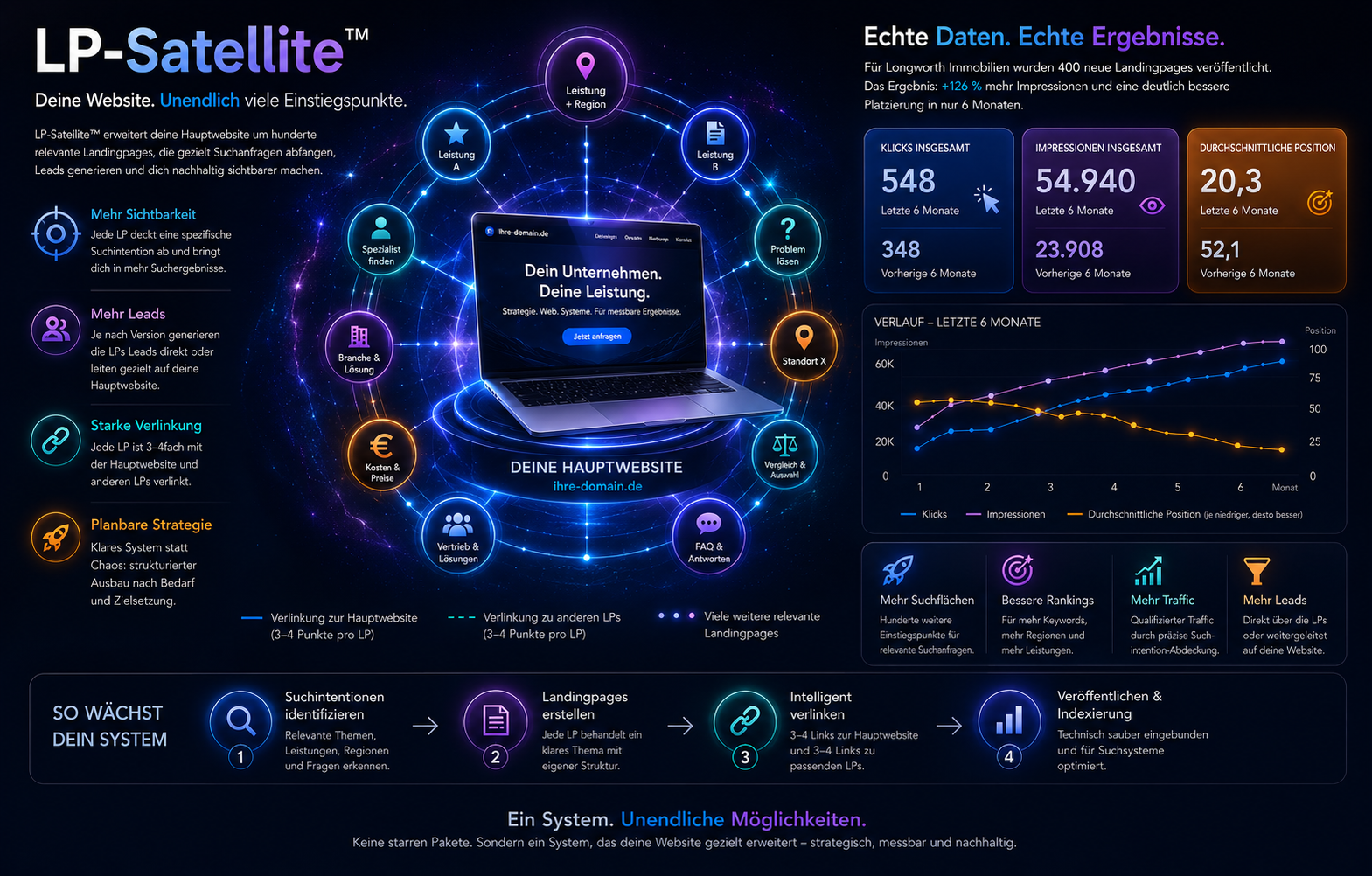
Global proof of systematic expansion
Systematic expansion requires clear rules, measurement, and technical stability
The global LP-Satellite™ case study demonstrates why extensive website development requires clear architecture, quality control, and measurement; for Website relaunch the rules for controlled migration, rather than purely visual updates, must therefore be defined before expansion. This reference is not from Lower Franconia and is not presented as a local customer relationship.
What Sets Us Apart
Responsibility for the system instead of selling off individual tasks
Classic project logic
-
Missing criterion for problem: Individual measures without a shared vision
-
Missing criterion for user guidance: Handoffs between strategy, design, and technology
-
Missing criterion for proof: Launch without a well-thought-out operational logic
VELUNO System Responsibility
-
Verifiable implementation for problem: Combining inventory and URL inventory with positioning and a new information architecture
-
Verifiable implementation for user guidance: Jointly planning migration and redirect concepts, performance, tracking, and technical QA
-
Verifiable implementation for proof: Considering operation and expansion from the outset
How We Work
From Current State to Sustainable System Logic: Four Controlled Steps
The process separates inventory, decision-making, implementation, and impact, ensuring clear progress Results can be verified. This phase only ends when the criterion, implementation, and expected impact are consistent for the problem.
Analysis
For the problem, the initial situation, decisions made, and implementation metrics are documented. Goals, existing content, systems, and risks are recorded. An inventory and URL survey provide the basis for reliable priorities.
Architecture
For user guidance, the initial situation, decisions made, and implementation metrics are documented. The target architecture defines the content inventory, target architecture, migration, and technical stability. Components, roles, and system boundaries are definitively established.
Implementation
This step defines a decision criterion and verifiable acceptance of the subsequent impact for the proof. Implementation follows the defined architecture and proceeds in verifiable steps. Changes are evaluated against the goal and dependencies.
Operations
For conversion, the initial situation, decisions made, and implementation metrics are documented. Post-launch stabilization, monitoring, and expansion are clearly defined. Monitoring and feedback determine the next logical development stage.
Typical Project Sizes
Project size is determined by dependencies and objectives, not by a one-size-fits-all approach.
Impact is demonstrated through controllable releases, reduced error rates, and a clearer foundation for relaunch. Flat-rate pricing, minimum budgets, and fixed timeframes would be unethical without reliable initial data.
Focused sub-project
The scope only expands if additional criteria influence the same implementation or the impact in the event of a problem.
Complete setup or rebuild
"Complete build or rebuild" remains the focus as long as the impact on user experience can be independently verified.
Scalable System Project
The scope only increases if additional criteria influence the same implementation or effect on proof.
What Determines the Scope
The scope only increases if additional criteria influence the same implementation or effect on conversion.
Further classifications
Background information on architecture, search, and digital systems
The following articles delve deeper into questions of architecture, visibility, and digital systems and help in classifying the next step.

SEO · GEO · AEO
Why classic SEO page models fall short in AI search
An explanation of how content must be structured so that search engines and response systems can reliably understand relationships.
Structure
Why company websites often fail due to their system logic
Analysis of typical breaks between content, user guidance, tracking, and technical maintainability.
Platforms
When a web project needs to evolve into a robust platform logic
Guidance for the transition from individual pages to roles, processes, data, and reusable system components.
FAQ
Frequently Asked Questions, Answered Objectively
The answers classify the scope, procedure, and Collaboration without any price, duration, or success guarantees.
A relaunch is advisable when structure, technology, or positioning are blocking fundamental goals and individual corrections no longer resolve the issue. Before making a decision, it should be clarified which content and signals must be retained.
For this purpose, existing URLs, rankings, internal links, and relevant content are fully inventoried. Redirect mapping, technical testing, and monitoring after the change reduce avoidable losses but cannot provide a blanket ranking guarantee.
No. Each piece of content is evaluated based on relevance, recency, search role, and technical dependencies, and then retained, merged, revised, or removed.
The duration depends on the scope, content status, decision-making processes, migration, and integrations. After analysis and defining the target architecture, a reliable process with verifiable milestones can be established; a fixed duration without this data would be speculative.
VELUNO collaborates with companies in Lower Franconia digitally and across the region. Workshops, coordination meetings, approvals, and acceptances are organized in clearly defined steps; no local branch or on-site support is claimed. For the initial inquiry, only the current situation, existing systems, objectives, and a realistic timeframe are required.
Next Step
Current friction can be transformed into a controllable development path.
For the initial assessment, the starting point, systems, and timeframe are sufficient; subsequently, criteria for the problem and the desired impact—"A controlled relaunch with clearer positioning, controlled migration, and a better technical foundation"—are defined, digitally and across regions with companies in Lower Franconia.