
For Osnabrück: Website relaunch with a clear structure and robust implementation.
Existing pages, navigation, and content are first disentangled before a new interface simply presents the same inconsistencies differently. For companies in Osnabrück, this results in a robust relaunch that secures content, URLs, technology, tracking, and operations. The "Target Image & Architecture" component receives clear inputs, deliverables, and acceptance criteria to prevent handovers from becoming a new source of errors.
The objection "We'll just transfer the existing content into a new design" is understandable, but it falls short. Multiple historical layers create duplicate content, unclear user paths, and page types that are difficult to maintain. Collaboration with companies from Osnabrück is conducted digitally and across regions; decisions, work progress, and approvals are documented. The target audience includes companies with organically grown, slow, or strategically outdated websites. The "Inventory and URL Review" section is only valuable if it leads to a verifiable next step.
Inventory and URL Inventory
The focus on "Inventory and URL Inventory" creates a reliable foundation for the next system decision.
Positioning and New Information Architecture
The focus on "Positioning and New Information Architecture" is measured against a concrete project decision rather than mere activity.
Migration and Redirect Concept
The focus on the "migration and redirect concept" is measured against a concrete project decision rather than mere activity.
Target Vision & Architecture
Migration & Development
Launch & Stabilization
Website relaunch becomes a system decision.
The systems approach connects the audit areas of "Inventory and URL Inventory," "Positioning and New Information Architecture," and "Migration and Redirect Concept." The new structure must function consistently in navigation, internal linking, content model, and editorial maintenance. This is aimed at companies with organically grown, slow, or strategically outdated websites. The audit area of "Launch and Development Plan" is only valuable if it results in a verifiable next step.
This service is aimed at companies with websites that have grown organically, are slow, or are strategically outdated. The industry focus is "cross-industry"; digital decisions should no longer be treated as isolated, individual projects.
Those who plan migration and operations too late jeopardize precisely what they want to preserve.
Before selecting a tool, layout, or feature, the target image must be robust. The new information architecture organizes services, target groups, and content according to their future role and eliminates unnecessary parallel structures. This classification applies to companies in Osnabrück as well as to comparable projects in the Georgsmarienhütte area, Wallenhorst and Bramsche. Collaboration and implementation remain digitally organized.
Old content is adopted without review
Without a clear decision on "Old content will be adopted without review," effort is shifted to later project phases. Priorities compete because the cause and the visible symptom are not clearly separated.
-
Priorities compete with each other
-
Decisions remain difficult to justify
-
Later changes become more expensive
URLs, rankings, and tracking are lost during the migration
Without a clear decision regarding "URLs, rankings, and tracking will be lost during the migration," effort is shifted to later project phases. Dependencies migrate to later project phases, creating unnecessary rework.
-
Data and states contradict each other
-
Handovers generate rework
-
Responsibility remains unclear
The new design sits on the same weak infrastructure
The weakness "The new design sits on the same weak structure" is not limited to this point. Multiple historical layers create duplicate content, unclear user paths, and page types that are difficult to maintain. This also affects content, technology, and operations.
-
Users experience inconsistencies
-
Maintenance becomes inconsistent
-
Expansion loses momentum
A robust relaunch connects the target vision, implementation, and transition to operation.
The new information architecture organizes services, target groups, and content according to their future role and eliminates unnecessary parallel structures. All four components thus pursue the same goal: a controlled relaunch with clearer positioning, controlled migration, and a better technical foundation. The service area Website Systems integrates this component into the overarching VELUNO system.
Analysis & Inventory
Existing pages, navigation, and content are first disentangled before a new interface simply presents the same inconsistencies differently. This results in a clear scope for "Analysis & Inventory" with verifiable inputs and results.
-
Page Inventory
-
URL and Redirect Plan
-
Tracking Inventory
-
Technical Risks
Target Vision & Architecture
This component translates business objectives into information architecture, page types, content decisions, and clear system boundaries. The new information architecture organizes services, target groups, and content according to their future role and eliminates unnecessary parallel structures.
-
Target Structure
-
Page Types
-
Content Mapping
-
CMS Decision
Migration & Development
VELUNO combines design, development, content transfer, redirects, and integrations in a controlled migration process. The "Untangling the Grown Structure" approach addresses the following: Multiple historical layers create duplicate content, unclear user paths, and page types that are difficult to maintain.
-
Components
-
Content Migration
-
Redirects
-
Quality Assurance
Launch & Stabilization
The "Launch & Stabilization" module defines what can be tested, implemented, and later expanded. The new structure must function consistently in navigation, internal linking, the content model, and editorial maintenance.
-
Launch Check
-
Indexing
-
Measurement
-
Stabilization
The project scope follows the bottleneck – not the desire for a large package.
Project size is not a measure of quality. A focused architecture sprint can clarify the critical page types and migration rules before the complete rebuild begins. The benchmarks remain maintained findability, clear user guidance, technical stability, and maintainable operation.
Focused Entry Point
Suitable if a core problem can be isolated and the rest of the site can initially remain stable. The new structure must function consistently in navigation, internal linking, content model, and editorial maintenance.
Structural Rebuild
Useful if content, technology, user experience, and operations share the same root causes. Multiple historical layers create duplicate content, unclear user paths, and page types that are difficult to maintain.
Systematic Expansion
Suitable if a stable core is followed by additional pages, functions, markets, or integrations. A focused architecture sprint can clarify the critical page types and migration rules before the full rebuild begins.
Four project logics demonstrate how the "Untangling an Organic Structure" approach translates into decision-making.
What matters is not the name of a customer, but the quality of the problem-solving. Each logic describes an independent path from the bottleneck to a reliable result and deliberately avoids fabricated key performance indicators (KPIs). A suitable project logic is shown on the page "B2B Website Rebuild ", without deriving a local reference promise from it.
B2B Relaunch
Focus: Inventory, Migration, and QA.
Project Logic
Inventory, Migration, and QA as a Cohesive Decision
Initial situation: Content, URLs, and technology have evolved organically over time and are difficult to change reliably. Key decision: Inventory, target structure, migration, and quality assurance are planned in a binding manner before implementation. Effect: The change protects relevant content and creates a maintainable foundation for expansion. For this initial situation, it is also relevant that organically grown pages, navigation, and content are first disentangled before a new interface simply presents the same inconsistencies differently.
Mid-Market Rebuild
Transferable Logic with a Focus on Migration.
Project Logic
How "SME Rebuild" puts the "Disentangling Organic Structures" approach into practice
Initial situation: Content, URLs, and technology have evolved organically over time and are difficult to change reliably. Key decision: Inventory, target structure, migration, and quality assurance are planned in a binding manner before implementation. Effect: The change protects relevant content and creates a maintainable foundation for expansion. For this starting point, the following is also relevant: Multiple historical layers create duplicate topics, unclear user paths, and page types that are difficult to maintain.
Multilingual Relaunch
Focus: Inventory, Migration, and QA.
Project Logic
The key decision for the "Multilingual Relaunch"
The starting point is clear: Content, URLs, and technology have evolved organically over time and are difficult to change reliably. Therefore, the project stipulates that inventory, target structure, migration, and quality assurance will be planned in a binding manner before implementation. This ensures that the change protects relevant content and creates a maintainable foundation for future expansion. Crucially, the new information architecture organizes services, target groups, and content according to their future role and eliminates unnecessary parallel structures.
Technical Consolidation with CMS Change
Focus: Inventory, Migration, and QA.
Project Logic
From Bottleneck to Clear Decision: Inventory and Migration
The starting point is clear: Content, URLs, and technology have evolved organically over time and are difficult to change reliably. Therefore, the project stipulates that inventory, target structure, migration, and quality assurance will be planned in a binding manner before implementation. This means that the change protects relevant content and creates a maintainable foundation for future expansion. Crucially, the relaunch results in a more understandable website with less structural friction and a clearer development path.
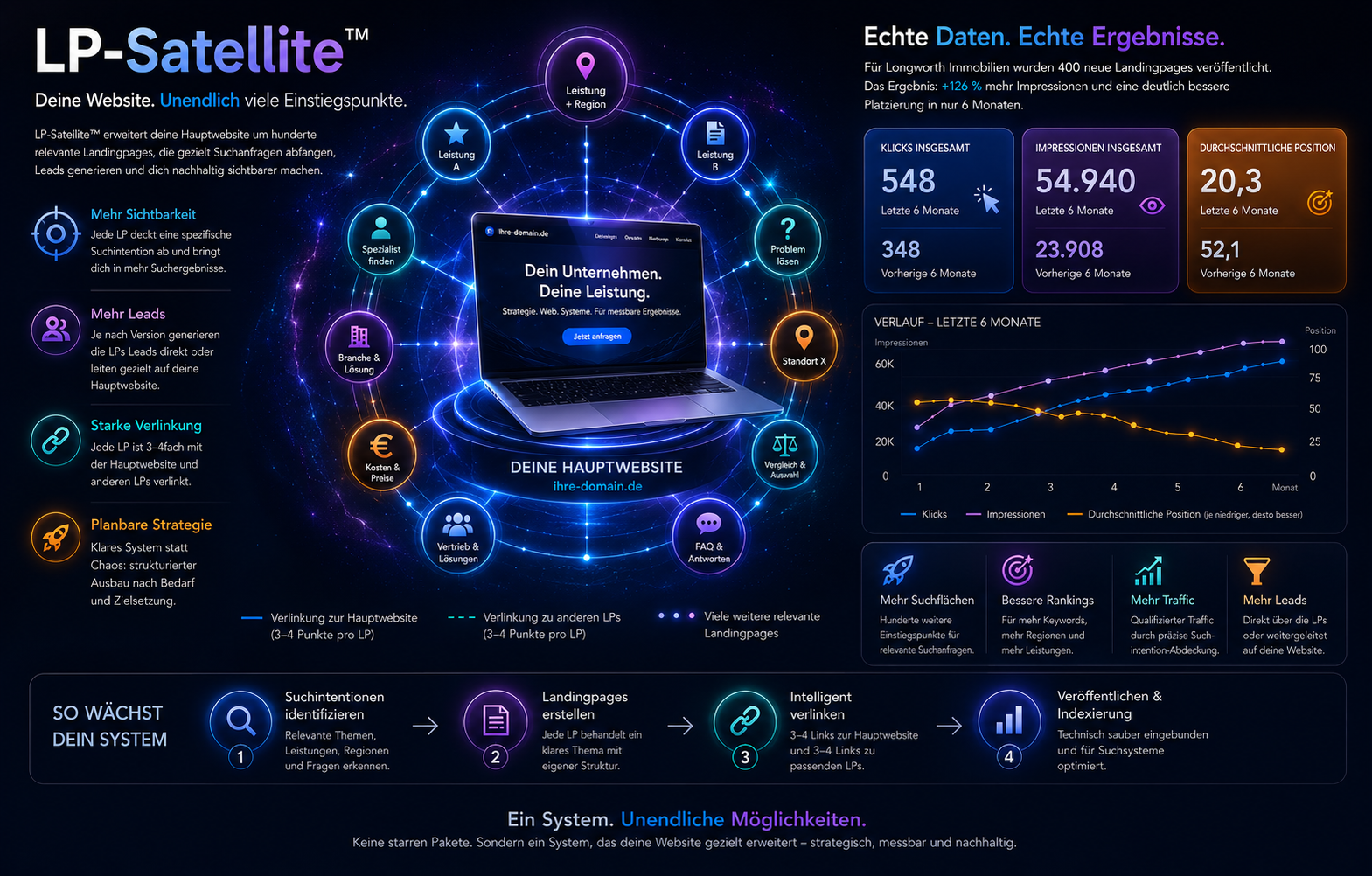
A global case study for controlled Landing PageExpansion
The reference demonstrates a systematic expansion using reusable structures. The connection to a website relaunch lies in the evidence type "technical quality criteria and operational logic," not in any claimed local customer proximity. Details remain consolidated in the global case study.
Website Relaunch: Sell Services or Take System Responsibility?
Classic Activity Logic
-
Individual measures without a common goal.
-
Transitions between strategy, design and technology.
-
Launch without a plan for operation and further development.
VELUNO system logic
-
VELUNO combines inventory and URL analysis with positioning and a new information architecture.
-
VELUNO plans migration and redirect concepts, performance, tracking, and technical quality assurance together.
-
VELUNO considers operation and expansion from the very beginning.
How the approach of "untangling an existing structure" is translated into a manageable project workflow.
The process first resolves the central misconception, makes the resulting risk visible, and then leads to improved decision-making logic. Decisions are documented in the project, risks are identified, and handovers are only released after clear checkpoints have been established.
Analysis
The analysis separates proven problems from assumptions and reveals dependencies. The focus is on the "Inventory and URL Survey" audit area.
Architecture
This stage establishes rules for the "Positioning and New Information Architecture" review area, for data pathways, and for future expansions. This reduces modifications during implementation.
Implementation
During implementation, content, user guidance, technology, and measurement are integrated in controlled work steps. The "Migration and Redirect Concept" audit point is secured with clear acceptance criteria.
Operations
For operations, monitoring, maintenance, responsibilities, and the next logical expansion stage are defined. The "Launch and Development Plan" review point thus remains part of the project.
The scope is determined by the root cause, dependencies, and the next reliable result.
A focused architecture sprint can clarify the critical page types and migration rules before the complete rebuild begins. A rebuild becomes necessary as soon as several system components need to be changed simultaneously. For a corresponding need in the surrounding area, there is additional information on website relaunch in Georgsmarienhütte; this does not imply any local presence.
Focused sub-project
The initial phase is deliberately small, but it resolves a complete bottleneck. A focused architecture sprint can clarify the critical page types and migration rules before the full rebuild begins.
Complete setup or rebuild
Suitable when multiple causes are interconnected and require a common foundation. The new information architecture organizes services, target groups, and content according to their future roles and eliminates unnecessary parallel structures.
Scalable System Project
Reusable components and documented rules form the stable core. The relaunch creates a more intuitive website with less structural friction and a clearer development path.
Decision-making based on need
There is no fixed price or contract duration. The new structure must function consistently in terms of navigation, internal linking, content model, and editorial maintenance. Only then can the scope of the project be justified.
Thinking ahead: Search architecture, website structure, and platform logic.
These three global articles delve into structural issues relevant to website relaunches. The content is referenced here only and not copied into the page.

SEO · GEO · AEO
Why Traditional SEO Page Models Often Fall Short in AI Search
How to make content structurally understandable for both traditional search and generative answer systems.
Structure
Why Many Corporate Websites Do Not Have a Marketing Problem, but a System Problem
The consequences of developing messaging, UX, tracking, content, and technology separately.
Platforms
From Web Project to Platform Logic: When a Company Becomes More Digitally Resilient
When reusable systems, portals, and integrated workflows provide a better foundation.
Official Regional Framework · GV-ISys
Osnabrück in the official municipal context
The Federal Statistical Office lists Osnabrück as a city in Lower Saxony. This information places Osnabrück regionally for the purposes of the Osnabrück website relaunch. It does not indicate a VELUNO location or a local customer relationship.
Population and area figures are taken from the official municipal register. Neither demand nor project success can be derived from this data. We continue to evaluate a project from Osnabrück based on its objective, existing infrastructure, system limitations, and required collaboration.
Federal state – Lower Saxony
District or Independent city – Osnabrück, City
Administrative postal code – 49,074
Area – 119.8 km²
Population as of December 31, 2024 – 166,057
Population density – 1,386 people per km²
Travel region in the GV-ISys – County of Bentheim-Emsland-Osnabrücker Land
Degree of urbanization – Densely populated
Official municipality code – 03404000
Official municipality name – Osnabrück, City
What the regional data on Osnabrück classifies – and what it doesn't
The data clearly defines Osnabrück and avoids confusion with places with the same or similar names. It does not replace an individual analysis by the requesting company.
What should be clarified before a website relaunch project.
Five factual answers regarding scope, approach, risks, and digital Collaboration in the project.
The decisive factor is not the age of the website, but its actual bottleneck. A focused architecture sprint can clarify the critical page types and migration rules before the complete rebuild begins. The expected benefits must justify the changes to content, technology, and operations.
The new structure must function consistently in terms of navigation, internal linking, content model, and editorial maintenance. This includes complete URL mapping, robust redirects, technical testing, and close monitoring. An absolute ranking guarantee would be irresponsible.
A blanket takeover would be exactly the wrong approach. Existing pages, navigation, and content must first be disentangled before a new interface simply presents the same inconsistencies differently. Every content decision requires a transparent and traceable connection to the new structure.
A fixed duration cannot be reliably determined without an inventory and scope. A focused architecture sprint can clarify the critical page types and migration rules before the complete rebuild begins. Page types, migration, integrations, approvals, and technical risks determine the process.
Collaboration takes place digitally and across regions. Workshops, work progress reports, decisions, and launch monitoring are organized to ensure accountability and progress remain transparent.
A structural bottleneck should not result in another individual project.
Describe existing systems, the specific bottleneck, the goal, and the timeframe. This will help determine whether a focused entry, a rebuild, or an scalable system project is appropriate. No local branch is claimed for Osnabrück; the project will be managed digitally.