
Website Performance Optimization Heidelberg: System Logic Instead of Digital Background.
The connection is clear. Loading times, mobile usability, and technical stability negatively impact visibility, conversion, and maintainability. In day-to-day operations, it becomes apparent that minor adjustments don't resolve the underlying system issue. VELUNO supports companies in Heidelberg with a digitally and regionally managed website performance project. Loading times, rendering, delivery, and technical stability are planned collaboratively. The goal: A measurably faster, more stable, and technically transparent website.
The expected benefits don't come from an isolated measure. The benchmark remains: Improved user experience, reduced technical risk, and a more robust foundation for SEO and conversion. The objection "A cache plugin should solve the problem" is therefore considered within the overall decision-making process. Collaboration with companies in Heidelberg is transparent, digital, and supra-regional; no local branch or on-site presence is claimed.
Measurement of real user and lab data
The component "Measurement of real user and lab data" provides a reliable basis for the next decision.
Frontend and Asset Analysis
The component "Frontend and Asset Analysis" is documented and approved using verifiable criteria.
Hosting, Caching, and Delivery
The component "Hosting, Caching, and Delivery" visibly contributes to the target state and remains expandable for future use.
Frontend & Assets
Hosting & Delivery
Monitoring & Operations
Performance arises from the interplay of elements.
Measurement data, frontend, assets, hosting, and caching must be examined as a coherent cause-and-effect chain. Loading time is the result of rendering, assets, content structure, server response, and delivery.
This addresses companies with slow websites, weak Core Web Vitals, or unstable technical setups. The focus is on the concrete benefits: improved user experience, reduced technical risk, and a more robust foundation for SEO and conversion.
Operational Friction as a Warning Signal: Analysis to Further Development.
Performance is addressed with individual plugins or compression, even though architecture, assets, hosting, and the frontend all interact. If only one team optimizes its part, the bottleneck often shifts to another location. This becomes relevant for companies with slow websites, weak Core Web Vitals, or unstable technical setups. Loading times, mobile usability, or technical stability negatively impact visibility, conversion, and maintainability. The search may also affect the adjacent area towards Leimen, Schwetzingen and Wiesloch; regardless, the collaboration remains digital and supra-regional.
Large assets and unnecessary frontend code slow down pages
Unplanned images, scripts, fonts, and components lengthen the critical rendering path. Mobile users experience longer wait times, layouts jump around, and interactions are delayed. If only one team optimizes their part, the bottleneck often simply shifts to another location.
-
Asset budget is insufficient
-
JavaScript is blocked
-
Layout shifts
Hosting and caching are not aligned with the system
Prioritization is given to what is actually slowing down current operations. Server response, caching strategy, and delivery don't align with the actual page logic. The result: Frontend optimizations are wasted if every request is processed unnecessarily expensively.
-
Slow server response
-
Cache without a concept
-
CDN misused
Individual optimizations postpone problems instead of solving them
Individual plugins change the symptoms, but not the underlying technical cause. The solution must work in everyday use and not just be convincing at launch. This leads to the following concrete consequence: Without a measurement plan, fluctuating results and new regressions occur after every update.
-
No baseline
-
Unclear priority
-
Regressions persist
Four building blocks: Analysis to further development; operational friction in everyday use.
The connection is clear. The common goal: A measurably faster, more stable, and technically verifiable website. The four building blocks follow analysis, architecture, implementation, and further development. Their contribution to concrete benefits is evaluated: improved user experience, reduced technical risk, and a more sustainable foundation for SEO and conversion. The biggest bottlenecks are prioritized based on real usage data, not on the easiest single measure. The technical framework is described on the page: Platforms & Infrastructure .
Measurement & Diagnostics
Lab data, field data, and loading processes are combined to create a reliable baseline. The audit distinguishes measurable bottlenecks from mere assumptions. The biggest bottlenecks are prioritized based on real usage data, not on the easiest single measure.
-
Measurement of real user and lab data
-
Network Waterfall
-
Core Web Vitals
-
Prioritized Findings
Frontend & Assets
Prioritization focuses on what is actually slowing down current operations. CSS, JavaScript, images, fonts, and components are ordered according to their impact and dependencies. This creates the benefit: The browser receives what is truly necessary for the visible content sooner.
-
Frontend and Asset Analysis
-
Asset Formats
-
Code Splitting
-
Component Budget
Hosting & Delivery
Performance Budgets and Monitoring connect editorial, frontend, and infrastructure during operation. The specific delivery contribution: Hosting, caching, CDN, and server-side processing are tailored to the system. This reduces response times without compromising maintainability through custom solutions.
-
Hosting, Caching, and Delivery
-
Cache Rules
-
CDN Delivery
-
CMS Configuration
Monitoring & Operations
Measurement and technical quality are continuously monitored after rollout. Performance thus remains an ongoing operational metric rather than a one-time acceptance test. If only one team optimizes its part, the bottleneck often simply shifts to another location.
-
Code and Component Optimization
-
Post-Implementation Monitoring
-
Error Budgets
-
Further Development
Project Scope: From Analysis to Further Development; Operational Friction in Daily Practice.
Not every starting point requires a complete rebuild. The biggest bottlenecks are prioritized based on real usage data, not on the easiest single measure. The initial phase is limited so that the next expansion stage remains open.
Focused Entry Point
A clearly defined scope establishes solid facts before further components are added. Operational friction becomes apparent in handovers, rework, and a lack of decision-making.
Structural Rebuild
The Rebuild Combines loading time, rendering, delivery, and technical stability in a common target architecture. If only one team optimizes its part, the bottleneck often shifts to another location.
Systematic Expansion
The system project separates core architecture from subsequent extensions. Operation, measurement, and responsibilities remain transparent.
Four Project Logics: From Analysis to Further Development; Operational Friction in Daily Practice.
Good project examples not only explain the result. They make visible which risk was addressed first and why a particular decision was made. Guiding principle: Optimize frontend, hosting, and content together.
Core Web Vitals Remediation
Website Performance · Anonymized Decision Logic
Initial Situation · Decision · Impact
Core Web Vitals Remediation: Effectiveness is achieved through a clear sequence.
Initial Situation: A website that has grown organically is missing key core web vitals and is sluggish on mobile devices. Operational friction is evident in handoffs, rework, and a lack of decision-making.
Measurement of real user and lab data
Analysis
Performance rebuild
Website Performance · Anonymized Decision Logic
Initial Situation · Decision · Impact
Performance Rebuild: From visible symptoms to a robust structure.
Initial Situation: The existing frontend is difficult to optimize due to numerous dependencies. Prioritization is based on what is actually slowing down current operations. Decision: Instead of further patches, a lean rendering and component framework is defined. Impact: The website becomes more stable, transparent, and can be expanded without introducing new legacy technical burdens. The impact is monitored during operation at clearly defined handover points and measurement points. This process integrates operational friction in daily operations, the path from analysis to further development, and the guiding principle of "optimizing frontend, hosting, and content together."
Frontend and Asset Analysis
Architecture
CMS and Asset Consolidation
Website Performance · Anonymized Decision Logic
Initial Situation · Decision · Impact
CMS and Asset Consolidation: Impact arises from a clear sequence.
Initial Situation: The CMS, media library, and templates deliver assets that are too large or duplicated. The problem and its specific consequences are clarified first, before defining the target image and system solution. Decision: Formats, variants, loading behavior, and editorial rules are consolidated. Impact: Editorial and technical teams subsequently work with clearly defined performance limits. This process integrates operational friction in daily operations, the path from analysis to further development, and the guiding principle of "optimizing frontend, hosting, and content together."
Hosting, Caching, and Delivery
Implementation
Technical Foundation for SEO Growth
Website Performance · Anonymized Decision Logic
Initial Situation · Decision · Impact
Technical Foundation for SEO Growth: Optimizing Frontend, Hosting, and Content Together in Practice.
Initial Situation: Organic growth fails due to slow templates and inconsistent technical quality. Performance budgets and monitoring connect editorial, frontend, and infrastructure during operation. Decision: technical basis The content is standardized and monitored before expansion. The decision follows analysis, architecture, implementation, and further development. Impact: New pages launch with reliable loading and quality standards. This approach integrates operational friction in daily operations, the path from analysis to further development, and the guiding principle of "optimizing frontend, hosting, and content together."
Code and Component Optimization
Operations
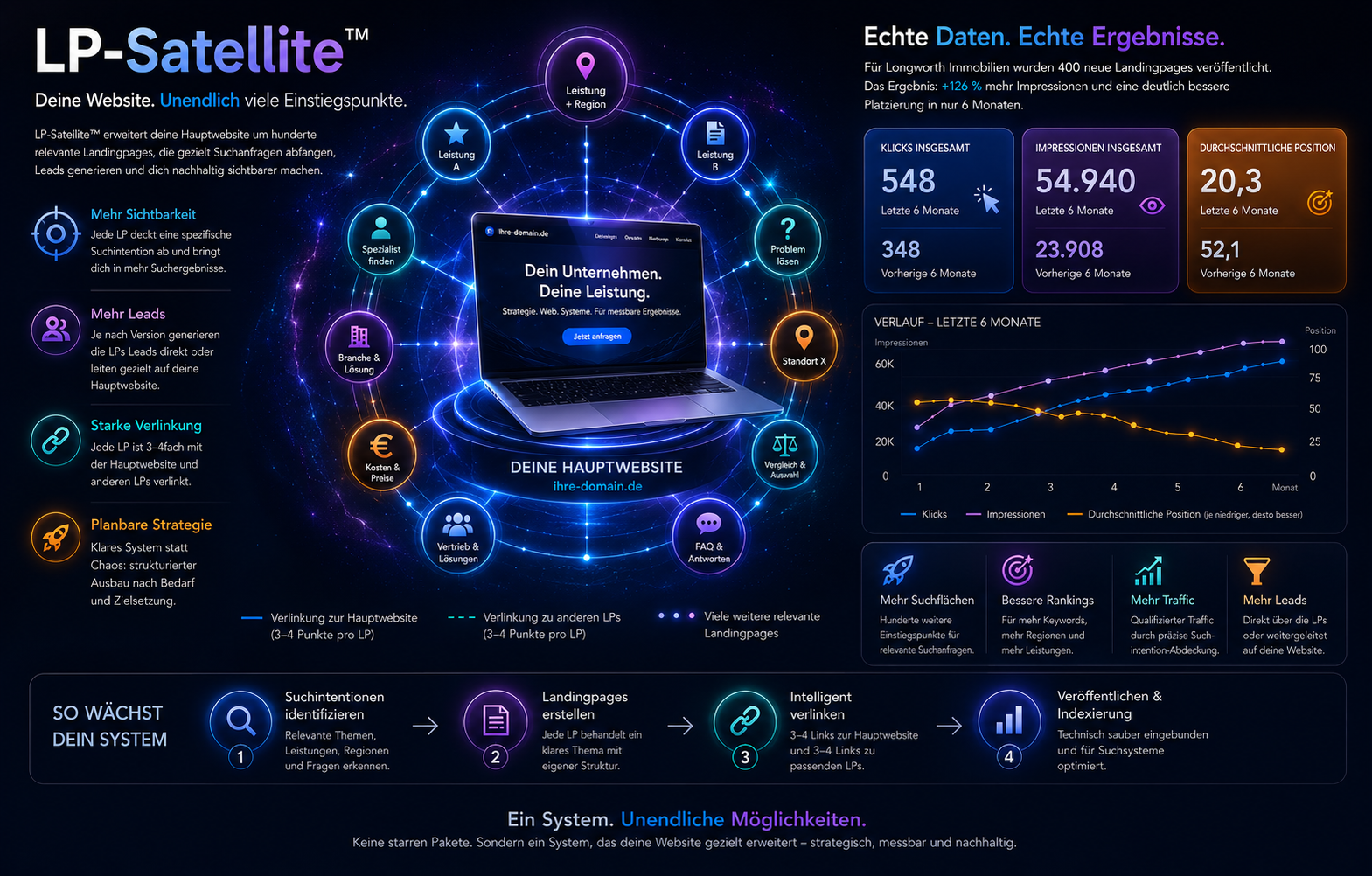
Systematic expansion as verifiable proof of website performance.
The global expansion case study primarily demonstrates the disciplined combination of a technical framework, controlled publication, and ongoing measurement. The connection to this page lies in the guiding principle of "optimizing frontend, hosting, and content together": Deliverables, measurement points, and expansion limits are made visible before implementation. The corresponding service context is found under Website Systems described.
System responsibility: Analysis, further development, and operational friction in daily practice.
Classic project logic
-
Individual measures without a shared vision
-
Handover between strategy, design, and technology
-
Launch without a well-thought-out operational logic
VELUNO system logic
-
Combining the measurement of real-world user and lab data with frontend and asset analysis
-
Jointly planning hosting, caching, delivery, and code and component optimization
-
Considering operation and expansion from the outset
Four steps: Analysis to further development; operational friction in daily practice.
The problem and its concrete consequences are clarified first, before the target architecture and system solution are defined. Each phase ends with a documented decision rather than mere activity.
Analysis
Initial situation, objective, risks, and open decisions are jointly recorded. Operational friction becomes visible in handovers, rework, and missing decisions.
Architecture
The target architecture prioritizes loading time, rendering, delivery, and technical stability, and defines system limits, measurement points, and deliverables.
Implementation
Implementation is carried out in verifiable packages with clear handovers. The solution must function flawlessly in everyday use and not just impress at launch.
Operations
Operations verifies effectiveness, technical stability, and the need for changes. Responsibilities and handovers are clarified to prevent any new friction.
Three project sizes: analysis to further development; operational friction in daily use.
Project sizes are defined by deliverables and system boundaries. Performance budgets and monitoring connect editorial, frontend, and infrastructure during ongoing operations.
Focused sub-project
Suitable when a clearly defined bottleneck needs to be addressed first. The biggest bottlenecks are prioritized based on real usage data, not on the easiest single measure. Architecture and measurement remain compatible for future expansion.
Complete setup or rebuild
The complete rebuild replaces several interconnected legacy systems with a unified target architecture. Prioritization focuses on what is actually slowing down current operations.
Scalable System Project
Core architecture and expansion phases are planned separately. This allows for the controlled addition of further markets, content, or functions.
"Optimizing Frontend, Hosting, and Content Together" – a more in-depth look at operational friction in everyday practice.
These three articles delve deeper into technical readability, website structure, and platform logic. Website structural errors are also relevant in this specific context.

SEO · GEO · AEO
Why Traditional SEO Page Models Often Fall Short in AI Search
How visibility changes when content must not only rank, but also be understood and cited.
Structure
Why Many Corporate Websites Do Not Have a Marketing Problem, but a System Problem
What goes wrong when content, tracking, UX, and technology coexist instead of working together.
Platforms
From Web Project to Platform Logic: When a Company Becomes More Digitally Resilient
When website logic is no longer enough—and why portals, workflows, and reusable systems are then the logical next step.
Official Regional Framework · GV-ISys
Heidelberg in the Official Municipal Context
The Federal Statistical Office lists Heidelberg as a city in Baden-Württemberg. This data places Heidelberg regionally in terms of website performance. It does not substantiate a VELUNO location or a local customer relationship.
Population and area data are taken from the official municipal register.
Travel region in the GV-ISys – Northern Baden-Württemberg
Degree of urbanization – Densely populated
Official municipality code – 08221,000
Official municipality name – City of Heidelberg
Federal state – Baden-Württemberg
District or Independent city – Heidelberg, Urban District
Administrative postal code – 69,117
Area – 108.83 km²
Population as of December 31, 2024 – 155,756
Population density – 1,431 people per km²
What the regional data on Heidelberg classifies – and what it doesn't
The data clearly defines the boundaries of Heidelberg and avoids confusion with places with the same or similar names. It does not replace an individual analysis by the requesting company.
Website Performance in Heidelberg: Questions to Consider Before Starting a Project.
Direct answers regarding scope, risks, collaboration, and sensible expansion logic.
Multiple factors usually have the strongest impact: server response, rendering path, images, scripts, fonts, and third-party code. A reliable priority can only be established based on real user data and reproducible lab tests. The biggest bottlenecks are prioritized based on actual usage data, not on the easiest single measure.
Largest Contentful Paint, Interaction to Next Paint, and Cumulative Layout Shift are relevant metrics. These key performance indicators (KPIs) must be considered in the context of page types, devices, and actual users. If only one team optimizes its part, the bottleneck often shifts to another location.
Yes, provided the architecture and technical condition offer sufficient leeway. An audit reveals whether targeted interventions are sufficient or a structural rebuild is more economical. Load time is the result of rendering, assets, content structure, server response, and delivery.
Before implementation, a baseline is established using field and lab data. After changes, the same page types are retested and monitored to prevent regressions. Performance budgets and monitoring connect editorial teams, frontend, and infrastructure during operation.
This requires access to measurement tools, hosting and CMS information, and a clear technical contact person. Collaboration with companies in Heidelberg is organized digitally and across regions; a local branch is not necessary.
Next step: Analysis to further development; operational friction in daily practice.
For a reliable assessment, the initial situation, existing website or systems, goal, and desired timeframe are sufficient. The guiding principle "optimizing frontend, hosting, and content together" indicates which decision should be examined first. Website performance optimization in Leimen is also available for related search queries.