
Web development Jena: System logic instead of digital scenery.
Functions, data flows, or integrations cannot be structured and mapped using existing standard solutions. In day-to-day operations, it becomes clear that minor adjustments don't solve the underlying system problem. VELUNO supports companies in Jena with a digitally and regionally managed web development project. Requirements, system boundaries, data model, frontend, backend, testing, and operations are planned collaboratively. The goal: a maintainable, high-performance, and scalable web solution with a clear architecture.
"Custom web development automatically becomes expensive and difficult to maintain." This objection is understandable, but it only addresses part of the underlying issue. The tangible benefit remains: fewer technical dead ends and a solution that can be further developed in a controlled manner. Collaboration with companies in Jena is transparent, digital, and supra-regional; no local branch or on-site presence is claimed.
Requirements and System Boundaries
The "Requirements and System Boundaries" module provides a reliable basis for the next decision.
Data Model and Integrations
The "Data Model and Integrations" module is documented and approved using verifiable criteria.
Frontend and Backend Architecture
The "Frontend and Backend Architecture" module visibly contributes to the desired outcome and remains expandable in the future.
Architecture & Data
Development & Integration
Testing, Deployment & Operations
Web Development Begins with Architectural Decisions
Technology can only be meaningfully evaluated once user tasks, data flows, integrations, and quality requirements are clear. Functions only make sense once system boundaries, the data model, and operational responsibilities are defined.
This addresses companies with requirements that go beyond standard templates and simple CMS pages. The evaluation focuses on the concrete benefits: fewer technical dead ends and a solution that can be further developed in a controlled manner.
Operational Friction as a Warning Signal: Analysis to Further Development.
Custom development too often starts with features instead of system boundaries, the data model, and operations. Without this sequence, custom approaches, integration efforts, and subsequent technical costs increase simultaneously. This question becomes relevant for companies with requirements that go beyond standard templates and simple CMS pages. Functions, data flows, or integrations cannot be structured and mapped using existing standard solutions. The search may also extend to the surrounding area towards Apolda, Weimar, and Naumburg Regardless, the collaboration remains digital and supra-regional.
Features are built without a robust data and role model.
Development optimizes individual requirements, but not the overall process. The cause is not a single issue. Requirements are collected as a feature list without clarifying user tasks and system boundaries. Without this prioritization, custom solutions, integration efforts, and subsequent technical costs increase simultaneously.
-
Feature list
-
Goal unclear
-
Boundaries missing
Interfaces are fragile or manual
Prioritization is based on what actually slows down current operations. Data models and interfaces are developed in parallel with the user interface. The result: Late changes have a profound impact on the frontend, backend, and operations.
-
Data delivered too late
-
APIs improvised
-
Dependencies grow
Maintenance depends on individuals or undocumented code
The architecture prioritizes core processes and dependencies before a large backlog develops. Specifically, this manifests as follows: testing, deployment, documentation, and maintenance are treated as the final tasks. The system works at launch but remains difficult to develop securely.
-
Tests incomplete
-
Deployment manual
-
Knowledge not documented
Four building blocks: Analysis to further development; operational friction in everyday use.
The order is deliberate. The common goal: a maintainable, high-performing, and extensible web solution with a clear architecture. The four building blocks follow analysis, architecture, implementation, and further development. Their contribution to concrete benefits is evaluated: fewer technical dead ends and a solution that can be further developed in a controlled manner. The architecture prioritizes core processes and dependencies before a comprehensive backlog is created. The technical framework is described on the page Digital Products .
System Analysis
The architecture prioritizes core processes and dependencies before a large backlog is created. The specific deliverables—user tasks, requirements, risks, and clear system boundaries—are described before the technology decision. The project is given a verifiable, functional framework.
-
Requirements and System Boundaries
-
User Tasks
-
Risks
-
System boundaries
Architecture & Data
The frontend and backend operate on the same rules. The building block is clearly defined for this purpose. The data model, integrations, states, and responsibilities are defined as the technical architecture. Functions only make sense once system boundaries, the data model, and operational responsibilities are clarified.
-
Data Model and Integrations
-
APIs
-
States
-
Responsibility
Development & Integration
Further development takes place via clearly separated modules, documented interfaces, and controlled releases. The solution must function in everyday use and not just be convincing at launch. Operationally, this means: The frontend, backend, and interfaces are implemented modularly and tested against defined quality criteria. Performance, security, and usability remain integral to the development process.
-
Frontend and Backend Architecture
-
Backend
-
Tests
-
Security
Testing, Deployment & Operations
Deployment, monitoring, documentation, and maintenance are set up for real-world operation. Without this sequence, custom workarounds, integration efforts, and subsequent technical costs increase simultaneously. The effect on the overall project: The system can be further developed in a traceable manner.
-
Performance, Security, and Testing
-
Deployment, Documentation, and Operation
-
Documentation
-
Maintenance
Project Scope: From Analysis to Further Development; Operational Friction in Daily Practice.
Not every starting point requires a complete rebuild immediately. The architecture prioritizes core processes and dependencies before a large backlog is created. The initial phase is limited so that the next expansion stage remains open.
Focused Entry Point
The initial phase isolates the bottleneck with the greatest impact. The architecture prioritizes core processes and dependencies before a large backlog is created. The goal, measurement point, and system boundary are defined before implementation.
Structural Rebuild
Several related issues are resolved in a controlled rebuild. Prioritization is based on what is actually slowing down current operations.
Systematic Expansion
Expansion begins on a stable foundation and adds further modules in verifiable steps. Further development takes place via clearly separated modules, documented interfaces, and controlled releases.
Four Project Logics: From Analysis to Further Development; Operational Friction in Daily Practice.
Each logic begins with a different starting point and ends without fabricated key performance indicators. Decision quality and operational impact are relevant, not the size of a logo.
Custom web application
Web Development · Anonymized Decision Logic
Initial Situation · Decision · Impact
Custom Web Application: Architecture Before Feature List in Practice
Initial Situation: An internal process is managed via spreadsheets, email, and manual data transfer. The central risk is assessed using the guiding principle of "architecture before feature list." Decision: User tasks, the data model, and interfaces are defined before the user interface. Effect: A web application maps the process transparently and step-by-step. Functions only make sense once system boundaries, the data model, and operational responsibilities are defined. This approach integrates operational friction in daily use, the path from analysis to further development, and the guiding principle of "architecture before feature list."
Requirements and System Boundaries
Analysis
SaaS Platform
Web Development · Anonymized Decision Logic
Initial Situation · Decision · Impact
SaaS Platform: Architecture Before Feature List in Practice
Initial Situation: An existing website requires functionalities that cannot be reliably implemented with standard plugins. Prioritization is based on what is currently slowing down operations. Decision: System boundaries and extension points are clearly separated between the CMS and the application. Impact: New functionalities remain maintainable and do not jeopardize editorial operations. The impact is evaluated during operation using clear handoffs and measurement points. This process integrates operational friction in daily use, the path from analysis to further development, and the guiding principle of "architecture before feature list."
Data Model and Integrations
Architecture
Web Development · Anonymized Decision Logic
Initial Situation · Decision · Impact
Customer Portal: Clarify the core decision before implementation.
Initial Situation: Several systems need to exchange data, but they use different models and states. Without this sequence, custom workarounds, integration effort, and subsequent technical costs increase simultaneously. Decision: APIs, mapping, error handling, and responsibilities are defined before implementation. The decision follows analysis, architecture, implementation, and further development. Impact: Integrations become testable, and operations gain clear diagnostic paths. This approach integrates operational friction in daily operations, the path from analysis to further development, and the guiding principle of "architecture before feature list."
Frontend and Backend Architecture
Implementation
Technical website platform with APIs
Web Development · Anonymized Decision Logic
Initial Situation · Decision · Impact
Technical website platform with APIs: Architecture before feature list applied in practice.
Initial Situation: A custom application is growing, but releases are manual and risky. The current state is condensed to the critical bottleneck; this leads to the architecture and controlled expansion. Decision: Testing, deployment, monitoring, and documentation are established as the operational framework. Impact: Further development becomes more predictable, and errors can be isolated more quickly. This brings together the operational friction of everyday work, the path from analysis to further development, and the guiding principle of "architecture before feature list."
Performance, Security, and Testing
Operations
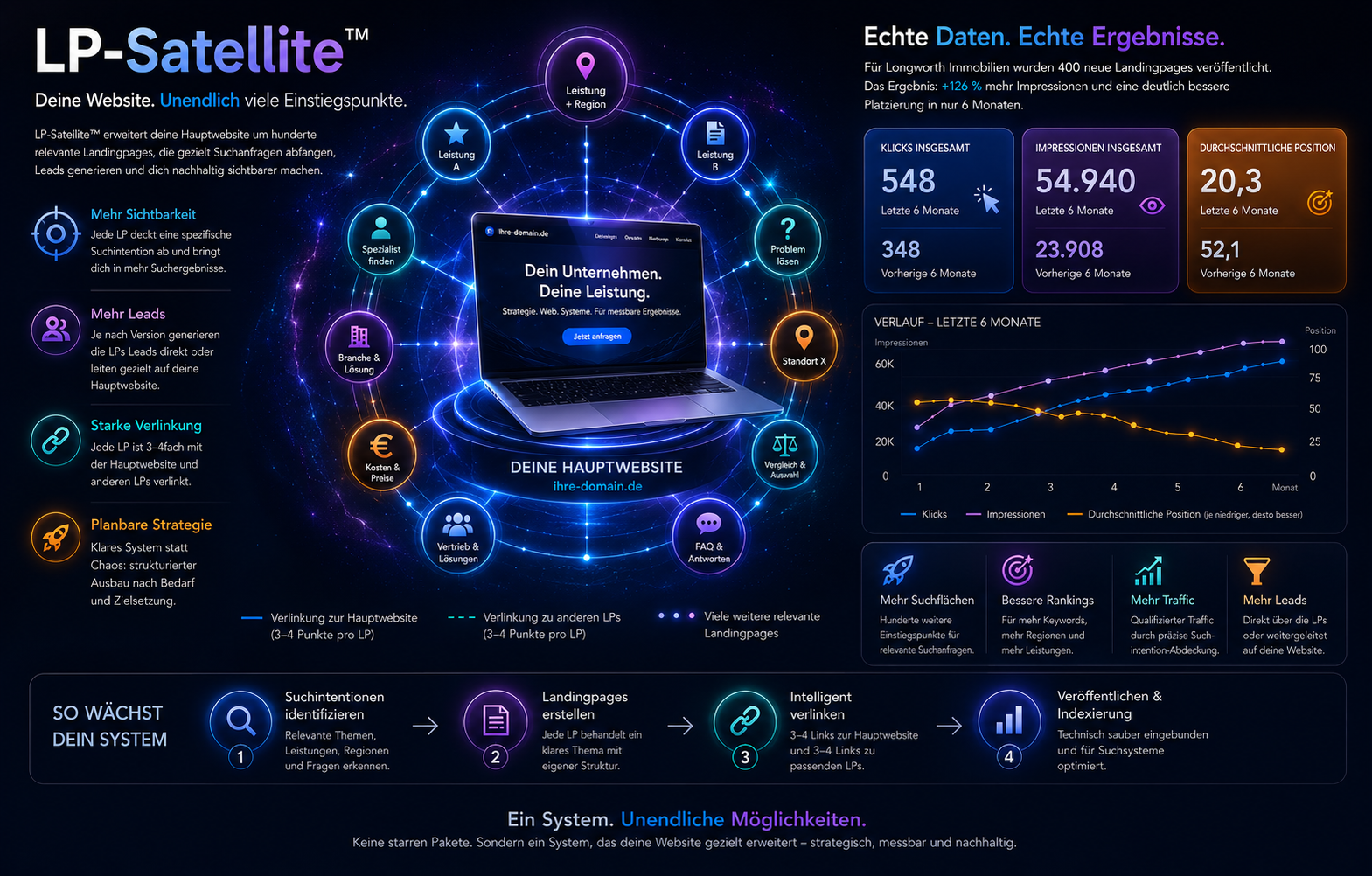
Systematic expansion as a verifiable proof of web development.
The global expansion case demonstrates a controlled technical and editorial system; the same verifiability is crucial for individual development. The connection to this page lies in the guiding principle of "architecture before feature list": deliverables, measurement points, and expansion limits are made visible before implementation. The relevant service context is found under Platforms & Infrastructure described.
System responsibility: Analysis, further development, and operational friction in daily practice.
Classic project logic
-
Individual measures without a shared vision
-
Handover between strategy, design, and technology
-
Launch without a well-thought-out operational logic
VELUNO system logic
-
Connecting requirements and system boundaries with the data model and integrations
-
Planning frontend and backend architecture, performance, security, and testing together
-
Considering operation and expansion from the outset
Four steps: Analysis to further development; operational friction in daily practice.
The work follows analysis, architecture, implementation, and further development. Further development is achieved through clearly separated modules, documented interfaces, and controlled releases.
Analysis
Initial situation, objective, risks, and open decisions are jointly recorded. Operational friction becomes visible in handovers, rework, and missing decisions.
Architecture
Priorities, components, and technical dependencies are bindingly defined before implementation. The architecture prioritizes core processes and dependencies before a large backlog is created.
Implementation
Each component is checked against the target state and dependencies before it is incorporated into the overall system. The architecture prioritizes core processes and dependencies before a large backlog is created.
Operations
Monitoring, maintenance, and defined responsibilities prevent the solution from reverting to an unplanned state after launch.
Three project sizes: analysis to further development; operational friction in daily use.
There is no rigid boundary between a focused sub-project and the complete system build. The architecture prioritizes core processes and dependencies before a large backlog is created.
Focused sub-project
Suitable when a clearly defined bottleneck needs to be resolved first. The architecture prioritizes core processes and dependencies before a large backlog is created. The architecture and measurement remain adaptable for future expansion.
Complete build or Rebuild
It makes sense to renew positioning, structure, technology, and content together. Without this sequence, custom approaches, integration efforts, and subsequent technical costs increase simultaneously.
Scalable System Project
Core architecture and expansion phases are planned separately. This allows for the controlled addition of further markets, content, or functions.
Further exploration of "architecture before feature list": Operational friction in everyday practice.
The three contributions delve deeper into technical readability, website structure, and platform logic. Also relevant to the specific context is SaaS Platform .

SEO · GEO · AEO
Why Traditional SEO Page Models Often Fall Short in AI Search
How visibility changes when content must not only rank, but also be understood and cited.
Structure
Why Many Corporate Websites Do Not Have a Marketing Problem, but a System Problem
What goes wrong when content, tracking, UX, and technology coexist instead of working together.
Platforms
From Web Project to Platform Logic: When a Company Becomes More Digitally Resilient
When website logic is no longer enough—and why portals, workflows, and reusable systems are then the logical next step.
Official Regional Framework · GV-ISys
Jena in the official municipal context
The Federal Statistical Office lists Jena as a city in Thuringia. This information places Jena regionally for web development. It does not indicate a VELUNO location or a local customer relationship.
Population and area data are taken from the official municipal register. Neither demand nor project success can be derived from this information. We continue to evaluate projects from Jena based on their objectives, existing infrastructure, system limitations, and necessary collaboration.
Population density – 956 people per km²
Travel region in the GV-ISys – Saaleland
Degree of urbanization – Densely populated
Official municipality code – 16053000
Official municipality name – Jena, City
Federal state – Thuringia
District or Independent city – Jena, City
Administrative postal code – 07743
Area – 114.77 km²
Population as of December 31, 2024 – 109,725
What the regional data on Jena classifies – and what it doesn't
The data clearly defines Jena and avoids confusion with places with the same or similar names. It does not replace an individual analysis by the requesting company.
Web development in Jena: Questions to ask before starting a project.
Direct answers regarding scope, risks, collaboration, and sensible expansion logic.
Custom web development is advisable when processes, roles, or integrations cannot be reliably mapped using standard templates. The decision should be based on requirements and system boundaries, not on a desire for specialized technology. The architecture prioritizes core processes and dependencies before a large backlog is created.
The technology is chosen to match requirements, existing infrastructure, integrations, team, and operating model. A generic list of frameworks without context would not be a reliable recommendation. Without this prioritization, custom solutions, integration effort, and subsequent technical costs increase simultaneously.
Interfaces and data flows are described using source systems, models, states, responsibilities, and error handling. Only then are APIs and technical implementations carried out. Functions only make sense once system boundaries, the data model, and operational responsibility have been clarified.
Maintainability is achieved through clear modules, tests, documentation, automated deployment, monitoring, and traceable dependencies. Responsibilities and update processes are also part of this. Further development is carried out via clearly separated modules, documented interfaces, and controlled releases.
The project is managed digitally through requirements workshops, architectural decisions, iterative releases, and acceptance testing. Business and technical contacts are regularly involved. Collaboration with companies in Jena is organized digitally and across regions; a local branch is not required.
Next step: Analysis to further development; operational friction in daily practice.
The first step is not choosing a package, but defining the most important problem. The goal: A maintainable, high-performing, and extensible web solution with a clear architecture. Web development in Apolda is also available for related searches.