
Web Design Zittau: Information Architecture Instead of Page Count.
More Pages Don't Solve Orientation Problems. For companies in Zittau, VELUNO first develops an information architecture that logically organizes offers, user questions, and next steps. Only on this foundation are content, design system, and technology developed to create a fast, clearly positioned, and inquiry-oriented company website.
A visually modern website can still explain too much, hide important information, or lose visitors among similar subpages. What matters is not the scope and effects, but rather clear page roles, straightforward conversion paths, and a technical foundation that allows for controlled expansion. The collaboration is digital and supra-regional, without maintaining a local presence in Zittau.
Positioning and Messaging
Sharpens the target audience, value proposition, and the messages that truly facilitate selection.
Information Architecture
Organizes pages, content, and user queries in a clear hierarchy with unambiguous roles.
UX and conversion management
Leads from orientation and trust to a comprehensible next step.
First page roles, then page count.
Every page needs a clear purpose: to provide orientation, explain a service, address an objection, build trust, or enable the next step. Without these roles, content grows, but decision-making remains weak.
For companies whose existing website contains a lot of content but doesn't prioritize enough, repeats statements, or doesn't consistently prepare for qualified inquiries.
When more content further impairs orientation
The common misconception is: If users can't find something, another subpage is needed. In reality, additional content exacerbates the problem as soon as hierarchy, terminology, and internal linking are unclear. For companies in Zittau and the surrounding area of GörlitzLöbau and Bautzen, a clear structure is therefore more important than the most comprehensive relaunch possible.
A comparable regional search term is categorized separately for web design in Görlitz.
The key question remains: Which approach makes sense for web design in Zittau if the result is not only supposed to look modern but also function structurally? Design, positioning, structure, and technology were treated separately. This relationship must be clarified before the first design or development decision, because later corrections will only shift the symptoms.
Unclear positioning and interchangeable statements
Vague statements create multiple pages with virtually the same promise. Users don't recognize priorities, search engines see overlaps, and internal teams don't know which page should be maintained in the future.
-
Overlapping statements
-
unclear priorities
-
Internal competition
Arbitrary page logic without clear decision-making
If navigation and page types originate from the internal organization, the website follows departments instead of questions. Visitors jump between levels without receiving sound decision-making support.
-
Department-driven navigation
-
Long search paths
-
Missing decision points
Technology that is slow, difficult to maintain, or poorly extensible
A website that has grown organically over time makes cleanup difficult because templates, URLs, and content are interdependent. New pages inherit old errors and increase the effort required for future migrations.
-
Rigid templates
-
Legacy URLs
-
Growing migration
An architecture where content and user journey align
VELUNO first organizes search queries, user questions, services, and existing content. This results in page types with a clear role and a logical connection between them. Design and technology implement this order instead of simply modernizing an unclear structure visually.
The functional building blocks are listed under Digital Experience and Website Systems .
The quality foundation connects positioning and messaging, information architecture and UX and conversion management; solid technical implementation, performance, and maintainability are also essential components.
A clearly positioned, fast, and inquiry-oriented company website is not an abstract goal, but a benchmark for every priority. The practical benefits: clearer communication, better user guidance, and a robust technical foundation. Each development stage must demonstrably contribute to this goal before additional functions or content are added.
Positioning & Messaging
Positioning and messaging create a common vocabulary for services, target groups, and benefits. Repetition is reduced without blurring relevant distinctions.
-
Conceptual model
-
Service differentiation
-
Key Messages
-
Redundancy reduction
Information architecture & UX
Information architecture and UX determine which page answers which question and how users move between orientation, in-depth exploration, and interaction.
-
Page Types
-
User questions
-
Linking
-
Conversion Paths
Design system & frontend
A design system maps page types and content priority in reusable components. The frontend remains consistent, fast, and accessible.
-
Components
-
Content hierarchy
-
Responsive UX
-
Frontend
Performance, tracking & operation
Performance, tracking, and operations reveal which approaches are working and where content needs improvement. Extensions follow fixed rules instead of case-by-case decisions.
-
Loading time.
-
Measurement
-
Maintenance
-
Expansion Rules
Start small, without obstructing the future structure
A focused approach can be beneficial if a central area is first organized and used as a model for the rest. It is crucial that the overarching architecture is considered from the outset; otherwise, it will simply create another exception. The chosen starting point must be usable independently while simultaneously enabling a controlled next step.
Focused Entry Point
A service family or central user journey is restructured and serves as a robust template for other pages.
Structural Rebuild
In cases of overlapping content and legacy technical issues, page inventory, target architecture, migration, and components are addressed collaboratively.
Systematic Expansion
Following the organized core, additional services, campaigns, or locations are implemented based on defined page types and quality standards.
Four project logics for organized page landscapes
The examples describe anonymized decision patterns and do not refer to Zittau. They demonstrate how a well-defined information architecture can have different consequences for content, migration, and technology depending on the initial situation.
Further classification is provided B2B Website Rebuild.
Company website with a clear performance logic
Clear page roles replace competing ones Service Pages.
Initial Situation · Decision · Impact
Clear page roles replace competing service pages
Initial situation: A company website distributes services across many similarly named pages. Decision: Services are transferred into a clear hierarchy with unambiguous entry points. Effect: Users and editorial staff know which page is responsible for what.
B2B Relaunch with a New Information Architecture
Migration follows a pre-tested target architecture.
Initial Situation · Decision · Impact
Migration follows a pre-tested target architecture.
Initial situation: A B2B website has valuable content but no consistent navigation or URL logic. Decision: Page types, target paths, and migration are defined before the redesign. Impact: The relaunch preserves substance and eliminates structural redundancies.
Search Architecture System for Recurring Campaigns
Campaigns are integrated into the existing information system.
Initial Situation · Decision · Impact
Campaigns are integrated into the existing information system.
Initial situation: Recurring campaigns generate new landing pages without a connection to the main website. Decision: Campaign types, mandatory content, and internal linking are standardized. Impact: Pages support the overall architecture and remain measurable.
Technical Consolidation of a Grown Website
A consolidated content model facilitates expansion.
Initial Situation · Decision · Impact
A consolidated content model facilitates expansion.
Initial situation: Templates and content have grown organically over the years and are difficult to maintain. Decision: Components and the content model are consolidated. Impact: New pages can be built more quickly without further impacting structure and performance.
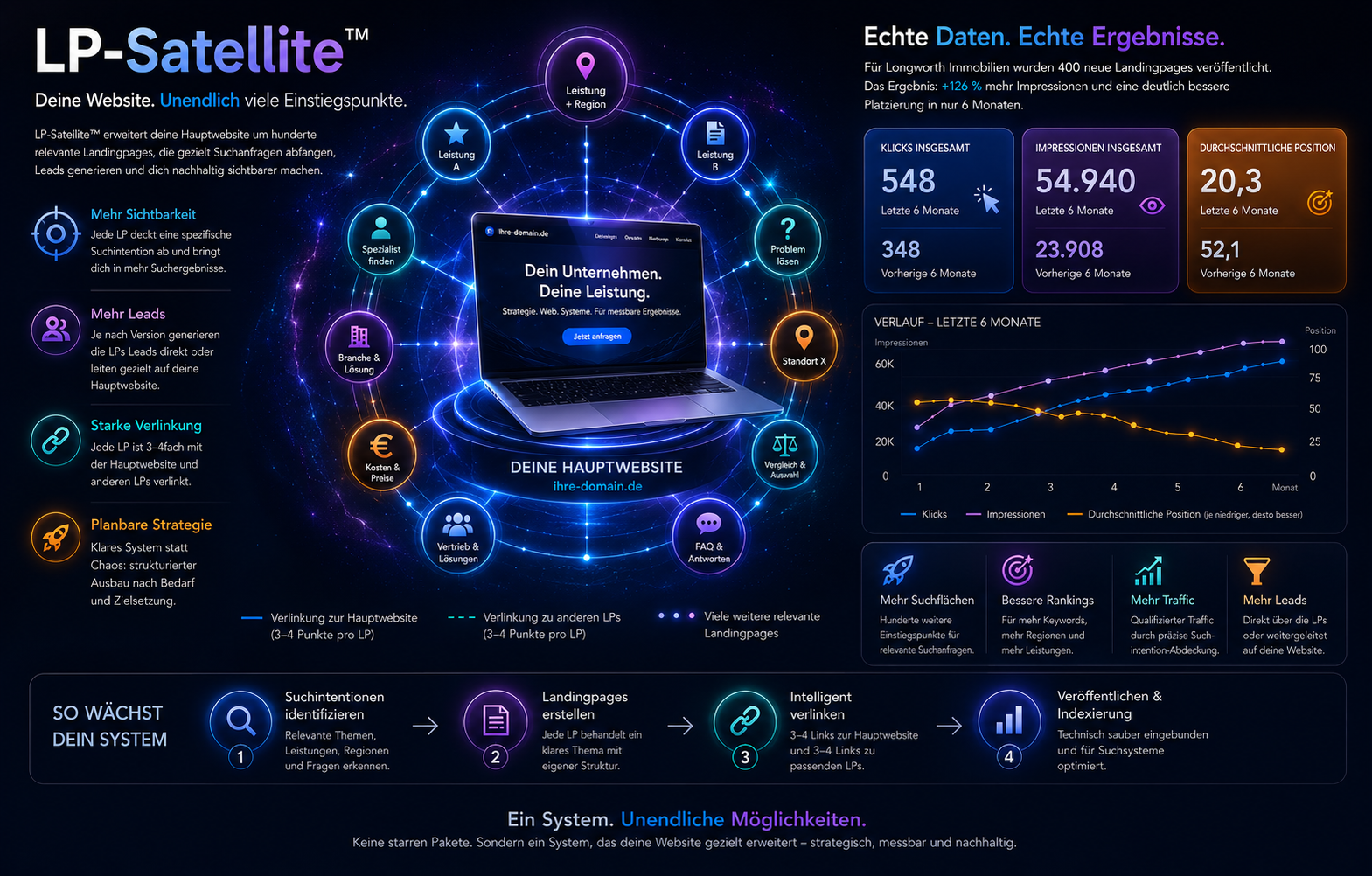
Controlled Expansion Requires a Data and Page Model
The global LP satellite case demonstrates that many landing pages only grow effectively with defined page types, data fields, and validation. The transferable message for web design is clear: a large number of pages without an architecture multiplies ambiguity, while a system enables controlled expansion and measurement. This case study is not from Zittau.
Producing Pages or Designing Information Pathways
Classic project logic
-
Individual measures without a shared vision
-
Handover between strategy, design, and technology
-
Launch without a well-thought-out operational logic
VELUNO system logic
-
Connect positioning and messaging with information architecture.
-
Plan UX and conversion management and solid technical implementation together.
-
Considering operation and expansion from the outset
From the Current State to Controlled Expansion
The process begins with the existing set of pages and leads through bottlenecks and target architecture to a prioritized implementation. Expansion only occurs once roles, links, and quality rules are robust.
The argumentation deliberately follows the levels of risk, priority, solution, and scaling. This ensures that the decision that will have an impact is clarified first; only then are implementation, operation, and potential further development definitively prioritized.
Analysis
Content, URLs, user queries, search queries, and technical dependencies are inventoried. The analysis reveals duplicates, gaps, and pages without a clear purpose.
Architecture
Positioning and messaging, information architecture, and UX and conversion guidance are linked to page types, hierarchy, and linking rules.
Implementation
Content, design system, and frontend are implemented according to priority. Migration, redirects, performance, and clean technical implementation are subject to controlled testing.
Operations
Usage, search visibility, and editorial effort are monitored. Additional pages are only created if they fulfill a new purpose and fit into the architecture.
Project sizes are determined by the structural requirements.
The effort depends not only on the number of pages but also on overlaps, migration, components, and technical compatibility. Therefore, no flat rates or fixed deadlines are quoted. It is crucial that the deliverables, acceptance criteria, technical responsibility, and subsequent maintenance are clearly defined and documented before the project begins.
Focused Entry Point
For a prioritized service area or core section that serves as a structural template for the rest of the website.
Structural Rebuild
For established websites whose content, URLs, page types, and technology need to be reorganized.
Systematic Expansion
For additional topics, campaigns, or regional search queries based on clear page and quality guidelines.
In-depth exploration of search engine optimization and system architecture
The referenced content delves deeper into how to make pages understandable for AI search, why structural errors weaken the entire website, and when platform logic is the next logical step.

SEO · GEO · AEO
Why Traditional SEO Page Models Often Fall Short in AI Search
Classification of how content must be structured so that search engines and generative systems can reliably understand relationships.
Website Structure
Why many company websites have a system problem.
Analysis of typical breaks between content, user guidance, technology, and measurement—and their consequences for ongoing operations.
Platforms
When a web project should evolve into a platform logic
Decision support for the point at which recurring processes, roles, and data no longer fit on individual pages.
Official Regional Framework · GV-ISys
Zittau in the official municipal context
The Federal Statistical Office lists Zittau as a city and university town in Saxony. This information provides a regional classification of Zittau for web design purposes. It does not imply a VELUNO location or a local client relationship.
Population and area data are taken from the official municipal register. Neither demand nor project success can be derived from this data. ...
Official municipality name – Zittau, city, university town
Federal state – Saxony
District or Independent city – Görlitz
Administrative postal code – 02763
Area – 66.75 km²
Population as of December 31, 2024 – 25,286
Population density – 379 people per km²
Travel region in the GV-ISys – Upper Lusatia/Lower Silesia
Degree of urbanization in Zittau – Average population density
Official municipality code – 14626610
What the regional data on Zittau classifies – and what it doesn't
The data clearly defines Zittau and avoids confusion with places with the same or similar names. It does not replace an individual analysis by the requesting company.
Questions about information architecture and web design
Answers regarding strategic Web designrequired content, project workflow, phased development, and digital collaboration.
Strategic web design first defines the required user queries, page roles, and conversion paths. Design translates this architecture into a visual representation. Positioning and messaging, information architecture, UX and conversion guidance, as well as robust technical implementation, are planned collaboratively.
We need to know the objectives, existing pages and content, typical queries, technical access, and knowledge of services. The content does not need to be fully edited. A complete overview is essential to identify duplications and gaps.
The process begins with an analysis of the existing infrastructure and any bottlenecks. This is followed by the development of the target architecture, page types, content, and design system; the technical implementation, including migration, then takes place. Performance, tracking, and maintainability are tested before launch.
Yes, if the next step fits into an overarching architecture. A service area or user journey can be implemented first and serve as a template. Individual pages without a clearly defined role, on the other hand, would create new structural debt.
VELUNO works digitally and across the region with companies in Zittau. A local office, address, or long-standing on-site experience is not claimed. Workshops, consultations, and approvals are clearly documented online.
Turning a large number of pages into a clear decision architecture
Transforming a large number of pages into a clear decision architecture.