
Digital Experience · Falkensee
Web Design Falkensee: Performance as Part of the Design.
Web design in Falkensee needs a clear framework of responsibility. The existing website doesn't explain enough, appears interchangeable, or generates too few qualified leads. VELUNO organizes goals, deliverables, approvals, and operations within a shared project logic. The desired outcome: a clearly positioned, fast, and inquiry-oriented company website.
Not every starting point requires a complete rebuild. The decisive factor is the desired benefit: clearer communication, improved user experience, and a robust technical foundation. Collaboration with companies in Falkensee is digital and regional; no physical office is claimed.
Positioning and Messaging
The offering, target group, and differentiation are condensed so that relevance is immediately apparent.
Information Architecture
Content follows a comprehensible decision-making process rather than internal organizational logic.
UX and conversion management
Every important page type leads to a logical next step and avoids dead ends.
Responsibility and deliverables go hand in hand.
Responsibility is assigned to four deliverable areas: positioning and messaging, information architecture, UX and conversion management, and solid technical implementation. Open handovers are clarified before the project begins.
This approach is suitable for companies with outdated, haphazard, or poorly managed websites. Responsibilities and deliverables are defined before implementation.
Web design loses its effectiveness when decisions are made in silos.
The weakness begins before the layout: Design, positioning, structure, and technology were treated separately. This results in unclear page roles, subsequent corrections, and a difficult-to-maintain website. Potsdam collaborate with VELUNO digitally and across regions. Whether the search begins with a web agency, a website agency, or a homepage creation service, it usually refers to the same business decision.
Unclear positioning and interchangeable statements
What initially seems like a minor detail changes the entire decision-making process. Benefits, target audience, and differentiation remain too vague. Potential customers have to deduce relevance and suitability themselves. Ultimately, trust is built slowly, and inquiries start with false expectations.
-
Benefits are recognized late
-
Statements seem interchangeable
-
Trust is built more slowly
Arbitrary page logic without clear decision-making
The cause lies in an unresolved preliminary decision. Specifically: Page roles and priorities remain unclear. If it isn't corrected, visitors will have to piece together the information themselves from scattered pieces. The result: Important contact and decision-making processes lose their clarity.
-
Navigation follows internal logic
-
Priorities remain hidden
-
Bounce rates increase
Technology that is slow, difficult to maintain, or poorly extensible
The root cause lies in an unresolved preliminary decision. Specifically, components, data paths, and operational responsibilities are not clearly defined. If this isn't corrected, changes will create new special cases, and measurement will remain incomplete. The result: performance, maintainability, and future expansion will become unnecessarily expensive.
-
Maintenance becomes unnecessarily expensive
-
Changes create new risks
-
Expansion slows down
Performance arises from coordinated decisions, not from isolated tasks.
The initial situation and the objective determine which building blocks are actually needed. Positioning and messaging, a clear information architecture, and UX and conversion guidance are all addressed together; in addition, a solid technical implementation, performance, and maintainability ensure smooth operation.
Positioning & Messaging
Three tasks are intertwined: refining target groups and decision-making situations; prioritizing key messages and benefits; and connecting evidence to these statements. Potential customers understand more quickly what the company stands for and what the next logical step is. Learn more: Digital Experience.
-
Defining Target Groups and Decision-Making Situations
-
Prioritizing Key Messages and Benefit Arguments
-
Linking Evidence to the Statements
Information architecture & UX
Three tasks are intertwined: defining page roles and user paths; organizing content according to search and decision-making questions; and planning navigation and internal links. The website becomes easier to understand and leads to the desired outcome without unnecessary detours.
-
Defining page roles and user paths
-
Organizing content according to search and decision-making criteria
-
Planning navigation and internal links
Design system & frontend
This building block is not treated as an isolated discipline. The plan includes defining reusable components; implementing responsive design flawlessly; and seamlessly integrating content and design in a technically consistent manner. The website remains visually clear, performs well, and can be expanded in a controlled way later on.
-
Define reusable components
-
Implement responsive design cleanly
-
Connect content and design in a technically consistent manner
Performance, tracking & operation
Three tasks are intertwined: ensuring loading behavior and technical quality; defining metrics for relevant actions; and planning for maintenance and further development. The website not only remains functional at launch but also provides a robust operational foundation.
-
Ensuring loading behavior and technical quality
-
Defining measurement points for relevant actions
-
Planning maintenance and further development
The biggest bottleneck determines the starting point.
The scope must align with internal resources, approvals, and technical responsibilities. Therefore, deliverables and system boundaries are defined before production.
Focused Entry Point
A clear area of responsibility is implemented with defined deliverables and approval points.
Structural Rebuild
The rebuild consolidates previously separate responsibilities for content, UX, technology, and quality. Supplementary Classification: Website Systems.
Systematic Expansion
The expansion adds new areas of responsibility without diluting existing governance.
Not every project needs the same architecture.
The examples each answer three questions: What was the bottleneck, what decision was made, and what changes does this bring to the system? First, positioning and messaging are refined. This is followed by the site structure, technical implementation, and a robust plan for maintenance and further development.
Company website with a clear performance logic
Proof · Expansion · Page Roles
Project Logic
Page roles, documentation, and communication channels are planned collaboratively.
Finding: An incomplete or inconsistent corporate presence without clear priorities. Prioritized decision: A focused structure with clearly defined page roles, content, and technical standards. Outcome logic: The website presents the offering and next steps as a cohesive system. The pattern demonstrates a different system logic without claiming a local reference or success metric.
B2B Relaunch with a New Information Architecture
Operation · Inventory · Migration
Project Logic
The rebuild separates viable assets from structural baggage.
Finding: An organically grown website with overlaps, outdated content, and technical inconsistencies. Prioritized decision: A prioritized information architecture with a clear migration and implementation sequence. Outcome logic: Existing content, user guidance, and technology are once again logically integrated. The guiding principle "Performance as part of the design" determines the priority.
Search Architecture System For Recurring Campaigns
Topics · Templates · Expansion
Project Logic
New pages emerge from architecture, not copies.
Finding: Recurring themes without a common page logic. Prioritized decision: A scalable structure based on search intent, content, and internal linking. Outcome logic: New pages can be added in a controlled manner without diluting the main website. The guiding principle "Performance as part of the design" determines the priority. Relevant Project Reference: B2B Website Rebuild.
Technical Consolidation of a Grown Website
Data Paths · Operation · Interfaces
Project Logic
A controllable system foundation emerges from organically grown technology.
Findings: An organically grown technical foundation with duplicate components and a high maintenance burden. Prioritized Decision: Consolidation of templates, data paths, and operational responsibility. Result Logic: Changes become more predictable, and the platform can grow meaningfully again. The guiding principle "Performance as Part of the Design" determines the priority.
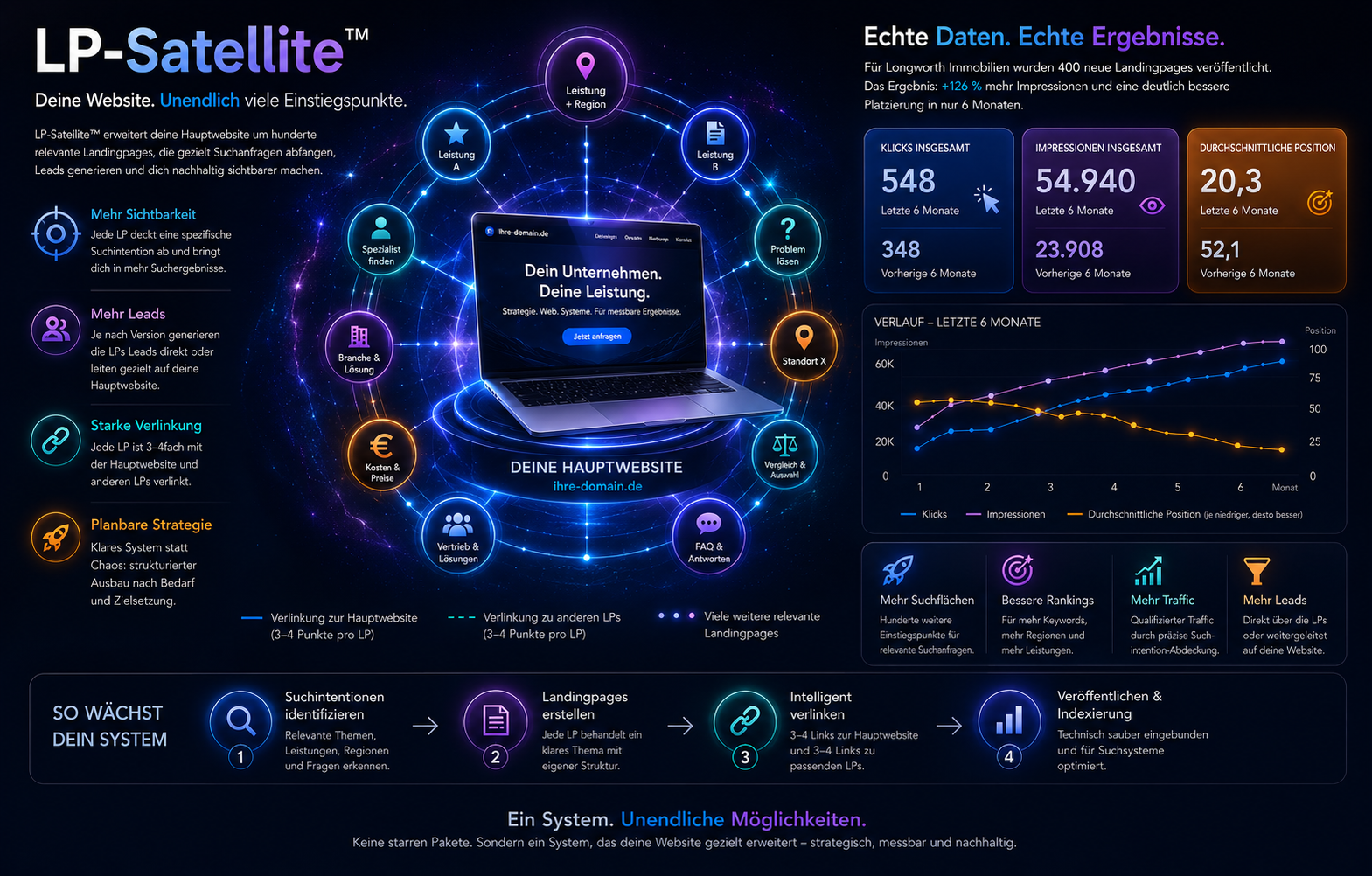
Global Proof – Systematic Expansion
Measurable impact requires a robust website architecture first.
The global LP-Satellite™ case is referenced here as evidence of systematic expansion. For web design, it is relevant that page structure, technical quality, and measurement were planned together. The case is not from Falkensee and is not presented as a local reference.
Why separate disciplines lead to friction in web design.
Separate Activity Logic
-
Individual measures are initiated without a shared vision.
-
Handoffs between strategy, design, and technology generate conflicting decisions.
-
The launch is planned, but a well-thought-out operational logic is not.
VELUNO System Responsibility
-
Positioning and messaging are linked to the information architecture.
-
UX and conversion management, as well as solid technical implementation, are planned jointly.
-
Operation and expansion are considered from the outset.
A clear process for web design: decide first, then build.
First, positioning and messaging are refined. This is followed by site structure, technical implementation, and a robust plan for maintenance and further development. This decision-making process is practically implemented through analysis, architecture, implementation, and operation.
Analysis
Existing conditions, objectives, and risks are jointly reviewed. One focus is on positioning and messaging. Additionally, technical limitations and the most important decision-making question are identified.
Architecture
The target state is translated into page logic, components, responsibilities, and measurement points. This clarifies the benchmarks for implementation before production begins.
Implementation
Content, UX, and technology are implemented in controlled steps and tested against each other. First, positioning and messaging are refined. This is followed by site structure, technical implementation, and a robust plan for maintenance and further development. Approvals are based on the target vision, not on isolated screens.
Operations
A binding quality criterion applies to operations: performance and maintainability. Changes are prioritized according to impact and risk to prevent the system from growing uncontrollably again.
Clear initial scope, open expansion path.
Internal resources, approval processes, and technical responsibility limit the practical scope. The scope is realistically aligned with these limitations.
Focused sub-project
A clearly defined responsibility assumes a limited scope of work with fixed approvals.
Complete setup or rebuild
Responsibility for content, UX, technology, and quality is consolidated in a project model.
Scalable System Project
New areas of responsibility are integrated into the existing management structure in a controlled manner.
Decision-making based on need
The scope must be appropriate for contact persons, approval capabilities, and internal resources.
Thinking Ahead: Structure, Visibility, and Platform Logic
The following content delves into three decisions that remain relevant in Web design technical and semantic visibility, a robust website structure, and the transition to platform or system logic. These are references to existing insights, not copied article texts.

SEO · GEO · AEO
Why Traditional SEO Page Models Often Fall Short in AI Search
Further context on visibility, prioritization, and controlled development beyond the launch.
Structure
Why Many Corporate Websites Do Not Have a Marketing Problem, but a System Problem
An explanation of how structure is combined with the guiding principle of "performance as part of the design" and a sound technical foundation.
Platforms
From Web Project to Platform Logic: When a Company Becomes More Digitally Resilient
In-depth information for companies that want to treat platform logic not as an isolated measure, but as part of their digital architecture.
Official Regional Framework · GV-ISys
Falkensee in the official municipal context
The Federal Statistical Office lists Falkensee as a city in Brandenburg. This information provides a regional classification for web design purposes. It does not indicate a VELUNO location or a local customer relationship.
Population and area data are taken from the official municipal register.
Degree of urbanization in Falkensee – Average population density
Official municipality code – 12,063,080
Official municipality name – Falkensee, city
Federal state – Brandenburg
District or Independent city – Havelland
Administrative postal code – 14,612
Area – 43.34 km²
Population as of December 31, 2024 – 45,720
Population density – 1,055 people per km²
Travel region in the GV-ISys – Havelland
What the regional data on Falkensee classifies – and what it doesn't
The data clearly defines Falkensee and avoids confusion with places with the same or similar names. It does not replace an individual analysis by the requesting company.
What companies should know about web design.
The answers refer to the scope of services, the digital project workflow, and the existing system infrastructure. Prices, duration, and local presence are not stated as general terms.
Strategic web design begins with positioning, target groups, and site logic. Design translates these decisions into an understandable interface; it does not replace them. First, positioning and messaging are refined. This is followed by site structure, technical implementation, and a robust plan for maintenance and further development.
The starting point is the existing website, project documentation, target group knowledge, and the most important project goals. VELUNO organizes the material, identifies gaps, and determines which new content needs to be created. The end result is clear: A clearly positioned, fast, and inquiry-oriented website. Company website.
The process follows analysis, architecture, implementation, and operation. First, the objective, existing infrastructure, and risks are clarified, followed by the definition of the site logic and components. The objection, "A visually modern website is all we need," is objectively examined in relation to the objective, risks, and operational requirements.
A phased expansion is often advisable. The prerequisite is that the site structure, components, and technology support the next steps. The "solid technical implementation" checkpoint is bindingly included in the scope.
Yes. Collaboration for projects in Falkensee is digital, with dedicated contacts and transparent approval processes. The specific design follows the guiding principle of "performance as part of the design" and the existing system infrastructure.
Unclear starting points are not improved by another blanket offer.
To provide a sound assessment, four pieces of information are sufficient at the outset: the current website or systems, the most important objective, known bottlenecks, and a realistic timeframe. This allows us to determine whether a focused approach, a rebuild, or an expandable system is the best option. We collaborate with companies in Falkensee digitally and across regions. Adjacent market side: Web design in Hennigsdorf.