
Web agency East Frisia: Strategy and implementation without handover losses.
A robust solution emerges when the crucial friction before Design and development becomes visible. The architecture follows from this, not the other way around. VELUNO manages the project for companies in East Frisia digitally and beyond. The goal is a clearly managed website project with a shared vision for content, UX, technology, and operation.
The statement "A classic, broadly positioned agency already covers that" cannot simply be dismissed. It is translated into verifiable requirements so that scope and benefits align. Companies in East Frisia collaborate with VELUNO beyond the region and without a simulated on-site structure.
Clear project responsibility
Gives the building block "clear project responsibility" a clearly defined task within the overall system. This transforms an idea into a verifiable structural decision.
Strategy, UX, and Development from a Single Logic
Gives the building block "Strategy, UX, and Development from a Single Logic" a clearly defined role within the overall system. This keeps implementation focused and operations scalable. The next development stage is only prioritized when it demonstrably supports the desired target vision.
Transparent Scope of Services
Translates complex content into clear entry points and comprehensible paths. This reduces the number of open fundamental questions in the further course of the project.
The website project connects user needs, technology, and operations.
The website project is not an isolated interface. The point "Clear Project Responsibility" forms the foundation; the points "Strategy, UX, and Development from a Single Logic" and "Transparent Scope of Services" connect usage and verification. "Direct Communication" as well as "Operation and Further Development" ensure conversion and scalability. The website project remains expandable because decisions regarding the building block "Strategy, UX, and Development from a Single Logic" are not made solely for the initial release.
This approach is suitable for companies in East Frisia whose next digital step should be based on a transparent architecture.
Where established processes limit the impact of digital solutions
The focus on "resolving misconceptions" here means that the specific friction is described before the solution is sought. Many agency offerings bundle services but leave open who assumes responsibility for the overall system. This ensures that the requirements remain verifiable. The focus is on companies that do not want to distribute strategy, UX, development, and operations among multiple providers.
Unclear responsibilities between consulting, design, and development
"Unclear responsibilities between consulting, design, and development" is a symptom of an unclear shared logic regarding goals, implementation, and operations. As a result, effort is diverted to coordination, maintenance, or sales, even though the root cause lies earlier within the system.
-
Weak user guidance
-
Inconsistent statements
-
Limited connectivity during expansion
Beautiful concepts without robust technical implementation
This issue often only becomes apparent when new content or features are added. Without clear rules, the pattern of "beautiful concepts without robust technical implementation" increases operational friction and hinders controlled expansion.
-
Hidden media and system breaks
-
Duplicate maintenance
-
Lack of measurability
Launch focus without a plan for operation and further development
The problem of "launch focus without a plan for operation and further development" can affect several areas simultaneously for the target group described. User guidance, data, and responsibilities then no longer align. The next step involves examining which data, content, and responsibilities are actually necessary for "transparent scope of services."
-
Priorities without shared criteria
-
Dependence on individual expertise
-
Unnecessary handoffs
What needs to be planned jointly for the website project to work
The scope follows the result instead of a task list. Further classification is provided by Services in more detail regarding the relevant system components.
Analysis & Vision
In "Analysis & Target Vision," the contribution to the goal is defined first. This is followed by content, functions, and technical requirements in a sequence that takes future operations into account.
-
Assessing Inventory and Risks
-
Defining Goals and Boundaries
-
Prioritizing Dependencies
-
Creating a Decision Template
Structure & UX
The "Structure & UX" component is not implemented in isolation. It has defined interfaces with the other project components to ensure that the desired outcome is not lost during handoffs.
-
Modeling Performance Logic
-
Building Entry Points as Needed
-
Assigning Pages and Content
-
Clearly Defining Next Steps
Development & Integration
"Development & Integration" translates the project goals into verifiable decisions. Its scope and depth depend on usage, risk, and what will be further developed after launch.
-
Capture data sources
-
Define the system of record
-
Plan interfaces and error handling
-
Monitor synchronization
Operations & Ongoing Development
For "Operations & Further Development," responsibilities, dependencies, and quality criteria are clarified before implementation. The aim is to minimize communication breakdowns, make clearer decisions, and achieve a solution that can be sustained after launch. This ensures that the component's contribution remains transparent.
-
Secure the access control concept
-
Define tests and approvals
-
Set up monitoring
-
Controlled rollout of updates
The package itself isn't the deciding factor, but rather the robust sequence.
Not every bottleneck requires the same scope. The linked project example How We Work shows a related project logic; for this project, the starting point and expansion are nevertheless derived from the existing infrastructure.
Focused Entry Point
A clearly defined component addresses the biggest bottleneck first. The architecture and data pathways are designed so that the website project can be expanded later without changing direction.
Structural Rebuild
Several issues are addressed in a single, cohesive project. These include the existing system, the target vision, implementation, migration, and stabilization.
Systematic Expansion
This approach is suitable when the website project is intended to grow in several phases. Each phase has its own objective and remains technically compatible. A clear priority prevents the "direct communication" component from being diluted by additional requests or becoming unnecessarily complicated from a technical standpoint.
Four project logics, four different decisions
The examples describe problem classes and key decisions, not fabricated local references. A suitable, more in-depth technical analysis is Projects with a comparable system perspective.
Website Rebuild with Clear Positioning
Core problem in the existing system: Services and target groups without clear page navigation.
Project Logic
The central decision: Aligning positioning, service structure, and inquiry channels with a target vision.
The focus was not on industry conventions, but on the interdependence between content, technology, and responsibility. The decision was to align positioning, service structure, and inquiry channels with a target vision. This gave the expansion a robust sequence.
Relaunch with Migration and Technical Consolidation
Project launch with a clear assessment: historically grown content and legacy technical issues.
Project Logic
From bottleneck to a reliable result.
The existing infrastructure was assessed based on benefits and risks. Subsequently, the guiding decision was implemented: evaluate the existing infrastructure, define the target architecture, and carry out a controlled migration. This resulted in clearer handovers, less duplication of effort, and a foundation for the next expansion phase.
Portal project with role and process logic.
Visible at the outset: recurring service processes with manual handovers.
Project Logic
Portal project with role and process logic: clarify dependencies, then expand strategically.
The project logic separated the necessary core from later expansion. The first step was clear: model roles, tasks, and backend integration as a continuous process. This made the website project more understandable, maintainable, and measurable.
Growth expansion via structured Landing Pages
Starting point of the project: numerous search queries without consistent page logic.
Project Logic
A standardized architecture replaces the existing, fragmented approach.
The decisive factor was a binding system boundary. This led to a clear requirement: to use a modular template with a clear intent and link structure. Unnecessary functions were removed, while essential components were retained.
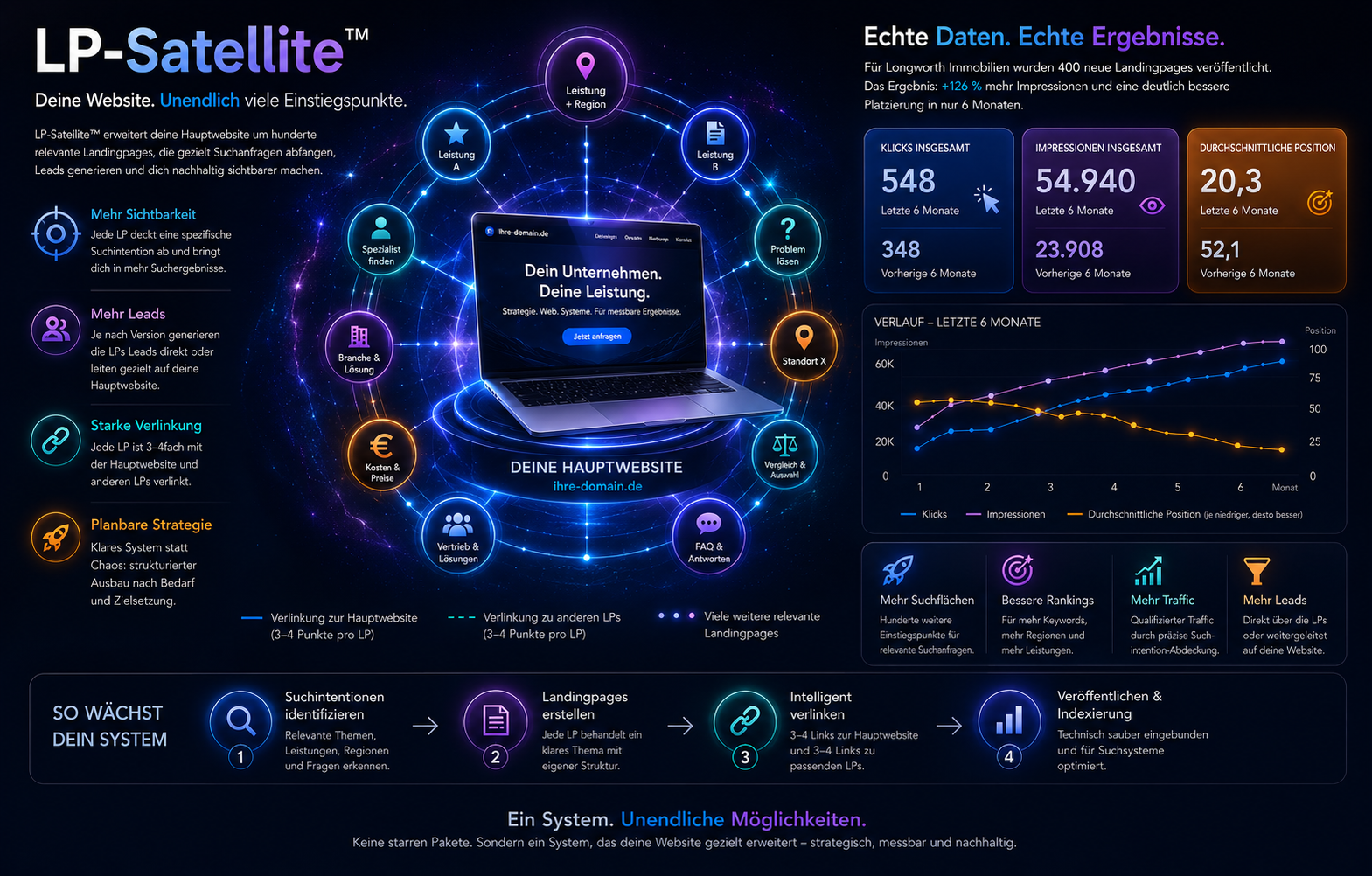
Impact arises from a consistent structure, not from a single measure
As a global project example, this case demonstrates that systematic development requires clear technical and editorial guidelines. The relevant connection lies in the shared objectives, implementation, and operational logic, not in any purported local reference. This case is not presented as a local reference for the East Frisia region.
Responsibility instead of a handover chain
Separate Activities
-
Individual measures without a shared vision
-
Handover between strategy, design, and technology
-
Launch without a well-thought-out operational logic
VELUNO System Responsibility
-
Clear project responsibility combined with strategy, UX, and development from a single logic
-
Transparent scope of services and direct communication planned collaboratively
-
Considering operation and expansion from the outset
The project process follows open decisions
The process translates the perspective of "strategy and implementation without handover losses" into four clear phases. The rationale prioritizes positioning, followed by structure, technology, and operations. Each phase concludes with a documented result.
Analysis
The current state, objectives, risks, and open decision-making questions for the website project are documented. The result of this phase is a concrete decision, not a loose collection of ideas.
Architecture
The target state defines system boundaries, components, and handovers before implementation resources are committed. This reduces the risk of subsequent work being based on untested assumptions. Existing components are evaluated based on their benefits and risks; viable parts are retained and seamlessly integrated.
Implementation
Components and functions are tested against the target state, not just against a layout template. The result of this phase is a concrete decision, not a loose collection of ideas.
Operations
Monitoring, maintenance, and the next development phase are defined with clearly defined responsibilities. The handover is documented and transparent for all involved parties.
Three key elements, one common benchmark: reliable benefits
Not every task requires the same project structure. Content depth, data pathways, migration, releases, and operation determine the realistic effort. This results in a necessary core and clearly separated expansion options.
Clearly defined entry point
The initial focus is on the task with the greatest benefit. Unnecessary expansions are deliberately postponed and documented only as expansion options.
Structural Rebuild
The existing infrastructure is reviewed and transformed into a robust, shared logic for objectives, implementation, and operations. This scope also includes migration, quality assurance, and stabilization. The goal is to reduce communication breakdowns, make clearer decisions, and develop a solution that can be sustained after launch.
Systematic Growth Path
The website project is prepared for additional markets, content, or features. Reuse and clear boundaries prevent the creation of isolated solutions.
No Artificial Project Size
The scope is tailored to actual needs. The necessary core, sensible expansion, and future options are identified separately. The "clear project responsibility" component is aligned with the requirements of the defined target group, without making maintenance and expansion dependent on individual expertise.
Three areas for further system expansion
The following global VELUNO content delves deeper into three related questions. It is referenced and not provided as individual project documentation.

SEO · GEO · AEO
Why Traditional SEO Page Models Often Fall Short in AI Search
How visibility changes when content must not only rank, but also be understood and cited.
Structure
Why Many Corporate Websites Do Not Have a Marketing Problem, but a System Problem
What goes wrong when content, tracking, UX, and technology coexist instead of working together.
Platforms
From Web Project to Platform Logic: When a Company Becomes More Digitally Resilient
When website logic is no longer enough—and why portals, workflows, and reusable systems are then the logical next step.
Frequently Asked Questions: Web Agency · East Frisia
The answers directly address requirements and limitations. They do not include a price guarantee, a fixed duration, or any claim about a local branch.
VELUNO works on goals, structure, content, UX, development, and technical compatibility. Which components are included depends on the existing infrastructure, risks, and desired operation.
Priorities are determined by benefits, risks, and effort. Every measure must explain which bottleneck it resolves and what prerequisites it requires.
Communication takes place via a clear project channel with documented results. This reduces information loss between consulting, design, and development.
Existing systems can continue to run if their limitations are transparent. Necessary adjustments and risks are weighed against the need for a change.
VELUNO manages projects for companies in East Frisia through digital workshops, binding decision-making documents, and regular reviews. Responsibilities and open issues remain visible to all participants.
Start with a solid foundation.
Briefly describe where friction currently arises, which systems are involved, and what result should be achieved. This will allow for a clear project launch with defined boundaries, priorities, and next steps. The process is digital, nationwide, and transparent for companies in East Frisia.