
Web agency Frankfurt am Main: System logic instead of digital backdrop.
For companies in Frankfurt am Main, hiring a web agency is beneficial when the following situation exists: A new website project is planned, but responsibilities, scope, and technical accountability are still unclear. The goal is a clearly managed website project with a shared vision for content, UX, technology, and operations. The guiding principle of "responsibility instead of performance ping-pong" serves as the basis for decision-making: Impact, effort, and subsequent costs must align before any approval.
Objections and benefits belong in the same decision: "A classic full-service agency already covers that." The better benchmark is less coordination failure, clearer decisions, and a solution that can be carried forward after launch because architecture, implementation, and operation can be jointly reviewed against it.
Clear project responsibility
Clear project responsibility is documented as a concrete decision in the decision book and reviewed against the "Costs and Impact" checklist before each approval.
Strategy, UX, and Development from a Single Logic
Strategy, UX, and development based on a consistent logic are documented as a concrete decision in the decision book and reviewed against the "Costs and Impact" checklist before each approval.
Transparent Scope of Services
The transparent scope of work is documented as a concrete decision in the decision book and reviewed against the "Costs and Impact" review area before each release.
Responsibility instead of a performance ping-pong.
The decision book organizes clear project responsibility, strategy, UX, and development according to a consistent logic, transparent scope of work, and direct communication. Each decision is linked to its cause, effort, and operational impact before release, resulting in a comprehensible investment logic.
The market focus is concrete, project management remains digital, nationwide, and clearly documented.
The most expensive wrong decision is made before the actual project starts
Many agency offerings bundle services but leave open who assumes responsibility for the overall system. For companies that don't want to distribute strategy, UX, development, and operations among multiple providers, this primarily leads to difficult-to-compare decisions and hidden follow-up costs. The decision-making process separates the cause, the scope of services, and future expansion options before committing a budget.
The objective market classification is provided by the neighboring website Webagentur Offenbach am Main – without inferring a claim to local presence.
Unclear responsibilities between consulting, design, and development
With "Unclear responsibilities between consulting, design, and development," the effects begin before the visible error. The point "clear project responsibility" loses its clear function because cause and effect are not separated.
-
Unclear cost implications
-
Missing approval threshold
-
Costly re-decision
Beautiful concepts without robust technical implementation
In ongoing operations, "Beautiful concepts without reliable technical implementation " manifest as additional coordination, exceptions, or manual checks.
-
Mandatory scope remains undefined
-
Benefits not comparable
-
Budget without a termination criterion
Launch focus without a plan for operation and further development
The problem is also a question of responsibility. With a "launch focus without a plan for operation and further development," it's unclear who decides on, implements, and monitors the "transparent scope of services" after the launch.
-
Follow-up costs invisible
-
Expansion without priority
-
Decision not documented
Four building blocks for a well-founded investment decision
The service model functions as a decision-making document. First, clear project responsibility and strategy, UX, and development are defined logically as a basis for decision-making; transparent scope of services, direct communication, and operation and further development follow only with documented consequences. The goal is a clearly managed website project with a shared vision for content, UX, technology, and operation.
Further described Services.
Analysis & Vision
Analysis and vision first provide a verifiable object: "clear project responsibility." Responsible parties, input data, and acceptance criteria are defined before the next building block begins. In this way, "responsibility instead of performance ping-pong" becomes operationally visible, rather than just verbally.
-
Clear project responsibility
-
Decision value documented
-
Follow-up costs visible
-
Release with limits
Structure & UX
In the area of structure and UX, the decision precedes production. The process examines which variant of "strategy, UX, and development from a single logic" achieves the objective and what dependencies it triggers.
-
Strategy, UX, and Development from a Single Logic
-
Decision value documented
-
Follow-up costs visible
-
Release with limits
Development & Integration
Development and integration define the system boundary for "transparent scope of services." Data, content, components, or interfaces are only connected where responsibility and operational sequence remain unambiguous. This prevents "responsibility instead of performance ping-pong" from ending with a new custom solution.
-
Transparent Scope of Services
-
Decision value documented
-
Follow-up costs visible
-
Release with limits
Operations & Ongoing Development
The "Operations and Further Development" module concludes with a concrete test for "direct communication." The same criteria must apply before and after; open assumptions remain visible. Only a successful test allows for the next expansion.
-
Direct Communication
-
Decision value documented
-
Follow-up costs visible
-
Release with limits
Scope Based on Decision Value: From Initial Assessment to Reliable Development
The initial scope should finalize a decision, not merely initiate work. The decision document separates the mandatory findings, implementation limits, and development options; thus, effort remains tied to a transparent investment logic.
The next relevant technical reference is How We Work.
Focused Entry Point
A focused approach clarifies clear project responsibilities and documents the cost implications of strategy, UX, and development from a single logic. The result is a robust basis for approval.
Structural Rebuild
Structural Rebuild Combines strategy, UX, and development from a single logic, transparent scope of work, and direct communication into a controlled implementation package. Every expansion is evaluated against the decision-making value.
Systematic Expansion
Systematic expansion leverages direct communication, operation, and further development for growth. New stages are assigned their own benefit and cost criteria.
Four Anonymized Decisions Between Effort and Impact
The four anonymized cases are interpreted as investment decisions. Each case illustrates the findings, the budget limit that protected against subsequent costs, and the justifiable next step.
As an existing project reference Projects.
Website Rebuild with Clear Positioning
Initial Situation, Decision, and Effect.
Initial Situation · Decision · Impact
Structure replaces provisional, individual decisions.
Initial situation: The existing structure did not provide a clear basis for "unambiguous project responsibility."
Relaunch with Migration and Technical Consolidation
Initial Situation, Decision, and Effect.
Initial Situation · Decision · Impact
The central decision separates the core problem from the subsequent effort.
Initially, the focus wasn't on building, but rather on distinguishing between the symptom and the cause.
Portal project with role and process logic.
Initial Situation, Decision, and Effect.
Initial Situation · Decision · Impact
Impact arises from a clear boundary and sequence.
The project began with inconsistent decisions regarding content, technology, and operations.
Growth expansion via structured landing pages
Initial Situation, Decision, and Effect.
Initial Situation · Decision · Impact
Structure replaces provisional, individual decisions.
The central decision was not the number of new pages or features, but rather the acceptance of "direct communication."
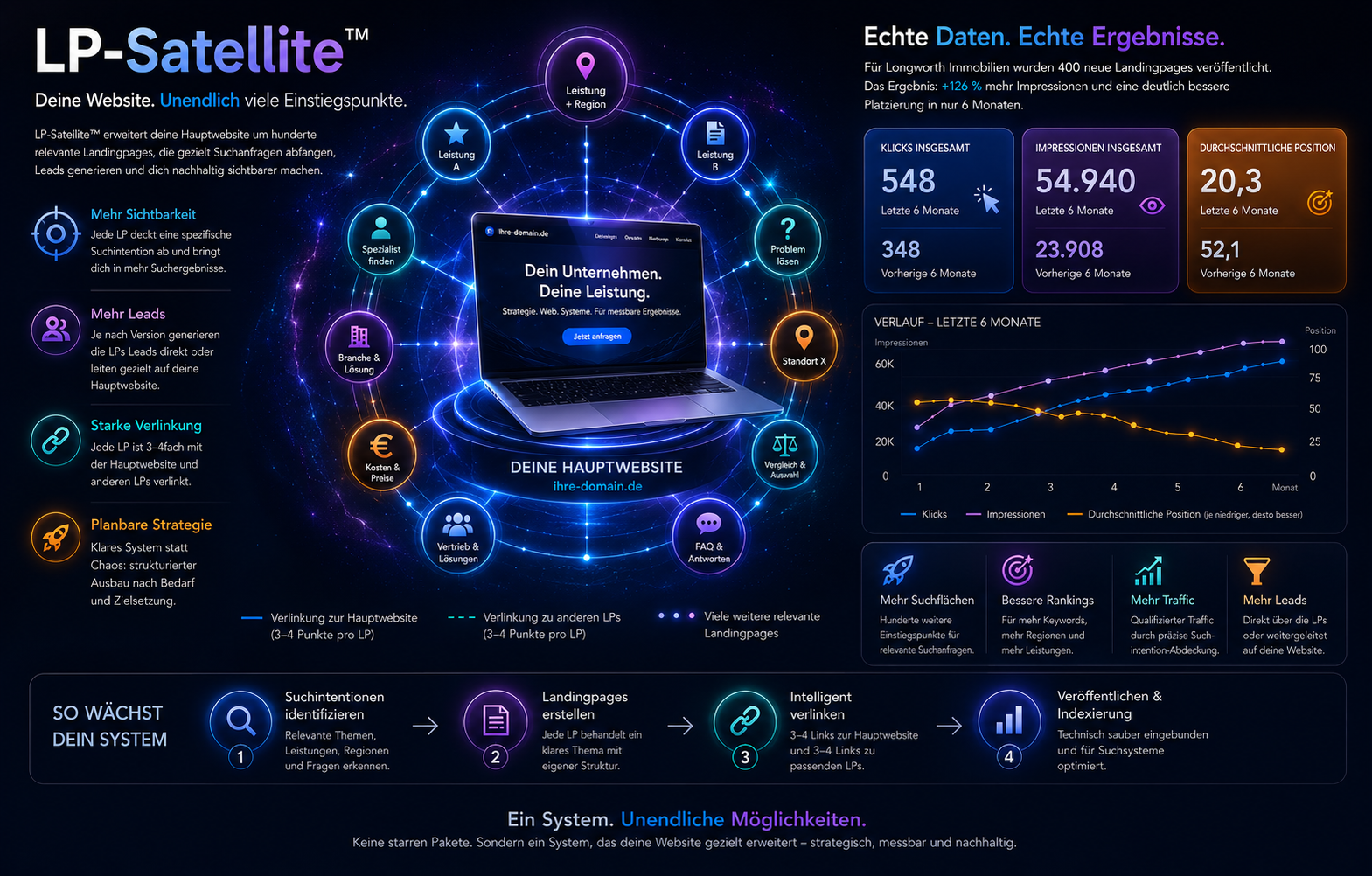
Existing Proof Block
Proof is robust if the underlying logic remains visible.
The global LP-SatelliteThe '-Case' is interpreted here as evidence of controlled expansion.
Scope of work or investment logic: where does the real responsibility lie?
Classic project logic
-
“Individual measures without a shared objective” evaluates effort without binding consequences. The budget is allocated before the mandatory scope and termination criteria are clarified.
-
"Handover between strategy, design, and technology" assesses effort without binding consequences. The budget is allocated before the scope of work and termination criteria are defined.
-
"Launch without a well-thought-out operational logic" assesses effort without binding consequences. The budget is allocated before the scope of work and termination criteria are defined.
VELUNO system logic
-
"Combining clear project responsibility with strategy, UX, and development from a single logic" is linked in the decision book to objectives, effort, acceptance, and operational sequence. Each approval thus has a verifiable basis.
-
"Jointly planning a transparent scope of work and direct communication" is linked in the decision book to objectives, effort, acceptance, and operational sequence. Each approval thus has a verifiable basis.
-
"Consider operation and expansion from the outset" is linked in the decision book to the objective, effort, acceptance, and operational sequence. Each approval thus has a verifiable basis.
Four approvals from the investment problem to controlled expansion
The four steps form a decision book. The weighting of business objective, system boundaries, implementation, and measurement indicates which approval clarifies business impact, system boundaries, implementation, or measurement first. Unjustified work is not postponed to the next stage.
Analysis
Analysis clarifies the inputs, the open decision, and the acceptance criteria for "clear project responsibility." Results are documented in such a way that the next step does not start from scratch.
Architecture
For "Strategy, UX, and Development from a Single Logic," architecture defines a baseline and subsequent monitoring. Impact is not merely asserted, but rather re-evaluated using the same criteria.
Implementation
For "Transparent Scope of Services," implementation clarifies the inputs, the open decision-making process, and the acceptance criteria. Results are documented in such a way that the next step does not start from scratch.
Operations
For "Direct Communication," operations define a baseline and subsequent monitoring. Impact is not merely asserted, but rather re-evaluated using the same criteria.
Four investment frameworks with clear decision boundaries
A project size is only meaningful if its decision value is known. Therefore, the framework shows which question is resolved, which follow-up costs become apparent, and which expansion can subsequently be justified.
Decision Audit
Clear project responsibility and strategy, UX, and development from a single logic are reviewed for business impact, scope of obligations, and follow-up costs.
Targeted Implementation Package
Transparent scope of services and direct communication are implemented and accepted as a cohesive investment decision.
Controlled Expansion
Operation and further development determine which next stage is appropriate based on observed impact.
Budget Limit
Assumptions, exclusions, and termination criteria remain visible before the proposal is submitted.
Global In-Depth Analysis of Investment Logic, Structure, and Expansion
The global references complement the view of value, structure, and expansion. The article texts remain central and are not duplicated here.

SEO · GEO · AEO
Why Classic SEO Page Models Fall Short in AI Search
A Global Insight on How Structure, Unambiguous Answers, and Technical Readability Interact in Classic and Generative Search Systems.
Website Structure
Why Many Website Problems Aren't Design Problems
A Global Insight into Information Architecture, Content Models, User Journeys, and Technical Dependencies Behind Visibly Weak Pages
Platform Logic
When a Web Project Becomes a Robust Platform
A Global Insight into Separating Website, Portal, Application, Data, and Operations, and Meaningful Modular Development Stages
Official Regional Framework · GV-ISys
Frankfurt am Main in the official municipal context
The Federal Statistical Office lists Frankfurt am Main, a city in Hesse. This information places Frankfurt am Main regionally for web agencies. It does not indicate a VELUNO location or a local client relationship.
Population and area data are taken from the official municipal register. This data does not allow us to infer demand or project success. We continue to evaluate projects from Frankfurt am Main based on their objectives, existing infrastructure, system limitations, and the necessary public participation. [The following appears to be a separate, unrelated sentence fragment: "Vegetation and area data are taken from the official municipal register. Neither demand nor project success can be derived from this. We will continue to evaluate projects from Frankfurt am Main based on their objectives, existing infrastructure, system limitations, and the necessary public participation."]
District or Independent city – Frankfurt am Main, City
Administrative postal code – 60,311
Area – 248.31 km²
Population as of December 31, 2024 – 756,021
Population density – 3,045 people per km²
Travel region in the GV-ISys – Main and Taunus
Degree of urbanization – Densely populated
Official municipality code – 06412000
Official municipality name – Frankfurt am Main, City
Federal state – Hesse
What the regional data on Frankfurt am Main classifies – and what it doesn't
The data clearly defines the boundaries of Frankfurt am Main and avoids confusion with places with the same or similar names. It does not replace an individual analysis by the requesting company.
Five questions for the economic project decision
The answers differentiate between the decision basis, the mandatory scope, and the later expansion option. Prices, duration, and impact are not stated without an inventory.
Depending on requirements, VELUNO combines positioning, UX, Website Systemsportals, web applications, platform architecture, integrations, performance, and growth. Not every discipline automatically becomes part of the project.
Priorities are set based on business impact, risk, dependency, and learning value. The first scope should deliver full benefits and prepare for the next development stage.
Responsibilities and communication are defined before the project starts. Technical, design, and professional decisions are not passed anonymously through multiple handoffs, but are documented and assigned to a clear role.
The web agency's objectives, initial situation, and system boundaries are clarified first. The binding building blocks are clear project responsibility, strategy, UX, development based on a consistent logic, and a transparent scope of services.
Yes. Collaboration with companies in Frankfurt am Main is organized digitally and across regions; no local branch or on-site presence is claimed.
The next approval requires a clear investment decision
For the initial assessment, the initial situation, previous investments, open decision-making needs, and desired impact are sufficient. From this, a digital scope is developed with mandatory scope, assumptions, and approval limits; a branch office in Frankfurt am Main is not claimed.