
Web Agency for Companies in Thuringia
Anyone planning to hire a web agency in Thuringia should first clarify which user decisions the site should facilitate and which operational friction it should reduce. What approach makes sense for a web agency in Thuringia if the result should not only look modern but also function structurally? The reliable answer is: first, define the problem and the user journey precisely, then combine clear project responsibility with strategy, UX, and development from a coherent logic. This results in a clearly managed website project with a shared vision for content, UX, technology, and operations. The information flow prioritizes the problem over user guidance and only incorporates details once their decision-making context is clear.
The objection, "A traditional, broadly positioned agency already covers this," is understandable, but it doesn't resolve the structural bottleneck. The goal is less coordination breakdowns, clearer decisions, and a solution that can be sustained after launch. The collaboration is digital, transparent, and nationwide; no branch or on-site presence in Thuringia is claimed.
Clear project responsibility
Clearly organizes project responsibilities so that user questions, content, and next steps build upon one another.
Strategy, UX, and Development from a Single Logic
Connects strategy, UX, and development with a coherent logic, clear responsibilities, and demonstrable benefits in the website's flow.
Transparent Scope of Services
Makes transparent scope of work a verifiable project decision rather than a general intention.
A shared vision for content, technology, and operation.
A web agency that combines clear project responsibility, strategy, UX, and development with a coherent logic and transparent scope of services. Complemented by direct communication, ongoing operation, and continuous development, this creates a foundation that extends beyond launch.
For companies with demanding website projects that want to reduce coordination issues, make clearer decisions, and continue developing their solution after launch without artificially inflating the project.
One project, one system logic, costs of poor structure and problem: where web agencies structurally lose effectiveness
Companies with a demanding website project often only notice the bottleneck when new content, features, or target groups need to be added.
Unclear responsibilities between consulting, design, and development
This pattern shifts the clarification from the website to sales, service, or internal coordination.
-
Unclear user priority
-
Increased sales inquiries
-
Weak decision-making
Beautiful concepts without robust technical implementation
This pattern shifts the clarification from the website to sales, service, or internal coordination.
-
Premature definition
-
Incorrect project scope
-
Subsequent fundamental corrections
Launch focus without a plan for operation and further development
This pattern shifts the clarification from the website to sales, service, or internal coordination.
-
Premature definition
-
Incorrect project scope
-
Subsequent fundamental corrections
One project, one system logic: from initial situation to problem to robust building blocks
A robust result only emerges when content, user guidance, technology, and measurement all share the same priority. The following building blocks are designed precisely for this purpose. Further in-depth information is available in: Services.
Analysis & Vision
Focusing on analysis and target vision creates a comprehensible part of the overall model. This facilitates content-related, technical, and operational decisions.
-
Target group and problem definition
-
Core messages and differentiation
-
Prioritized decision questions
-
Alignment with sales reality
Structure & UX
Focusing on structure and UX creates a comprehensible part of the overall model. This facilitates content-related, technical, and operational decisions.
-
Page and Theme Architecture
-
Performance and Use Case Allocation
-
Navigation and URL Logic
-
Prioritization Based on User Intent
Development & Integration
This building block translates development & integration into concrete decisions, content, and quality criteria. It contributes to ensuring that...
-
Source and Target Systems
-
Data Objects and Responsibilities
-
Synchronization and Error Handling
-
Technical Documentation
Operations & Ongoing Development
Operation and further development are not isolated work packages. The results must be integrated with the other components.
-
Access and Protection Concept
-
Monitoring and Logging
-
Maintenance and Update Path
-
Plan for Controlled Extensions
One project, one system logic, the cost of poor structure: setting the scope from problem to conversion
Not every project needs to include all conceivable functions in the first step. What matters is which structural part needs to be solved first and what foundation is essential for later expansions.
Focused Entry Point
A compact project core first resolves the most important decision or process question. The architecture prevents this initial approach from becoming problematic later on.
Structural Rebuild
Useful when content, navigation, technology, and operational logic can no longer be addressed separately.
Systematic Expansion
Expansion proceeds according to priority and measurable signals. Reusable components, clear data paths, and documented responsibilities support new steps.
Web agency: the cost of poor structure, initial situation, and impact in four project logics
For the Thuringian web agency, transferable problem classes are more meaningful than decorative reference tiles. Therefore, the cases are described as objective project patterns and not presented as local success stories. The corresponding service or project context can be found under How We Work.
Website Rebuild with Clear Positioning
Initial situation, decision, impact.
Project Logic
Website Redesign with Clear Positioning: Decision Before Design
Initial Situation: Terms, service descriptions, and benefit arguments were available, but presented side-by-side without any discernible levels of clarity. As a result, potential customers had to deduce the meaning of "website redesign with clear positioning" from technical details themselves. Decision: The content was sorted according to decision-making questions: first the problem, then user guidance, and only then the technical details. Each statement was given a clear purpose, moving from orientation to evaluation. Impact: The result is not a simplification of the service, but rather an understandable translation. Different roles can grasp relevance and suitability before delving into the details.
Relaunch with Migration and Technical Consolidation
Exemplary Project Scenario.
Project Logic
Relaunch with Migration and Technical Consolidation: Clarifying Dependencies Early on
Initial Situation: During the relaunch project involving migration and technical consolidation, existing websites, outdated terminology, and new requirements collided without a common basis for evaluation. Individual corrections would only have further exacerbated the inconsistencies. Decision: Before the rebuild, a decision list was created outlining what to retain, merge, reformulate, and discard. The problem and user experience determined the order of decisions. Design followed only after the content had been clarified. Effect: This makes the transition transparent: relevant substance is retained, duplicate statements are eliminated, and new content follows a consistent explanatory system.
Portal project with role and process logic.
Initial Situation, Decision, and Effect.
Project Logic
Portal Project with Role and Process Logic: Decision Before Design
Initial Situation: For a portal project with role-based and process-oriented logic, several technically correct descriptions existed, but no common answer to the questions of different user roles. Depending on the entry point, the offering appeared either too general or unnecessarily technical. Decision: The roles were described in terms of tasks, objections, and required documentation. This resulted in a tiered information sequence that linked transparent scope of services with concrete points of reference. Effect: The site can now accommodate multiple perspectives without duplicating messages. Depth remains available, while the initial access point is clearer and the subsequent decision is easier.
Growth expansion via structured landing pages
Initial situation, decision, impact.
Project Logic
Growth Expansion via Structured Landing Pages: Clarifying Dependencies Early
Initial Situation: The expansion of growth via structured landing pages was based on individually written pages. With each iteration, the structure, documentation management, and maintenance process changed, although the fundamental decision-making process remained the same. Decision: Recurring information tasks were defined as rules for entry, explanation, proof, and action. Variable content remained separate from shared components and received clear approval criteria. Effect: New pages can thus be added consistently without duplicating identical text. Expansion follows a comprehensible semantic structure instead of a collection of independent copies.
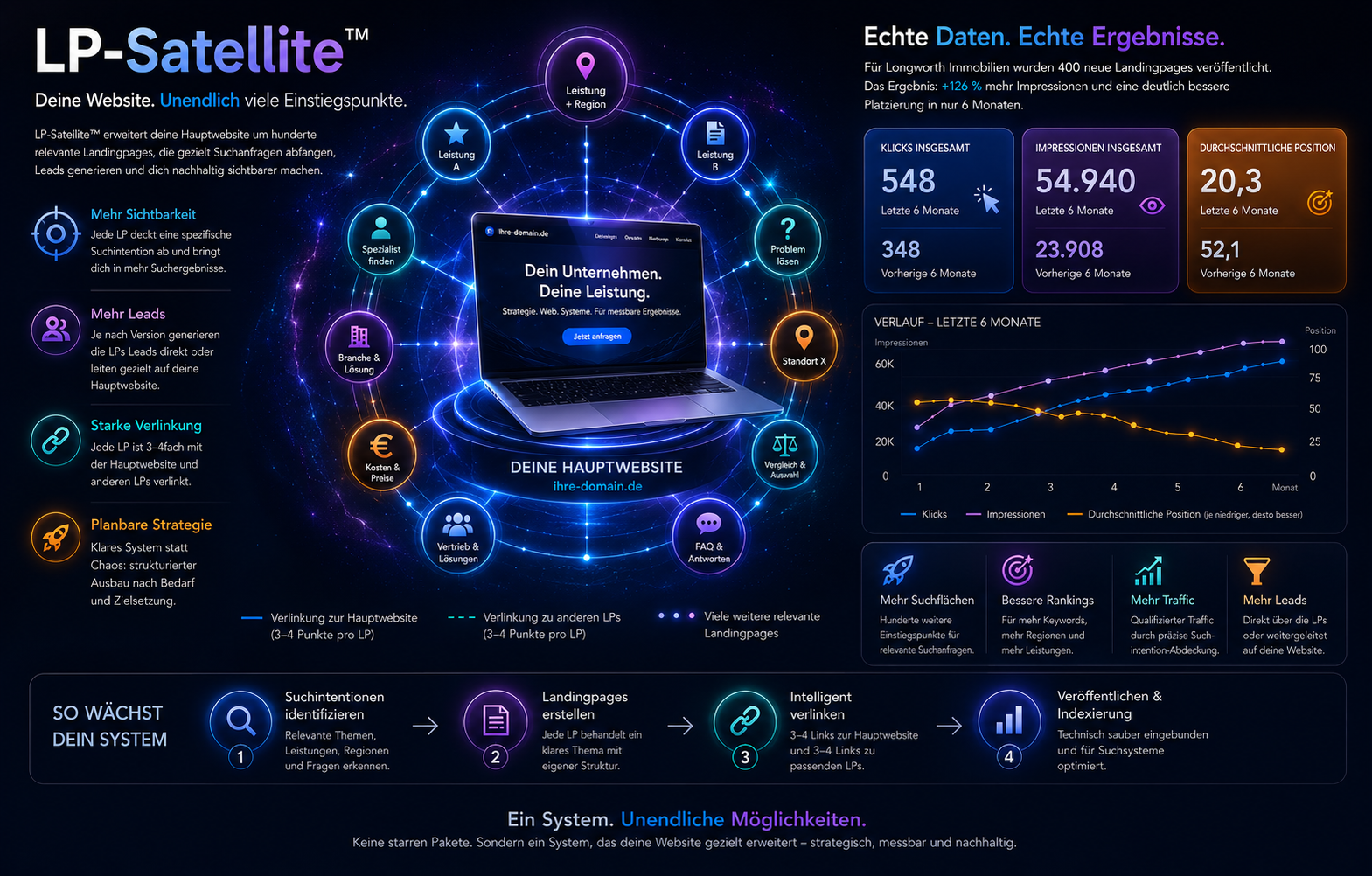
What the Proof Actually Shows
The existing proof module documents a global project logic of VELUNO. For the Thuringian web agency, this demonstrates how page architecture, quality assurance, and further development are linked; it does not claim to be a branch, client, or result located in Thuringia.
One project, one system logic: Shared responsibility for the problem and conversion
Separate Agency and Trade Logic
-
Individual measures without a shared vision; as a result, the goal, responsibility, and quality standards remain ambiguous between the various trades.
-
Handoffs between strategy, design, and technology. This creates handoffs where important assumptions are lost or only made belatedly.
-
Launch without a well-thought-out operational logic; as a result, the goal, responsibility, and quality standards remain ambiguous between the various trades.
VELUNO system logic
-
Clear project responsibility, combining strategy, UX, and development from a single logic. This keeps dependencies visible and allows for expansions.
-
Plan a transparent scope of work and direct communication together. This keeps dependencies visible and allows extensions to build upon existing rules.
-
Consider operations and expansion from the beginning and document decisions in such a way that content, UX, technology, and operations all share the same foundation.
One project, one system logic: from initial situation to effect and from problem to conversion
The process is deliberately non-linear in the sense of a rigid handover. Results are reviewed between analysis, architecture, implementation, and operation until the goal, system boundaries, and quality standards are consistent. The corresponding service or project context can be found under: Projects.
Analysis
Existing content, user paths, technology, data flows, and decision-making questions are checked against the business objective.
Architecture
The architecture defines system boundaries, page logic, integrations, and quality criteria. This makes existing dependencies visible before implementation.
Implementation
Implementation is component-based and uses short test cycles. Decisions remain traceable so that changes do not uncontrollably create new special cases.
Operations
After publication, functionality, measurement, maintenance, and prioritized development stages are checked. Operation and further development thus become part of the overall project.
Web agency: Combining a project, a system logic, the costs of poor structure, and the problem of scope
In the case of Web Agency the scope should solve the real problem and simultaneously create a sustainable foundation.
Structural Reorganization
Suitable when multiple causes are interrelated and isolated fixes would only create new dependencies. Architecture, content, and the technical foundation are reorganized together.
Modular Expansion
A robust foundation is expanded with additional pages, markets, functions, or integrations based on priority. Reusable rules guarantee consistency and maintainability.
Defined Subproject
A clearly defined bottleneck is resolved with all necessary content, UX, and technical decisions. The rest of the system remains documented and ready for integration.
A project, a system logic: Costs of poor structure, initial situation, and global classification
Technical classification belongs in standalone insights, not as copied article text on every service page. Therefore, the cards refer to existing global content and briefly outline its relevance to the project decision.

SEO · GEO · AEO
Systematically Planning Visibility in Search and AI Response Systems
This article explains how structure, semantics, and technical readability interact when content is not only to be found but also understood and cited.
Why Digital Presences Often Fail at System Boundaries Rather Than Due to Design Issues
This article highlights typical inconsistencies between content, navigation, tracking, technology, and operations, and helps identify the actual bottleneck before a relaunch.
Platforms
When a Website Becomes a Platform or Portal Task
This article separates classic page logic from role, data, and process requirements and explains when a modular system architecture makes sense.
A project, a system logic, the costs of poor structure, and the problem: Questions about web agencies in Thuringia
Before the project starts, terms, scope, and collaboration should be clearly defined. The following answers therefore specify prerequisites and limitations without resorting to marketing ploys.
VELUNO combines goal clarification, positioning, information architecture, UX, development, technical quality, measurement, and operation. The exact scope depends on the project goal. Services are not sold as a standardized list, but rather tailored to the necessary system responsibilities. Prioritization follows the order of problem before conversion.
The scope is determined by the goal, the initial situation, system boundaries, and risks. Mandatory criteria, a sensible core project, and subsequent expansion phases are evaluated separately. A small start is advisable if it is viable; however, architectural decisions should not be postponed. Prioritization follows the order of problem before conversion.
Communication is handled through clearly defined project responsibilities. Technical decisions are clarified directly with the responsible individuals for content, UX, or development as needed. This eliminates unnecessary communication chains between sales and implementation. Prioritization follows the order of problem before conversion.
This is possible if the existing system meets the target architecture, performance, security, and editorial requirements. VELUNO assesses extensibility, data model, technical debt, and integrations. Adoption is not based on habit but on a robust comparison with alternatives. Prioritization follows the order of problem before conversion.
VELUNO collaborates digitally and across Thuringia with companies. Coordination, workshops, reviews, development, and handovers can be organized entirely remotely. No branch office, local address, local employees, or on-site presence in Thuringia is claimed. The ranking follows the order of problem before conversion.
One project, one system logic: Costs of poor structure, problem, and the next step for a web agency in Thuringia
The next sensible step is not a generic offer template, but rather clarifying the goal, user journey, existing resources, and technical dependencies.