
Digital Experience Dachau
For Dachau: Company website with a clear structure and robust implementation.
A company website in Dachau shouldn't start with colors or page numbers. A modern interface doesn't solve the underlying structural problem. VELUNO first clarifies the service architecture, target group management, and trust and proof elements. The goal is a company website that clearly integrates offerings, expertise, proof, and contact methods.
The objection, "Our customers already know us; the website isn't that important," is understandable, but it's too simplistic. The concrete benefit: Greater clarity for potential customers and a professional digital sales tool. Collaboration with companies in Dachau takes place digitally and across regions; a local branch is not claimed.
Performance Architecture
Services are organized according to problems, target groups, and results, not just presented as a list.
Target Group Management
Different decision-makers can find the right entry point and context for them more quickly.
Trust and Proof Elements
Evidence, methodology, and expertise appear where they truly support a decision.
Systematically build trust: conceived as a system.
Four points form the decision-making framework: service architecture, target group management, trust and proof elements, and clear contact and conversion paths. This ensures that design, user experience, and technology are aligned toward the same goal.
This page is aimed at SMEs and B2B companies whose websites need to communicate services, expertise, and next steps more clearly. A project workflow is required that clearly separates assessment, decision-making, and approval.
The critical weaknesses arise before the actual implementation.
When discussing a company website, the first step shouldn't be about colors or page count. The existing company website no longer reflects the offerings, quality, or current company size. Services are available, but they are not presented quickly enough or credibly enough for potential customers. For companies in Dachau and the surrounding areas of Olching, Unterschleißheim, and Germering, project management is handled transparently and digitally. Company website, company homepage, and B2B Website are not separate projects, but rather different names for the same central platform.
The range of services is only listed instead of explained.
The weakness is evident in three areas. First: Benefits, target group, and differentiation remain too vague. Second: Potential customers have to deduce relevance and suitability themselves. Third: Trust is established slowly, and inquiries begin with false expectations.
-
Relevance remains unclear
-
Comparability increases
-
Inquiries are less relevant
Target groups cannot find a clear entry point.
Page roles and priorities remain unclear. Visitors have to piece together the offering from scattered information. Important contact and decision-making channels lose their clarity.
-
Entry points remain random ...
-
Page roles overlap
-
Decisions are made more difficult
References, expertise, and next steps remain too invisible.
Methodology, criteria, and evidence remain hidden behind a list of tasks. Decision-makers can hardly assess quality and suitability before the conversation. Inquiries are generated with little context and require fundamental further qualification.
-
Decision-makers receive little guidance
-
Proof appears disconnected
-
Comparison is based on price
How a company website becomes a robust system
The four building blocks translate the guiding principle of "systematically building trust" into concrete project decisions. They connect the performance architecture, target group management, and trust and proof elements. Clear contact and conversion channels, as well as a maintainable technical foundation, remain crucial for operational quality.
Service Structure
The review examines three points: grouping services according to problems and results; explaining dependencies and selection criteria; and connecting detail pages with a clear overall picture. Only their interplay makes the module robust. Offerings and expertise become more readily understandable. More information: Website Systems.
-
Grouping services according to problems and results
-
Explaining dependencies and selection criteria
-
Connecting detail pages with a clear overall picture
Target Groups & Use Cases
The review examines three points: differentiating relevant target groups and roles; translating typical situations into comprehensible entry points; and prioritizing appropriate benefit arguments for each context. Only their interplay makes the module robust. Different prospects can find the right entry point without having to search the entire page.
-
Differentiate relevant target groups and roles
-
Translate typical situations into comprehensible opening lines
-
Prioritize appropriate benefit arguments for each context
Proof & Trust
Implementation is planned based on the desired outcome. This requires three tasks: making project logic and working methods visible; placing evidence at decision-relevant points; and separating claims from verifiable criteria. Trust is built on substance, not interchangeable promises.
-
Making project logic and working methods visible
-
Placing evidence at decision-relevant points
-
Separating claims from verifiable criteria
Inquiry Channels & Operation
The review examines three points: ordering contact channels according to intention and maturity level; Limit forms and handovers to essential information; prepare for maintenance, monitoring, and expansion. Only their interplay makes the building block resilient. Inquiries become clearer, and the website remains manageable.
-
Organize contact channels according to intent and maturity level
-
Limit forms and handovers to essential information
-
Prepare for maintenance, monitoring, and expansion
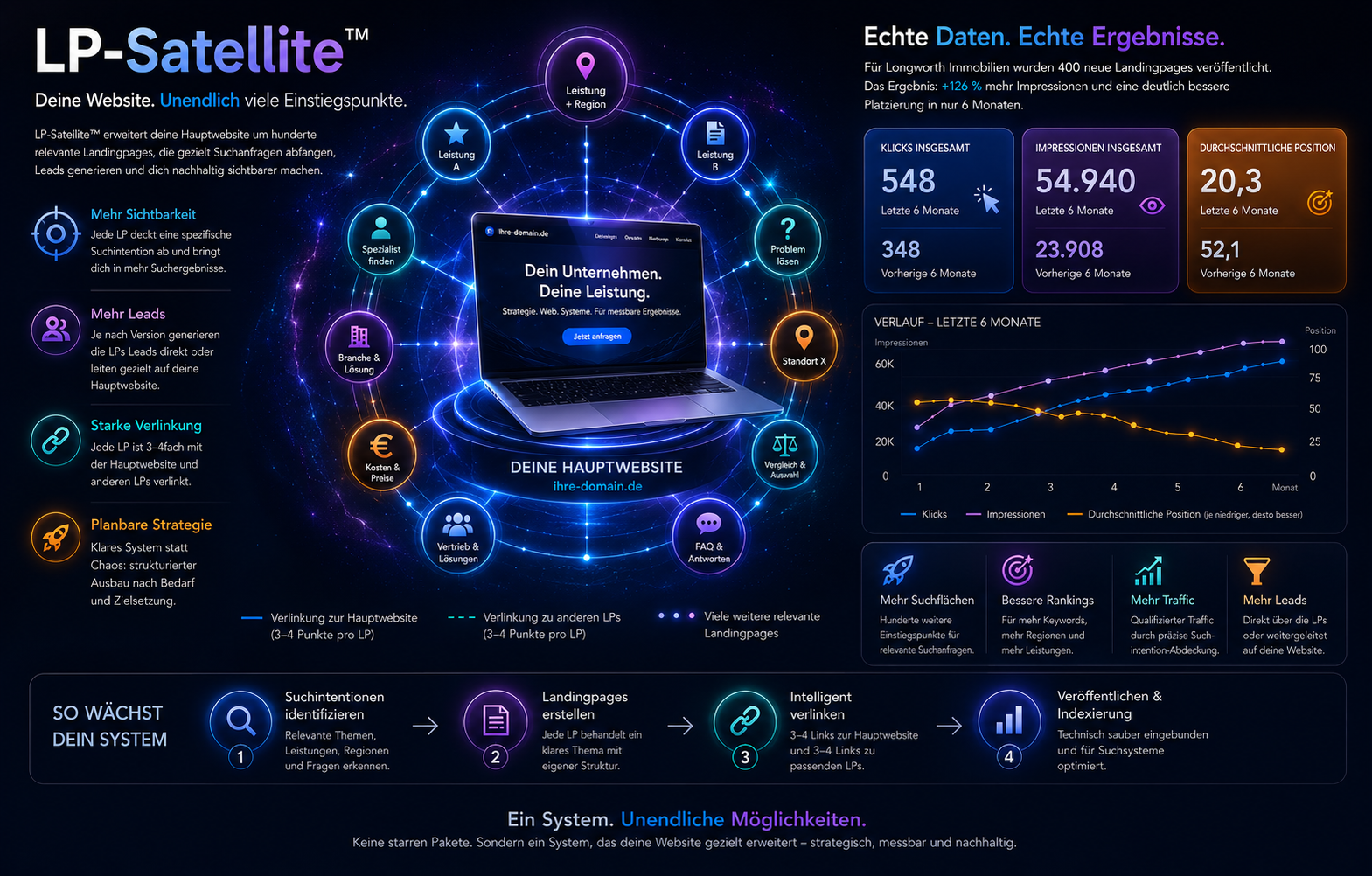
Global Proof – Systematic Expansion
Measurable impact requires a robust website architecture first.
A global case study with documented expansion logic serves as a global example. The significance lies not in the geographical location, but in the interplay of structure, technology, and ongoing development. For this page, the case study remains a supra-regional reference.
A shared vision instead of a collection of individual services.
Separate Activity Logic
-
Individual measures are initiated without a shared vision.
-
Handoffs between strategy, design, and technology generate conflicting decisions.
-
The launch is planned, but a well-thought-out operational logic is not.
VELUNO System Responsibility
-
Performance architecture and target group management are integrated into a common page logic.
-
Trust and proof elements, as well as clear contact and conversion paths, are planned collaboratively.
-
Operation and expansion are considered from the outset.
Not every starting point requires the same level of development.
The scope is planned backward from the desired result. Sub-projects, rebuilds, and system expansions have different tasks. Prices, minimum budgets, and fixed timelines are not stated without a data basis.
Focused sub-project
A clear bottleneck is resolved with a verifiable goal. The remaining infrastructure must support the next step.
Complete setup or rebuild
Multiple causes are addressed within a new overall structure for content, user guidance, and technology.
Scalable System Project
The foundation is prepared for new page types, integrations, or digital processes.
Decision-making based on need
Existing infrastructure, objectives, risks, and internal resources determine the scope; unnecessary functions are eliminated.
In-depth analysis of visibility, structure, and expansion.
The following content delves into three decisions that remain relevant for a company website: technical and semantic visibility, a robust website structure, and the transition to platform or System LogicThese are references to existing insights, not copied article texts.

SEO · GEO · AEO
Why Traditional SEO Page Models Often Fall Short in AI Search
An explanation of how visibility is combined with the guiding principle of "systematically building trust" and a solid technical foundation.
Structure
Why Many Corporate Websites Do Not Have a Marketing Problem, but a System Problem
Classification of how structure is linked to the guiding principle of "systematically building trust" and a sound technical foundation.
Platforms
From Web Project to Platform Logic: When a Company Becomes More Digitally Resilient
In-depth information for companies that want to treat platform logic not as an isolated measure, but as part of their digital architecture.
Official Regional Framework · GV-ISys
Dachau in the official municipal context
The Federal Statistical Office lists Dachau, a district in Bavaria. This information places Dachau regionally for company websites. It does not indicate a VELUNO location or a local customer relationship.
Population and area data are taken from the official municipal register. Neither demand nor project success can be derived from this information. We continue to evaluate projects from Dachau based on their objectives, existing infrastructure, system limitations, and necessary cooperation.
Official municipality name – Dachau, GKSt
Federal state – Bavaria
District or Independent city – Dachau
Administrative postal code – 85221
Area – 34.96 km²
Population as of December 31, 2024 – 47,138
Population density – 1,348 people per km²
Travel region in the GV-ISys – Munich metropolitan area
Degree of urbanization in Dachau – Average population density
Official municipality code – 09174115
What the regional data on Dachau classifies – and what it doesn't
The data clearly defines Dachau and avoids confusion with places with the same or similar names. It does not replace an individual analysis by the requesting company.
Answers regarding process, technology, and digital collaboration.
The answers refer to the scope of services, the digital project workflow, and the existing system infrastructure. Prices, duration, and local presence are not stated as general terms.
It must make the offering, target groups, expertise, and next steps quickly understandable. This includes clear page roles, comprehensible proof elements, and a maintainable technical foundation. The specific design follows the guiding principle of "systematically building trust" and the existing system infrastructure.
There is no universally correct number of pages. The pages needed are those that clearly and systematically present the offering, target audience, trust, and contact information. Documented responsibilities, verifiable deliverables, and a clear approval process are crucial.
The website shouldn't replicate every internal business logic. Instead, services are explained from the perspective of typical decision-making situations and linked to methodology, proof of concept, and next steps. For companies in Dachau, the process remains digital and organized across regions.
Yes, provided the information architecture, components, and technology are prepared for it. Landing pages can cover additional search intents; portals usually require their own role, data, and process logic. The exact scope is determined only after an initial assessment and is not predetermined in advance.
The initial situation, the desired outcome, and existing systems are crucial. VELUNO uses this information to define a comprehensible scope and clear responsibilities. First, the business objective and decision criteria are clarified. This is followed by defining system boundaries, implementation, and measuring relevant actions.
A realistic project scope instead of a hasty solution outline.
The project request should specify the initial situation, existing content and technology, desired outcome, and time frame. VELUNO then assesses risks, dependencies, and a potential scope. A local office in Dachau is not claimed; the project workflow is digitally organized. Related market: Company website Olching.