
Digital Agency Stralsund: Clear Decisions and Clean Implementation.
A comprehensive digital project in Stralsund makes sense when it's planned not based on appearance, but rather on the specific decision-making situation. Poor structure rarely causes only a presentation problem. It wastes time, complicates decision-making, and increases the cost of any future expansion.
VELUNO connects Digital Experiences, products, platforms, data pathways, and Growth Systems. This creates a prioritized digital system comprised of experience, products, infrastructure, and growth. The expected benefits: fewer isolated solutions and a clear sequence for effective digital investments. Collaboration is transparent, digital, and transregional.
Digital inventory
Existing content, URLs, systems, and measurement data are systematically recorded.
Prioritization based on business impact
The analysis combines qualitative findings with technical and operational dependencies.
System and data logic
The data model maps the business relationships and defines which systems are authorized to read, write, or approve data.
Digitalization without a Tool Collection.
A connected digital project is not created as an isolated, individual measure. The following points are planned jointly within the system: digital inventory; prioritization based on business impact; system and data logic; implementation in meaningful phases; operation and further development. This ensures that content, user experience, technology, and operations interlock as a comprehensible overall logic.
Websites, tools, data, tracking, and growth strategies evolve without a common architecture. VELUNO first identifies the cause, goal, and system boundaries, and then derives the implementation strategy from these.
Digitization without a tool collection: The bottleneck lies beneath the surface.
Website, tools, data, tracking, and growth measures are evolving without a shared architecture. This isn't an isolated presentation error, but rather impacts the prioritization of digital initiatives based on business impact and system dependencies. This particularly affects companies where website, processes, visibility, and technical systems must be considered holistically. The starting point: Several digital projects exist simultaneously, and individual Service Providers only address partial problems. Sales or operational teams then have to manually compensate for the lack of integration later. The guiding principle "Digitalization without a collection of tools" clearly defines the benchmark: It's not the number of pages that matters, but how reliably users can recognize relevance, differences, and the next step. A further spatial classification is offered by Digital Agency Greifswald.
Many individual measures without a common vision
Decisions are based on individual opinions because data, risks, and dependencies are not considered together. The desired benefits fail to materialize, even though the necessary expertise may be present.
-
Inventory and risk assessment
-
Prioritization Based on Impact
-
Clear acceptance criteria
Tool landscape with media breaks and duplication of effort
Each new subpage increases complexity because roles, hierarchy, and relationships are not defined. This lack of structure must later be addressed by sales or operational teams.
-
Information hierarchy
-
Internal Linking
-
Page and navigation model
Website and operational processes develop separately
A visually polished interface can be technically slow, difficult to extend, or unnecessarily risky in operation. This complicates the decision-making process and postpones necessary clarifications to later discussions.
-
Clear data and interface paths
-
Performance and technical quality
-
Maintainable components
Four interconnected building blocks for "Digitalization without a tool collection"
The building blocks are not planned as separate activities. Together, they represent Digital Experience, products, platforms, data pathways, and Growth Systems, following the sequence Problem – User Guidance – Proof – Conversion. This ensures that every decision remains focused on the business objective and subsequent operations. Further context is provided by Services.
Digital Experience
The architecture clearly separates overview, in-depth analysis, proof, and action. The building block directly contributes to the described objective.
-
Information hierarchy
-
Internal Linking
-
Page and navigation model
-
System and data logic
Digital Products
Content is organized according to user questions, decision readiness, and functional dependencies. This building block is part of the shared system logic: Digital Experience, Products, Platforms, Data Paths, and Growth Systems.
-
Information hierarchy
-
Internal Linking
-
Page and navigation model
-
Implementation in sensible stages
Platforms & Infrastructure
Content is organized according to user queries, decision readiness, and functional dependencies. This ensures that the prioritization of digital measures based on business impact and system dependencies remains embedded within the system.
-
Page and navigation model
-
Information hierarchy
-
Internal Linking
-
Operation and further development
Growth Systems
Topic priority, URL architecture, and conversion goal are linked. This building block directly contributes to the described goal.
-
URL and Internal Link Architecture
-
Technical Search Principles
-
Intent and Topic Model
-
Digital inventory
The project scope follows the bottleneck, not a package size
A sensible start addresses the bottleneck with the greatest impact first. Depending on the existing system, this could be a clearly defined sub-project, a complete rebuild, or a modular expansion. The key factors are the objective, dependencies, and the central system decision, not an artificially large project description.
Focused Entry Point
Suitable if a clearly identifiable bottleneck can be resolved in isolation. The objective, scope, and success criteria are narrowly defined, while maintaining future connectivity. The focus is on the central project decision.
Structural Rebuild
Useful when positioning, structure, and the technical foundation are outdated or contradictory. The existing infrastructure is reviewed, reorganized, and controlled before being transformed into a robust solution. System boundaries, integrations, data ownership, and a viable operational plan remain part of the decision-making process.
Systematic Expansion
Suitable when the basic structure is sound and additional pages, functions, or integrations are to be added gradually. Each stage follows a clear priority and verifiable benefits. The contribution to the described goal remains clear.
Four Project Logics for Digitalization Without a Tool Collection
The examples are illustrative project scenarios, not claims about local clients. They demonstrate how different starting points can lead to a robust solution through a clear decision. Investments follow a logical sequence and address the most critical bottleneck first. The decisive factor is the problem class, not an interchangeable portfolio motive. Further analysis is provided in: Digital Products.
Website plus CRM and tracking integration
Exemplary project scenario – no local reference
Initial Situation · Decision · Impact
Digitalization Without a Tool Collection: A Clear Decision Instead of a New Interface
Starting Point: Website, tools, data, tracking, and growth measures are developing without a common architecture. Decision: A "digital inventory" and "system and data logic" were planned as a common structure. Impact: Fewer isolated solutions and a clear sequence for effective digital investments.
Customer portal with operational process logic
Exemplary project scenario – no local reference
Initial Situation · Decision · Impact
Customer Portal with Operational Process Logic: Clear Priority Instead of Parallel Individual Measures
Initial Situation: Website, tools, data, tracking, and growth measures developed without a common architecture. Decision: "Digital Products" and "Platforms & Infrastructure" were connected before the visual development. Result: A prioritized digital system comprising Experience, Products, Infrastructure, and Growth.
Platform Relaunch
Exemplary project scenario – no local reference
Initial Situation · Decision · Impact
A Decision Chain with Clear System Boundaries
Initial Situation: Website, tools, data, tracking, and growth measures developed without a common architecture. Decision: "Platforms & Infrastructure" and "Growth Systems" were connected before the visual development. Effect: Investments follow a logical sequence and address the most critical bottleneck first.
Visibility System with Expanded Search Areas
Exemplary project scenario – no local reference
Initial Situation · Decision · Impact
From Structural Bottleneck to a Controllable Solution
Initial Situation: Website, tools, data, tracking, and growth measures developed without a common architecture. Decision: The priority followed the sequence Problem – User Experience – Proof – ConversionResult: Technically, system boundaries, integrations, data responsibility, and a viable operational plan are taken into account.
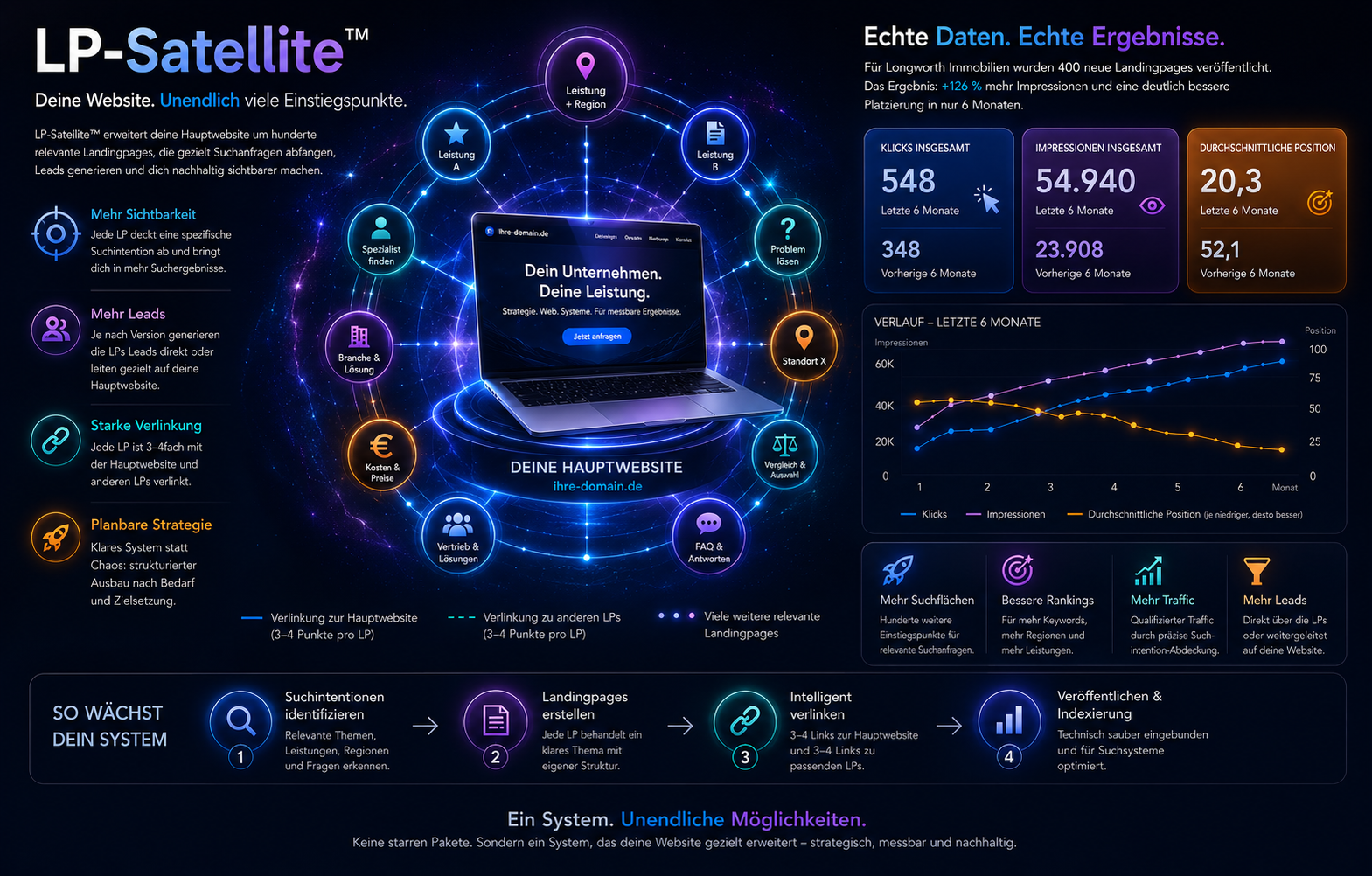
Impact is achieved when the prioritization of digital measures according to business impact and system dependencies is consistently implemented.
The existing LP-Satellite case serves here as global evidence for structured expansion. The methodological approach for this page lies in clear page roles, controlled publication, and measurement instead of random, isolated measures. The case is not from Stralsund.
Digital agency: Outsourcing activities or clarifying responsibilities?
Separate Activity Logic
-
Individual measures without a common goal.
-
Transitions between strategy, design and technology.
-
Launch without a plan for operation and further development.
VELUNO system logic
-
VELUNO combines digital inventory with prioritization based on business impact.
-
System and data logic are planned together with implementation in sensible phases.
-
Operation and scalability are considered from the outset.
From analysis to operation: four controlled steps
The process follows a clear dependency: Problem, User Experience, Proof, and Conversion. Each step provides decisions and checkpoints for the next. Thus, content, UX, and technology are not developed in parallel before their shared purpose is defined. A more in-depth analysis is provided by: Platforms & Infrastructure.
Analysis
Existing content, URLs, systems, and measurement data are systematically recorded. Risks and functioning components are assessed separately. This step follows the guiding principle of "digitalization without a tool collection."
Architecture
Page roles, information hierarchy, and linking are determined before design. This reduces later detours and ensures consistency in scaling. The result contributes to the described goal.
Implementation
Components, data paths, and interfaces are designed to allow for controlled future modifications. Prioritizing digital measures based on business impact and system dependencies remains the professional benchmark.
Operations
Operation, monitoring, and further development are already considered in the architecture. Responsibilities and quality boundaries remain clear after launch. The result is documented and ready for the next phase.
Project size as needed: focused, comprehensive, or modular.
The project size is derived from the initial situation, the objective, and dependencies. A clearly defined start can be useful if it resolves the biggest bottleneck; a complete build is necessary if multiple causes are interrelated. Technical operational requirements remain part of the planning in both cases.
Focused sub-project
A clearly defined bottleneck is analyzed and resolved. This is useful if multiple causes are interrelated and the existing system no longer achieves the desired effect.
Complete setup or rebuild
Positioning, structure, content, and technology are reorganized together. This is suitable if multiple causes are interrelated and the existing system no longer delivers the desired results.
Scalable System Project
A robust foundational architecture is developed in prioritized stages. Suitable for additional pages, functions, data paths, or integrations with clear connection logic.
Operation and further development
Monitoring, maintenance, and future expansion stages are transparently managed. This ensures that technical quality and enhancements remain controllable even after launch.
Three fundamentals for better digital decisions
Global VELUNO Insights delve deeper into search architecture, website structure, and platform logic. They are referenced on this page only.

SEO · GEO · AEO
Why Traditional SEO Page Models Often Fall Short in AI Search
Further VELUNO Insight on search architecture, semantic structure, and robust solutions.
Structure
Why many company websites have a structural problem
Further VELUNO insight on the connection between information architecture, user guidance, and the technical foundation.
Platforms
From web project to platform logic
Further VELUNO insights into roles, data paths, and a robust platform architecture.
Official Regional Framework · GV-ISys
Stralsund in the official municipal context
The Federal Statistical Office lists Stralsund, a Hanseatic city in Mecklenburg-Western Pomerania. This information places Stralsund regionally for digital agencies. It does not confirm a VELUNO location or a local client relationship.
Population and area data are taken from the official municipal directory. Neither demand nor project success can be derived from this information. We continue to evaluate a project from Stralsund based on its objectives, existing infrastructure, system limitations, and necessary cooperation.
Area – 54.59 km²
Population as of December 31, 2024 – 54,094
Population density – 991 people per km²
Travel region in the GV-ISys – Western Pomerania
Degree of urbanization in Stralsund – Average population density
Official municipality code – 13,073,088
Official municipality name – Stralsund, Hanseatic City
Federal state – Mecklenburg-Western Pomerania
District or Independent city – Western Pomerania-Rügen
Administrative postal code – 18,439
What the regional data on Stralsund reveal – and what it doesn't
The data defines boundaries Stralsund is clearly distinguished from other places and avoids confusion with similarly named locations. This classification does not replace an individual analysis by the requesting company.
Frequently Asked Questions: Digital Agency in Stralsund
Direct answers regarding approach, scope, technology, and digital collaboration.
A digital agency considers not only websites and design but also products, platforms, data paths, and operational processes. The difference lies not in the label, but in whether measures are prioritized and technically accounted for across system boundaries. In this context, the problem and user guidance are clarified first.
VELUNO can combine Digital Experience, web applications, platform and integration issues, and Growth Systems in a common architecture. Not every project requires all areas.
Priorities arise from business impact, user problems, risk, and technical dependencies. First, fundamental issues are resolved that will either support or hinder several subsequent measures.
No, a focused approach is often more sensible if the biggest bottleneck can be clearly defined. It is important that the first stage does not create a technical or structural dead end. The guiding principle of "digitalization without a tool collection" determines the priority.
Collaboration with companies from Stralsund is organized digitally and across regions. Coordination, reviews, and approvals proceed in clear steps with documented decisions.
Digitalization without a tool collection: Realistically assessing the current situation and goals
For an initial assessment, the current situation, existing website or systems, desired goal, and a realistic timeframe are sufficient. VELUNO then examines which decisions are needed first and whether a joint digital project in the described form makes sense. Coordination takes place digitally and across regions.