
Digital agency for companies in Ingolstadt
VELUNO supports companies in Ingolstadt with a digitally and nationally managed project for a digital agency. Experience, Digital Products, infrastructure, visibility, and prioritized implementation are planned collaboratively. The goal: A prioritized digital system comprising experience, products, infrastructure, and growth. Multiple digital projects exist simultaneously, and individual service providers only address partial problems. In day-to-day operations, it becomes clear that minor adjustments don't resolve the underlying systemic issue.
"We only need support in specific disciplines." This sounds pragmatic, but it can simply shift the structural problem. Therefore, every decision is evaluated based on its expected benefits: fewer isolated solutions and a clear sequence for effective digital investments. Collaboration with companies in Ingolstadt is transparent, digital, and supra-regional; no claim is made regarding a local branch or on-site presence.
Digital inventory
The "digital inventory" component is documented and approved using verifiable criteria.
Prioritization based on business impact
The "prioritization based on business impact" component visibly contributes to the target vision and remains expandable for future implementation.
System and data logic
The "system and data logic" component combines business impact with technically verifiable implementation.
Digital Products
Platforms & Infrastructure
Growth Systems
Digitalization requires a common system logic.
Websites, processes, data, tools, and visibility only deliver results when dependencies and priorities are clearly defined. Digitalization doesn't come from more tools, but from clear processes, data flows, and responsibilities.
This is aimed at companies where websites, processes, visibility, and technical systems must be considered together. The evaluation focuses on the concrete benefits: fewer isolated solutions and a clear sequence for effective digital investments.
Operational friction as a warning signal: risk to expansion.
Websites, tools, data, tracking, and growth measures develop without a common architecture. Disconnected systems increase coordination, data maintenance, and dependence on manual handoffs. Therefore, the root cause must be clarified before any individual measure is taken. This question becomes relevant for companies where websites, processes, visibility, and technical systems must be considered together. Multiple digital projects exist simultaneously, and individual service providers only solve partial problems. The search may also include the adjacent area towards Neuburg an der Donau, Pfaffenhofen an der Ilm, and Aichach Regardless, the collaboration remains digital and supra-regional.
Many individual measures without a common vision
Operational friction becomes apparent in handovers, rework, and a lack of decision-making. Disconnected systems increase coordination, data maintenance, and dependence on manual handoffs. In a project, this means: websites, campaigns, CRM, portals, and automations are commissioned as separate projects. Handoffs and conflicting assumptions generate more friction than progress.
-
Projects isolated
-
Data flows unclear
-
Responsibility distributed
Tool landscape with media breaks and duplication of effort
Digitalization doesn't come from more tools, but from clear processes, data flows, and responsibilities. Specifically, this manifests as follows: priorities follow tool suggestions or visible symptoms instead of business impact. Budget is spent on activities without resolving the crucial bottleneck.
-
Tool prioritized over goal
-
Benefits not measurable
-
Sequence incorrect
Website and operational processes develop separately
The solution must work in everyday use and not just impress at launch. After launch, a joint operational and expansion decision is lacking. As a result, systems age rapidly because monitoring, maintenance, and the next expansion phase are not regulated.
-
Operation lacking
-
Maintenance reactive
-
Roadmap open
Four building blocks: Risk to Expansion; Operational friction in everyday practice.
The four building blocks follow the categories of Risk, Priority, Solution, and Expansion. Their contribution to concrete benefits is evaluated: Fewer isolated solutions and a clear sequence for effective digital investments. The shared vision: A prioritized digital system comprising Experience, Products, Infrastructure, and Growth. Each measure is evaluated based on whether it improves a prioritized process or simply creates another isolated element. The technical framework is described on the page. Services .
Digital Experience
The visible interface is assigned a comprehensible function within the overall system. For this purpose, the building block is clearly defined. User experience, positioning, and conversion are defined as the Experience level. Each measure is evaluated based on whether it improves a prioritized process or simply creates another isolated element.
-
Digital inventory
-
UX
-
Content
-
Conversion
Digital Products
Portals, tools, and web applications are derived from processes and user tasks. Digitalization arises not from more tools, but from clear processes, data flows, and responsibilities. The impact on the overall project: Digital Products streamline concrete processes instead of simply creating new interfaces.
-
Prioritization based on business impact
-
Workflows
-
Roles
-
Self-service
Platforms & Infrastructure
Experience, applications, infrastructure, and growth are managed via a shared roadmap. The specific delivery contribution: Architecture, data, integrations, performance, and operations form the technical foundation. Interfaces and responsibilities remain manageable across expansion phases.
-
System and data logic
-
Data
-
Integrations
-
Operations
Growth Systems
SEO, GEO, AEO, content, and landing pages are linked with measurement and conversion. Disconnected systems increase coordination, data maintenance, and dependence on manual handoffs. The impact on the overall project: Visibility becomes part of the system and not a subsequent, isolated measure.
-
Implementation in sensible stages
-
Operation and further development
-
Content System
-
Measurement
Project scope: From risk to expansion; operational friction in daily practice.
A project can begin with focus when the goal, system boundaries, and next steps are clear. Experience, applications, infrastructure, and growth are managed via a shared roadmap.
Focused Entry Point
A clearly defined scope establishes solid facts before further components are added. Operational friction becomes apparent in handovers, rework, and a lack of decision-making.
Structural Rebuild
The rebuild connects experience, Digital Products, infrastructure, visibility, and prioritized implementation in a common target architecture. Disconnected systems increase coordination, data maintenance, and dependence on manual handoffs.
Systematic Expansion
Expansion begins on a stable foundation and adds further modules in verifiable steps. Experience, applications, infrastructure, and growth are managed via a shared roadmap.
Four project logics: Risk to expansion; operational friction in daily operations.
Each logic begins with a different starting point and ends without fabricated key performance indicators. Decision quality and operational impact are relevant, not the size of a logo.
Website plus CRM and tracking integration
Digital agency · anonymized decision logic
Initial Situation · Decision · Impact
Website plus CRM and tracking integration: Limiting risk and preparing for the next expansion.
Initial situation: A company website and several marketing tools deliver inconsistent data and messages. Operational friction is evident in handoffs, rework, and a lack of decision-making.
Digital inventory
Analysis
Customer portal with operational process logic
Digital agency · anonymized decision logic
Initial Situation · Decision · Impact
Customer portal with operational process logic: Effectiveness is achieved through a clear sequence.
Initial Situation: A manual customer process is to be digitally supported. Decision: User roles, workflow, data sources, and MVP are defined before the technology decision. Prioritization is based on what is currently slowing down operations. Impact: The first release resolves a clear bottleneck and remains scalable. Further development remains explicitly separate from the initial core decision. This approach integrates operational friction in daily operations, the path from risk to expansion, and the guiding principle of "digitalization without a tool collection."
Prioritization based on business impact
Architecture
PlatformRelaunch
Digital agency · anonymized decision logic
Initial Situation · Decision · Impact
Platform Relaunch: Digitalization without a tool collection put into practice.
Initial Situation: Several systems are connected via manual exports and individual solutions. Decision: Data responsibility, APIs, and error handling are defined as an integration architecture. The solution must function reliably in everyday use and not just impress at launch. Impact: Operations become more transparent, and new features can be developed in a more controlled manner. Further expansion remains explicitly separate from the initial core decision. This approach integrates operational friction in daily use, the path from risk to expansion, and the guiding principle of "digitalization without a tool collection."
System and data logic
Implementation
Visibility System with Expanded Search Areas
Digital agency · anonymized decision logic
Initial Situation · Decision · Impact
Visibility System with Expanded Search Areas: Digitalization without a tool collection put into practice.
Initial Situation: Visibility grows through individual pieces of content, but not through a consistent topic and landing page structure. Responsibilities and handoffs are clarified to prevent new friction. Decision: Content, page models, technical readability, and conversion are consolidated. Impact: Expansion follows priorities instead of a loose list of measures. The impact is tested in operation at clearly defined handover points and measurement points. This process integrates operational friction in daily operations, the path from risk to expansion, and the guiding principle of "digitalization without a tool collection."
Implementation in sensible stages
Operations
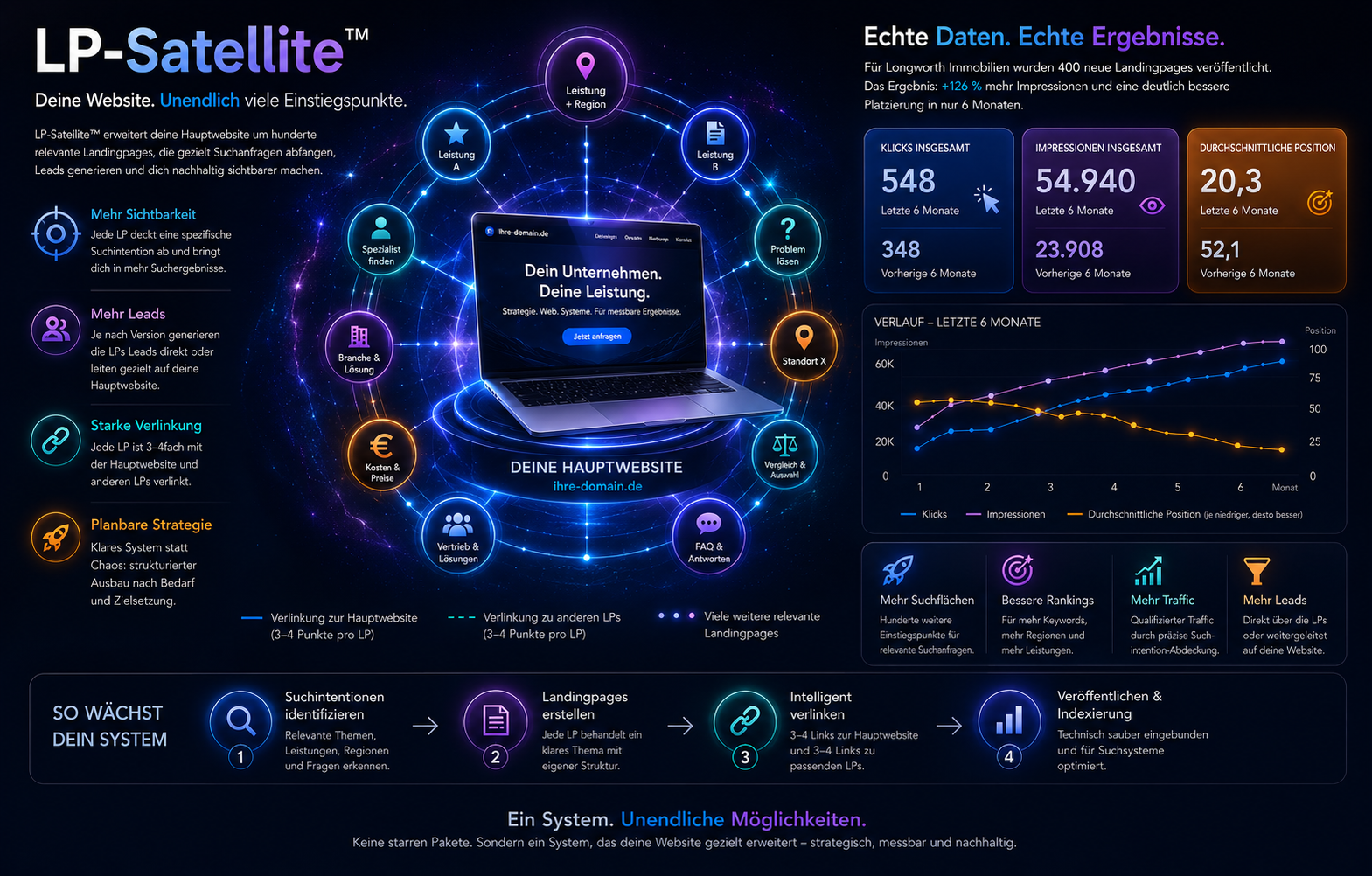
Systematic expansion as verifiable proof for a digital agency.
The global expansion case demonstrates a concretely implemented system logic and shows how strategy, technology, content, and measurement work together within a framework. The connection to this page lies in the guiding principle of "digitalization without a tool collection": Deliverables, measurement points, and expansion limits are made visible before implementation. The corresponding service context is found under Digital Products described.
System responsibility: Risk, expansion, operational friction in daily operations.
Classic project logic
-
Individual measures without a shared vision
-
Handover between strategy, design, and technology
-
Launch without a well-thought-out operational logic
VELUNO system logic
-
Combining digital inventory with prioritization based on business impact
-
Plan system and data logic and implementation in meaningful stages together
-
Considering operation and expansion from the outset
Four steps: Risk to expansion; operational friction in daily operations.
The current state is condensed to identify the critical bottleneck; this leads to the architecture and controlled expansion. Each phase concludes with a documented decision rather than mere activity.
Analysis
Initial situation, objective, risks, and open decisions are jointly recorded. Operational friction becomes visible in handovers, rework, and missing decisions.
Architecture
The target architecture organizes experience, Digital Products, infrastructure, visibility, and prioritized implementation and defines system boundaries, measurement points, and deliverables.
Implementation
Content, user guidance, technology, and measurement are integrated in a controlled manner. Architecture, data, integrations, Performance and operations form the technical foundation.
Operations
After rollout, operations, quality, and next expansion steps are controlled based on defined signals. Experience, applications, infrastructure, and growth are managed via a shared roadmap.
Three project sizes: risk to expansion; operational friction in daily operations.
The scope depends on the initial situation, risk, and integrations. No pricing, minimum budgets, or fixed timeframes are provided without a thorough assessment.
Focused sub-project
Suitable when a clearly defined bottleneck needs to be resolved first. Each measure is then evaluated to determine whether it improves a prioritized process or simply creates another silos. Architecture and measurement remain compatible for future expansion.
Complete setup or rebuild
A rebuild encompasses all components that are interdependent for a controlled system change. The scope and sequence follow the verified existing system.
Scalable System Project
Core architecture and expansion phases are planned separately. This allows for the controlled addition of further markets, content, or functions.
Deepening the "digitalization without a tool collection" approach: operational friction in daily operations.
The three contributions delve deeper into technical readability, website structure, and platform logic. Also relevant to the specific context is Platforms & Infrastructure .

SEO · GEO · AEO
Why Traditional SEO Page Models Often Fall Short in AI Search
How visibility changes when content must not only rank, but also be understood and cited.
Structure
Why Many Corporate Websites Do Not Have a Marketing Problem, but a System Problem
What goes wrong when content, tracking, UX, and technology coexist instead of working together.
Platforms
From Web Project to Platform Logic: When a Company Becomes More Digitally Resilient
When website logic is no longer enough—and why portals, workflows, and reusable systems are then the logical next step.
Official Regional Framework · GV-ISys
Ingolstadt in the official municipal context
The Federal Statistical Office lists Ingolstadt in Bavaria. This information places Ingolstadt regionally for digital agencies. It does not confirm a VELUNO location or a local client relationship.
Population and area data are taken from the official municipal register. Neither demand nor project success can be derived from this data.
Official municipality code – 09161000
Official municipality name – Ingolstadt
Federal state – Bavaria
District or Independent city – Ingolstadt
Administrative postal code – 85047
Area – 133.35 km²
Population as of December 31, 2024 – 141,185
Population density – 1,059 people per km²
Travel region in the GV-ISys – Cities of Upper Bavaria
Degree of urbanization – Densely populated
What the regional data on Ingolstadt classifies – and what it doesn't
– Ingolstadt
Digital agency Ingolstadt: Questions before project launch.
Direct answers regarding scope, risks, collaboration, and sensible expansion logic.
Every measure is evaluated based on whether it improves a prioritized process or simply creates another silo. A digital agency integrates website, Digital Products, infrastructure, and visibility within a unified decision-making framework. A purely digital agency Web Agency often focuses more on the individual product or service.
Disconnected systems increase coordination, data maintenance, and dependence on manual handoffs. VELUNO can connect positioning, UX, websites, portals, integrations, performance, as well as SEO, GEO, and AEO. Which topics actually belong together depends on the specific bottleneck.
Digitalization doesn't come from more tools, but from clear processes, data flows, and responsibilities. Priorities arise from business impact, user problems, risk, dependencies, and feasibility. A new tool or the mere visibility of a measure is not a sufficient reason.
Experience, applications, infrastructure, and growth are managed via a shared roadmap. No, a project should start with the smallest sensible scope that allows for a reliable impact or learning loop. The architecture and subsequent expansion phase must still be clear before the start.
Collaboration with companies in Ingolstadt is organized digitally and across regions; a local branch is not required. Collaboration takes place digitally through workshops, system analyses, reviews, and documented decisions.
Next step: Risk to expansion; operational friction in daily operations.
A project request should specify the current state, known risks, objective, and timeframe. Each measure is then evaluated to determine whether it improves a prioritized process or simply creates another silos. For related searches, the digital agency Neuburg an der Donau is also available.